
On September 10, the International Energy Agency (IEA) published its Coal Mid-Year Update 2026, examining recent coal market trends and forecasts across regional demand, production, trade, and prices. The report points out how the closure of the Strait of Hormuz has had an indirect impact on coal markets in Europe, Japan, Korea, and China.
Reversing previous outlooks, global coal demand expected to increase by 1.2% in 2026
In 2025, coal-fired power generation was the main driver of global coal demand. While overall global coal demand increased by 0.3% in 2025 to a record high of 8.84 billion tonnes (Bt), regional trends are diverging. China’s coal demand remained unchanged from the previous year, while India’s decreased by 1% and EU’s decreased by 6%. Driven by policy shifts under the second Trump administration, demand in the United States climbed by 9.5% in 2025.
In Japan, coal demand is expected to decline by 1% in 2026 to 161 million tonnes (Mt). However, increased power generation demand, driven by high LNG prices stemming from the Middle East crisis, has cushioned the drop in industrial consumption. While nuclear and renewable energy are anticipated to increase, the Japanese government’s decision to temporarily relax restrictions on inefficient coal-fired power plants has supported coal generation and slowed down the demand decline. In 2027, coal demand is projected to decrease in Japan as long as LNG prices fall.
Globally, coal demand in 2026 is projected to reach a record high of 8.94 Bt, a 1.2% increase from the previous year. While this has led to the revision of peak coal forecasts, the IEA identifies the Middle East conflict as a primary driver of the demand increase. In countries considering a transition to LNG as an alternative to coal, elevated imported gas prices following the Strait of Hormuz closure and disruptions to oil and LNG transport are fueling a new surge in coal demand.
Additionally, the IEA points to the exceptionally strong El Niño of 2026 as another factor that has led to the reversal of the coal demand forecast, as it pushes up cooling needs while depressing hydropower outputs. There is regional variation in coal demand forecasts for 2026. In India, coal demand is forecast to rise by 4.2% to 1,353 Mt, while Korea’s coal demand projection is expected to reverse and increase by 6% to 119 Mt. In the United States, coal demand is anticipated to fall by 7% in 2026. Despite increasing electricity consumption from infrastructure such as data centers supporting the continued operation of coal-fired power plants, cheaper domestic LNG and renewable capacity expansion is contributing to a decline in coal demand.
In 2027, the IEA expects global coal demand to decrease by 0.4% to 8.91 Bt. However, this forecast assumes that the Middle East crisis ends and LNG prices fall. Coal consumption could continue increasing in 2027 if the Strait of Hormuz remains closed.
Global coal production and consumption gap expected to narrow in 2026
In 2026, global coal production is projected to decline by around 0.7% compared to 2025. The dip reflects elevated inventories at the end of 2025 and policy measures that have constrained production in several major producing countries, including China. However, IEA expects production to increase again by 0.3% in 2027, remaining above 9 Bt for four consecutive years.
While China remains the world’s largest producer with production forecast to exceed 4.62 Bt, output growth has been limited in recent years due to high inventories. In response to a serious gas explosion in May 2026, over 100 mines across Shanxi Province were temporarily ordered to halt operations and restrict production. Still, the IEA estimates production will recover over the rest of 2026. India’s coal production is expected to set a new record at 1,095 Mt in 2026, supported by the government’s continued efforts to bolster domestic supply and lower import dependence. Indonesia is expected to make the largest supply adjustment among the world’s major producers in 2026, with output projected to fall by more than 12 Mt. A combination of market conditions, logistics constraints, and policy changes largely explains trends in other regions.
Global coal trade expected to resume decline in 2027 with lower thermal coal demand
After reaching an all-time high in 2024, global coal trade declined by around 4% in 2025, with import volumes falling to 1.48 Bt. The fall mainly stemmed from slowed demand for thermal coal imports in most countries, with thermal coal trade volume falling to approximately 1.11 Bt. Notably, most of the decline stems from China replacing imports with domestic production and existing inventories, but imports also decreased in India, Japan, Korea, Chinese Taipei, and the EU. Southeast Asian markets such as Vietnam increased their imports.
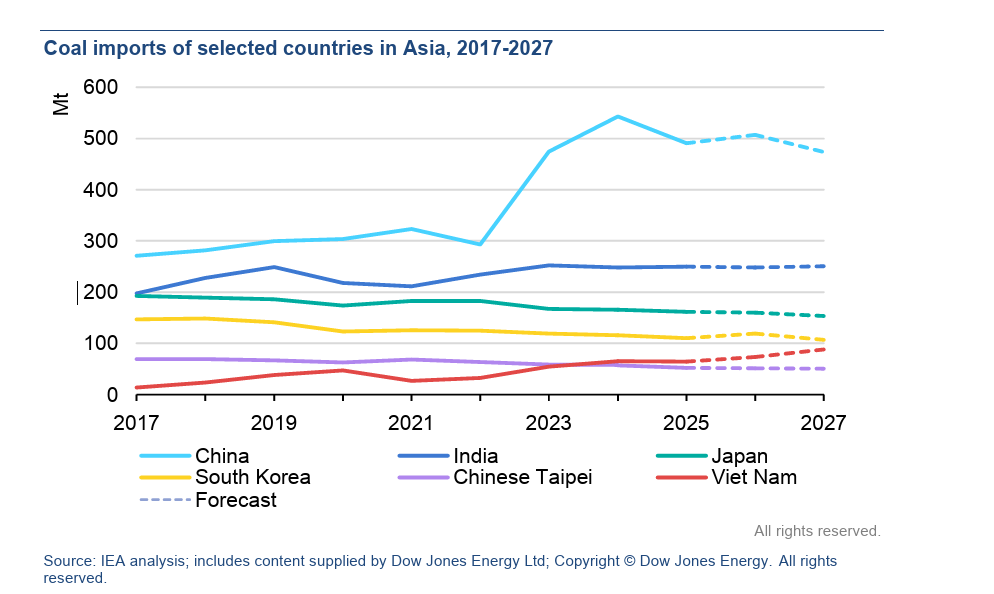
Source: IEA, Coal Mid-Year Update 2026 (pg. 19)
The IEA anticipates global trade volumes to increase in 2026, despite a decrease in demand and trade volumes in China, India and Europe. The IEA points out that coal use is exceeding previous forecasts for parts of the region, as import-dependent countries such as Japan and Korea switch from gas to coal due to the Middle East conflict. While Japan’s thermal coal imports, revised upward due to the Middle East conflict, are expected to remain at around 124 Mt, Korea’s coal imports are expected to climb by more than 10% compared to 2025.
However, the IEA expects that by 2027, global coal trade volume will fall to 2025 levels, as thermal coal shipments will resume declining across many parts of Asia and Europe.
Global thermal coal prices increased in the first half of 2026
During the 2022 energy crisis, the market experienced significant disruption, with thermal coal prices exceeding USD 400/t across several major benchmarks. However, since the beginning of 2025, the global coal market has remained stable. Although prices rose in the first half of 2026, they did not reach the unprecedented levels of 2022. The recent price recovery can be attributed to several factors, including the surge in LNG prices catalyzed by the Middle East conflict. This surge increased coal’s competitiveness in power generation, consequently supporting demand for thermal coal. Given these circumstances, a comparison of the Middle East crisis and the war in Ukraine shows that the outbreak of the war in Ukraine had a much stronger impact on international thermal coal prices, even in Asian markets, which are more directly exposed to Middle Eastern supply trends.
Middle East conflict has indirect impact on global coal markets
The IEA’s Coal Mid-Year Update 2026 shows that despite the fact that almost no coal shipments pass through the Strait of Hormuz, the conflict has had an indirect impact on coal markets. The sharp decline in LNG shipments through the Strait of Hormuz has driven up LNG prices, which has led to increased demand and prices in thermal coal markets. These dynamics illustrate the connection between fossil fuel markets and show that simply switching from one fossil fuel to another will not provide long-term stability or energy security.
According to the IEA, the global coal demand trends for 2027 are uncertain. If the LNG shipments volume passing through the Strait of Hormuz returns to pre-conflict levels and prices revert closer toward pre-crisis levels, global coal demand may decrease in 2027. However, if the crisis continues, global coal demand and consumption could reach even higher record levels.
IEA, Coal Mid-Year Update 2026 (September 10, 2026)
IEA Press Release: Global coal demand set to increase this year amid Middle East conflict (September 10, 2026)
Related Reports
【Report】Contrary to Trump’s intentions, the decline in coal-fired power continues
【Report】 Boom and Bust – Coal 2026
Written/Published by: International Energy Agency
Published: September 10, 2026