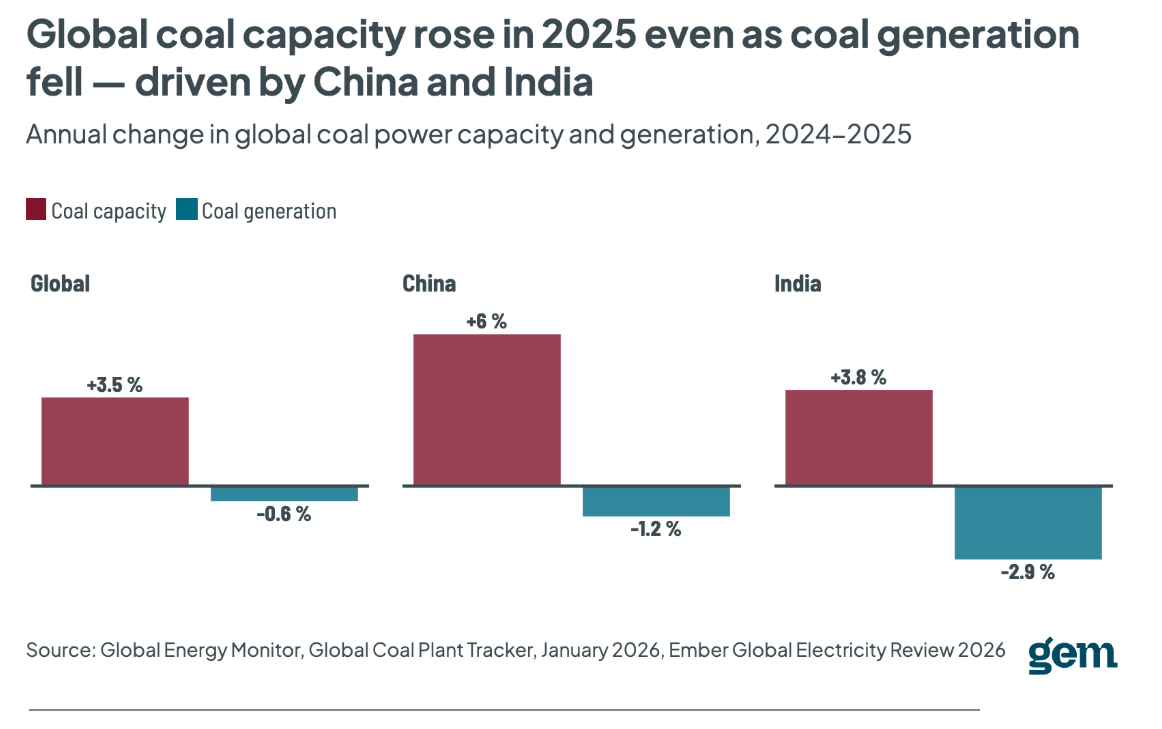
On May 21, 2026, Global Energy Monitor and other co-authors released a report titled “Boom and Bust Coal 2026,” on the global coal fleet now in its eleventh year. This report reveals a paradoxical finding: while global coal capacity increased by 3.5% in 2025, coal-fired generation fell by 0.6%.
Coal-related key developments of 2025
- In 2025, global coal power capacity continued to grow even as coal-fired generation declined. Global coal capacity increased by 3.5%, while coal generation fell by 0.6%, reinforcing a widening disconnect between coal capacity additions and how much coal was actually used.
- Coal generation fell most sharply in China and India even as both countries recorded high commissioning. In China, coal capacity expanded by 6% while generation declined 1.2%; in India, capacity grew by 3.8% while generation fell 2.9%. In both countries, wind and solar met most or all incremental demand, contributing to the divergence between rising capacity and falling output.
- In China, new and reactivated coal power projects in 2025 surged to a record high of 161.7 GW. In all, China has over 500 GW of coal-fired capacity in development. If built, the projects would commit China to years of coal expansion well into its 15th Five–Year Plan period (2026–2030), during which the government has pledged to reduce coal consumption.
- India recorded 27.9 GW of new and reactivated coal plant proposals in 2025. In all, India has 107.3 GW of capacity in pre-construction planning and another 23.5 GW under construction. The Indian government has set a target to add 100 GW of new coal capacity over the next seven years, even as record additions of solar and wind pushed non-fossil capacity to more than half of total installed power capacity in 2025.
- Globally, nearly 70% of coal-fired units scheduled to retire in 2025 did not do so, including 69% of scheduled retirements in the EU and 59% in the U.S. In the EU, most missed retirements reflect postponements that began during the 2022–23 energy crisis, even as formal coal phaseout commitments remain in place. In the U.S., retirement delays were more directly tied to government intervention that kept aging coal plants online through explicit orders.
- Coal construction outside China and India hit a record low, at just 5% of global construction capacity in 2025. Global coal expansion is increasingly driven by a small set of countries rather than broad-based global demand. In 2025, only 32 countries were proposing or building new coal plants — down from 38 the prior year and less than half the 75 countries doing so in 2014.
Pathways to a coal phase out diverge in South Korea and Japan
This report also reveals that South Korea and Japan, which have both traditionally placed emphasis on coal-fired power, have begun to take different pathways to a coal phase-out. South Korea has pledged to phase out coal-fired power plants and is implementing measures that are more stringent than those of Japan. Currently, South Korea has no coal-fired power plants under development, and 0.5 GW of coal-fired capacity was phased out in 2025, adding up to a 3.9 GW cumulative total of phased-out capacity since 2015. Japan, on the other hand, despite agreeing in the G7 agreement to phase out unabated coal-fired power generation by early 2030s, has yet to set a specific target for phasing out coal.
The following graph indicates the age profiles of coal plants in Japan and South Korea. Although many coal-fired power plants in Japan have reached the standard point at which power utilities should consider decommissioning, the government aims to maintain coal-fired power plants by implementing various measures such as carbon capture and storage (CCS) and ammonia co-firing to reduce greenhouse gas (GHG) emissions. However, the emission reduction benefits of CCS and/or ammonia co-firing are actually uncertain, and several other issues have been raised.
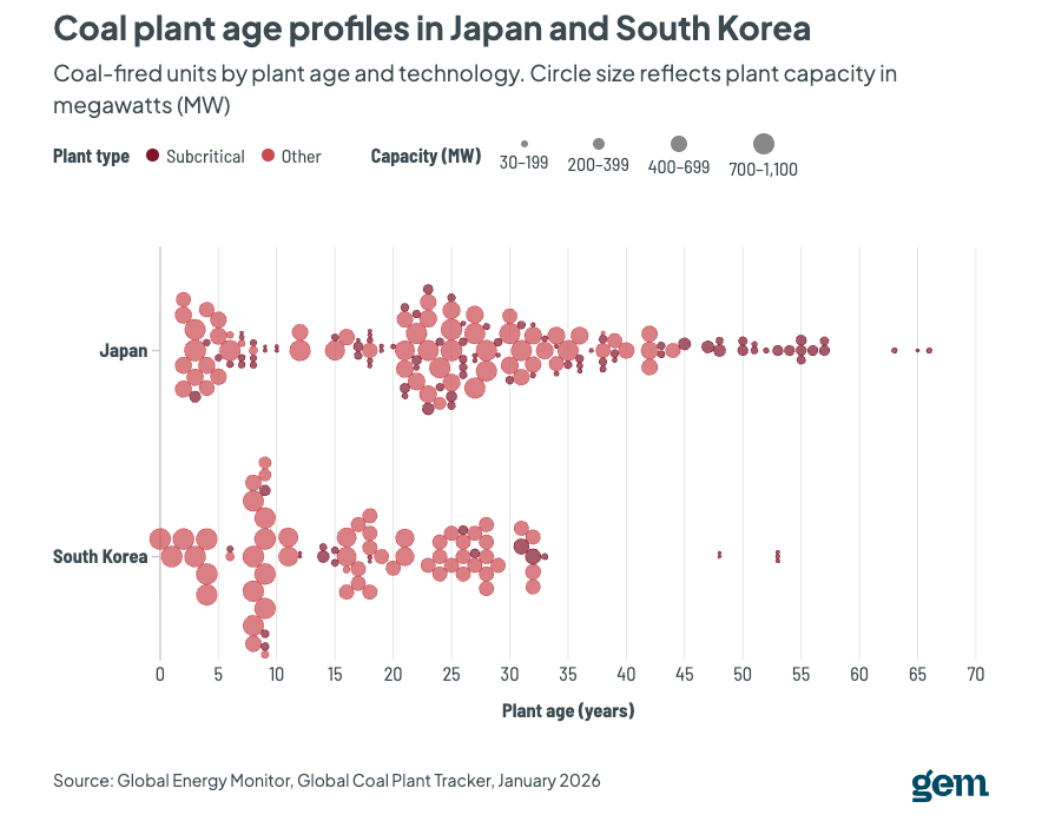
The gap is likely to widen between Japan, which has the largest coal-fired power generation capacity among OECD member countries and the fifth-largest coal capacity in the world, and South Korea, which has decided to phase out coal.
Global Energy Monitor
[Press Release] The world is using less coal, even as it builds more
[Report Download] Boom and Bust Coal 2026
[Press Release for Japan and South Korea] Pathways to a coal phase out diverge in South Korea and Japan (PDF)
Written/Published by: Global Energy Monitor
Published: May 21, 2026
Joint effort:
In addition to Global Energy Monitor, the report’s co-authors are the Africa Just Transition Network (AJTN), ARAYARA International Institute, Bangladesh Working Group on Ecology and Development (BWGED), CEE Bankwatch Network, Beyond Fossil Fuels, Centre for Research on Energy and Clean Air (CREA), Chile Sustentable, Climate Action Network (CAN) Europe, Coastal Livelihood and Environmental Action Network (CLEAN), Dhoritri Rokhhay Amra (DHORA), E3G, The Institute of Lawyers for the Protection of the Environment (INSAPROMA), Kiko Network, POLEN Transiciones Justas, Policy Research Institute for Equitable Development (PRIED), Razom We Stand, Reclaim Finance, Solutions for Our Climate (SFOC), Trend Asia, and Waterkeepers Bangladesh (WKB).