
“Climate action is a duty of nations”–amid the increasingly severe global impacts of climate change, the International Court of Justice (ICJ) issued an Advisory Opinion in July 2025 stating that failure by a country to take climate change action could constitute an unlawful act under international law.
On May 20, 2026, the United Nations General Assembly welcomed the Advisory Opinion of the ICJ and adopted it, with 141 countries, including Japan, voting in favor. The UN General Assembly highlighted the importance of Advisory Opinions, stating that they “officially contribute to clarifying existing international law.”
▼【News】International Court of Justice Advisory Opinion: Climate Change is an “Urgent and Existential Threat” (Japan Beyond Coal)
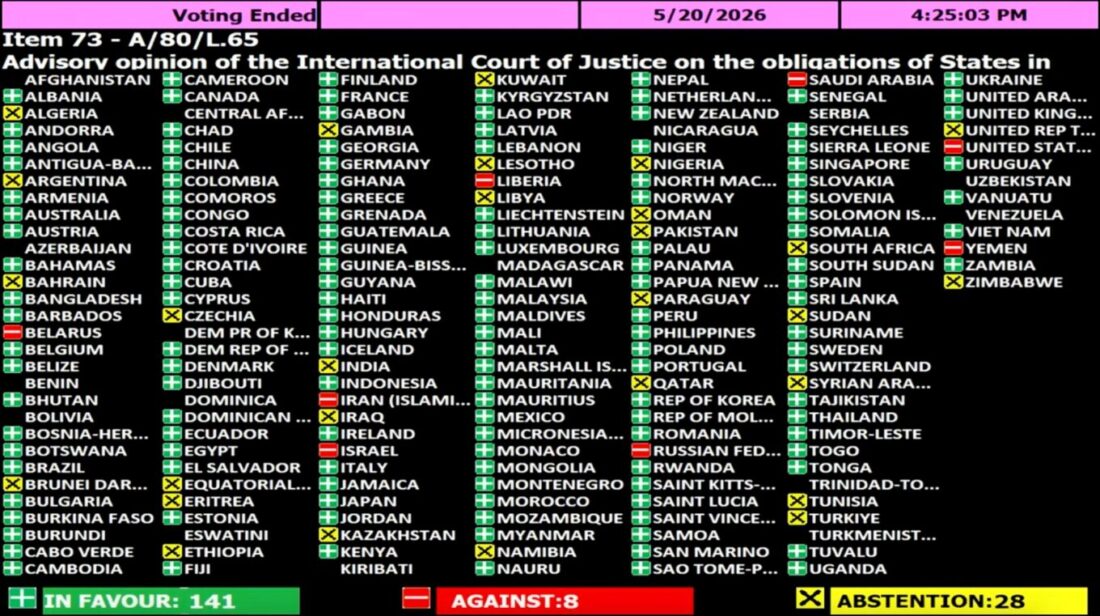
141 votes in favor, 8 against (Belarus, Iran, Israel, Liberia, Russian Federation, Saudi Arabia, United States, Yemen), 28 abstentions
Since February 2026, active efforts led by the government of Vanuatu to adopt a UN General Assembly resolution to implement this Advisory Opinion have gained momentum. The Associated Press reported that the Trump administration called on other countries to pressure Vanuatu into withdrawing this draft proposal. Subsequently, numerous consultations were held to reach an agreement among the member states, and as a result of repeated revisions, this draft resolution (A/80/L.65) was submitted to the UN General Assembly. Oil-producing nations such as Saudi Arabia submitted proposed amendments to this draft leading up to the day of the UN General Assembly vote. Despite this opposition, the resolution was adopted with the support of a majority of member states.
UN experts issued a statement welcoming the resolution, calling it “crucial for ensuring global justice and the rule of law.” They also called for the ICJ’s Advisory Opinion to be relied on in all future international conferences, including international climate change negotiations at COP and the Conference on Transitioning Away from Fossil Fuels.
While leaders of some countries, such as the United States, are strongly pushing for a return to fossil fuels, this adoption marks a significant turning point, reflecting a determination to ensure that the ICJ’s ruling is firmly linked to strengthening multilateral cooperation and accelerating climate action.
What does the resolution cover? National obligations outlined by the Advisory Opinion
What exactly is the ICJ’s Advisory Opinion, supported by nations in this resolution? The key points are outlined below.
<Key Points>
- Regardless of whether a country is a signatory to specific climate-related treaties, all States have a legal obligation to protect the climate system.
- Each country must implement measures based on its responsibilities and capabilities to prevent significant harm to the climate system.
- The “right to a clean, healthy, and sustainable environment” is a prerequisite for a dignified human life.
- Each country must set and continuously strengthen its target based on the premise of making the maximum possible effort to achieve the 1.5°C goal of the Paris Agreement.
- Neglecting to address the production and consumption of fossil fuels and failing to reduce GHG emissions may constitute a violation of international law.
- Regulating private corporations that negatively impact climate change is also a national obligation.
- Countries that fail to fulfill their obligations to protect the climate may be held accountable and required to pay reparations.
Reference: Kiko Network, ICJ Advisory Opinion Q&A (in Japanese)
The ICJ’s Advisory Opinion has already been cited in various climate lawsuits, supporting the efforts to demand climate action through the judicial system. The UN General Assembly resolution is expected to further strengthen this momentum.
Japan must also take climate action!
Following this resolution, countries are required to fulfill the State Obligations outlined in the Advisory Opinion. What specifically should Japan do moving forward?
First, regarding the point that national reduction targets must reflect a country’s highest level of ambition, Japan’s current GHG reduction targets are 46% by FY2030 and 60% by FY2035 (compared to FY2013). However, to limit global warming to within 1.5°C, reductions of 69% by 2030 and 81% by 2035 are required (according to Climate Action Tracker). Japan needs to raise its reduction targets.
Furthermore, regarding the requirement to regulate fossil fuel production, consumption, the granting of exploration permits, and subsidies, unfortunately, Japan currently shows no clear intention to break its dependence on fossil fuels. Japan allocates a substantial budget to fossil fuels, supports the construction of new LNG-fired power plants and the renovation of coal-fired power plants through the long-term decarbonization auction, and is deeply involved in procuring fossil fuels around the world. Failure to restrict these activities in the public and private sectors could constitute a violation of international law.
Although Japan voted in favor of the resolution, its current actions do not align with the climate actions deemed necessary in the Advisory Opinion. This resolution states that to comply with the 1.5°C target, it is necessary to triple global renewable energy capacity and double energy efficiency improvements by 2030. We expect Japan to responsibly review its policies in line with this path.
Reference: Background
- September 2021: Vanuatu, a country in the southwestern Pacific Ocean, announces its intention to seek an ICJ Advisory Opinion on climate change
- July 28, 2022: The UN General Assembly officially recognizes the right to a clean, healthy, and sustainable environment as a human right.
- March 29, 2023: A request for an Advisory Opinion of the ICJ on the Obligations of States in respect of climate change is adopted.
- July 23, 2025: The ICJ issues its Advisory Opinion, stating that all States have a legal obligation under international law to protect the climate system.
- May 20, 2026: The UN General Assembly adopts a resolution welcoming and supporting the ICJ’s Advisory Opinion.
Reference materials
UN Press Release: UN experts welcome UN General Assembly resolution supporting world court’s climate change ruling (Link)
UN General Assembly Strengthens Fight against Climate Change, Adopting Contentious, Yet Broadly Supported Draft among Several Texts on Myriad topics (Link)
UN 「THE HAGUE – The International Court of Justice (ICJ) delivers its Advisory Opinion on the Obligations of States in respect of Climate Change」(WebTV Link)