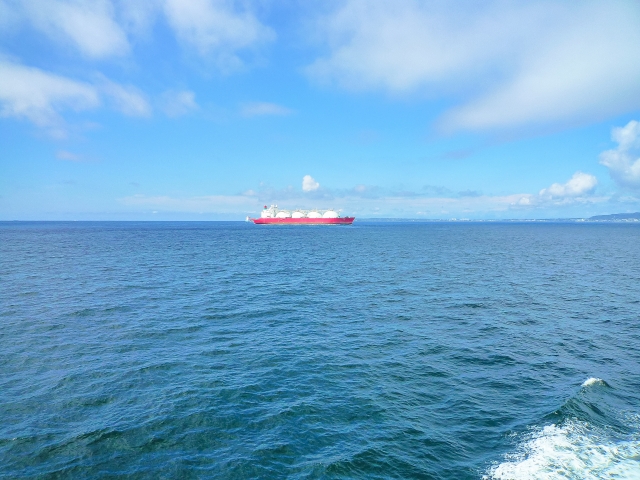
The closure of the Strait of Hormuz, triggered by the U.S. attack on Iran, has caused turmoil in the global economy through soaring crude oil prices and tightening energy fuel supplies.
In particular, it has a serious impact on the energy security of Asian countries including Japan, which is relatively highly dependent on the Middle East.
Needless to say, Japan relies on imports for most of its fuel. Even if it diversifies its supply sources and routes, it is impossible to avoid geopolitical risks. The Japanese government has a policy to secure “stable electricity supply.” However, it is releasing national crude oil reserves without implementing any policy shift to drastically reduce its dependency on fuel imports under rising tensions over the uncertain situation in the Strait of Hormuz.
Rising gas prices might extend life of coal-fired power plants
The current crisis in energy infrastructure is casting a shadow over the efforts to rapidly phase out coal-fired power plants, which are a major source of greenhouse gas (GHG) emissions. Italy, which chaired the G7 Climate, Energy, and Environment Ministers’ Meeting in 2024, led an agreement to phase out coal-fired power by 2035 and had committed to phase out its own coal-fired power by 2025 in its energy strategy. However, on March 31, Italy announced the postponement of the shutdown of coal-fired power plants to 2038. This is believed to be largely due to the fact that its gas-fired power, which accounts for about 40% of its electricity generation, relies on imports from the Middle East and that gas prices skyrocketed after the conflict began.
Wood Mackenzie, a UK-based research firm, has released its “Lens Energy Transition Scenarios*,” a set of future projections based on the company’s proprietary modeling results and insights. Based on this, the scenarios examine how global energy supply and demand, as well as investment patterns, might change if geopolitical instability caused by tensions in the Middle East continues. It concludes that coal could play a larger role in the near term, leading to an increase in coal use and delays in coal-fired power plant retirements.
As countries prioritize diversifying their energy sources and utilizing domestic resources, by 2050 they can reduce global oil demand by 20% and gas demand by 10%, relative to the base case (which assumes progress in the energy transition). In the near term, coal demand is expected to increase by 20%, while nuclear power generation is projected to rise by 40%.
On the other hand, Wood Mackenzie analyzes that renewable energy continues to expand rapidly and expects it to play a stronger role in national power systems in the future. Furthermore, the report states that the adoption of hydrogen and CO₂ capture technologies may decline as more efficient and safer energy pathways are prioritized.
*Wood Mackenzie’s four different energy transition pathways to 2060 under the Lens Energy Transition Scenario.
- Base case (‘energy evolution’): Renewables surge but meet only incremental demand, resulting in an average global temperature rise of 2.6 °C
- Delayed transition (‘energy dominance’) : security fears slow clean energy momentum, with fossil fuels filling the gap; temperatures rise 3.1 °C
- Country pledges (‘energy resilience’): A coordinated, pragmatic and decisive shift to clean energy results in a temperature rise of 2 °C
- Net zero (‘energy innovation’): A wholesale rewiring of the energy system keeps average global temperature rises to 1.5 °C
The Guardian reported that “Even if the strait remains open and production and refining capacity is restored to normal, many countries will be rethinking their approach to energy because of the crisis. In Asia, in particular, the Gulf crisis has exposed many countries to the risk of relying too heavily on a single region for energy supplies, with many likely to diversify their sources in the future,” and “There is likely to be a greater interest in nuclear power and renewable energy sources too, which, combined with a shift to electrified transport and greener industry, could help countries to cut their reliance on fossil fuels entirely.”
Many countries are moving away from coal rather than returning to it
Carbon Brief, which analyzes and reports on the latest trends in climate science and energy policies, summarized the responses of various countries in an article published on April 8 titled “Iran war analysis: How 60 nations have responded to the global energy crisis.”
Analysis of 185 government policies and campaigns across 60 nations reveals that while some nations emphasize the need to expand renewable energy domestically, others, such as Japan, Italy, and South Korea, have chosen to increase their reliance on coal, even if only in the short term.
In addition, some Asian countries that rely heavily on fossil fuels from the Middle East have implemented shutting down power plants, fuel rationing, and school closures in order to reduce fuel demand.
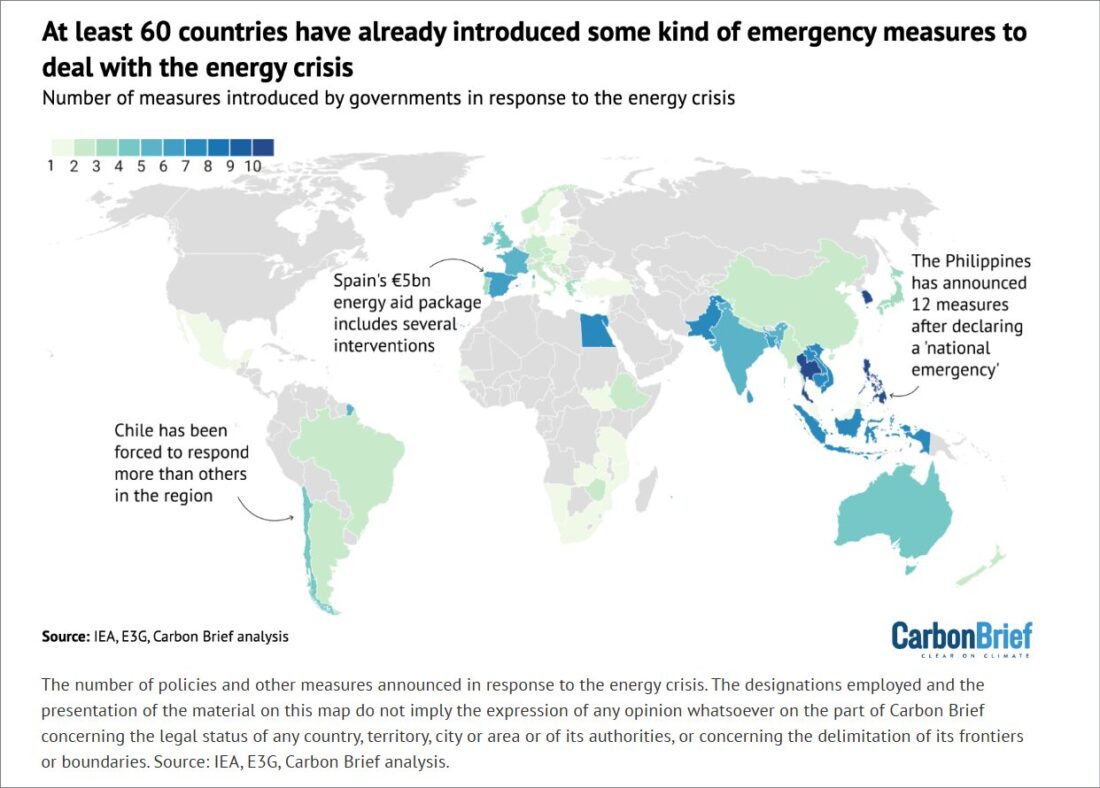
Although Europe has been relatively less immediately exposed to the current crisis than Asia, it cannot be said that there has been no impact at all. Germany and Italy, along with six Asian countries (Japan, South Korea, Bangladesh, the Philippines, Thailand, and Pakistan), have announced plans to delay the closure of coal-fired power plants, expand their use, or revise their plans for phasing out coal. Citing growing uncertainty regarding LNG procurement, the Japanese government has announced a policy to lift the restrictions on the operation of inefficient coal-fired power plants for a limited period of one year in order to increase the operation of readily available coal-fired power plants (please refer to another article for details on this matter).
In contrast to these trends, there are quite a few countries that are using the current energy crisis as an opportunity to clearly emphasize the importance of a structural shift toward clean energy. New renewable energy capacity will take time to come online, albeit substantially less time than developing new fossil fuel generation. While it takes time to build and commission renewable energy facilities, it is clear that the time required is significantly shorter than that needed to construct fossil fuel power plants.
Leaders in India, the Caribbean island nation of Barbados, and the United Kingdom have clearly emphasized the importance of a structural shift toward clean energy. In an announcement regarding the launch of new solar power and battery storage facilities, the Philippine Energy Secretary stated, “Amid the Middle East conflict, accelerating the development of renewable energy and storage is both a strategic necessity and a national imperative.” The New Zealand government has indicated that a plan to build a new LNG terminal by 2027 is now in doubt, while Vietnam’s conglomerate Vingroup is reported to have informed the government of its intention to abandon plans to build a new LNG-fired power plant in Vietnam in order to prioritize renewable energy.
As various countries show signs that they are reevaluating their future reliance on imported fossil fuels, South Korea has allocated funds to accelerate the transition to renewable energy, based on the view that dependence on foreign fossil fuels poses a great threat to energy security.
Italy, as mentioned earlier, has postponed the phase-out of coal-fired power. There are only four coal-fired power units remaining in the country (two on the mainland and two on Sardinia). Even if one or three units were kept in operation, according to 2024 data from the International Energy Agency (IEA), coal-fired power accounts for less than 2% of the energy mix in Italy. It is a big difference compared to Japan, where more than 100 coal-fired power plants are still in operation.
Shift from thermal power to renewable energy
According to an analysis by the Center for Research on Energy and Clean Air (CREA), total power generation from fossil fuels in March 2026 in countries with near-real-time data fell 1% year-on-year, with coal-fired generation remaining flat and gas-fired generation falling 4%. Overall, it is clear that the decline in gas-fired power generation was offset not by coal, but by solar and wind power. Furthermore, an analysis by the energy consulting firm Bombay Strategy found that global coal imports in March recorded their lowest level in five years, falling about 7.6% year-on-year.
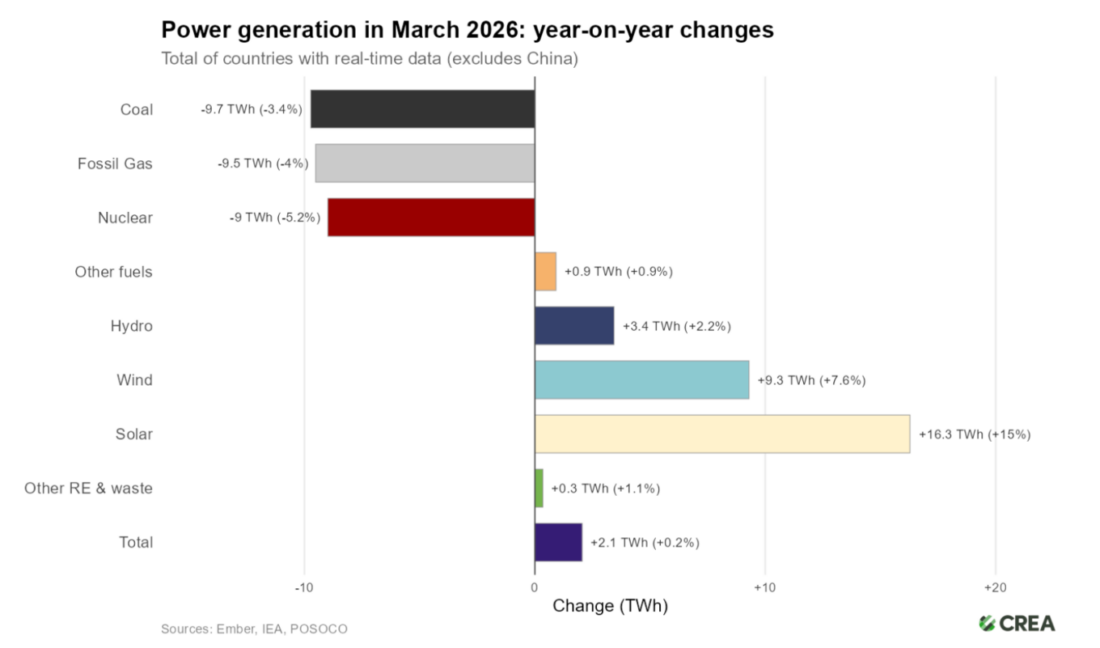
These reports and analyses indicate that many countries view the Middle East crisis not as a trigger to “return to coal,” but as an opportunity to accelerate the transition away from coal and toward alternative energy sources. As long as they are relying on fossil fuels, countries will not only remain at the mercy of international conditions and geopolitical risks, but will also continue to contribute to global warming.
That is why Japan must reassess the vulnerability of its energy structure, which heavily depends on imported fossil fuels, and transition toward a strategy that simultaneously ensures energy security and addresses climate change. This strategy should prioritize a significant expansion of renewable energy sources that can be sustainably utilized domestically.
Information
Carbon Brief: Iran war analysis: How 60 nations have responded to the global energy crisis
Iran war analysis: How 60 nations have responded to the global energy crisis – Carbon Brief
Center for Research on Energy and Clean Air (CREA)
Global fossil power generation fell after the Hormuz closure due to solar and wind growth
Reports and Recommendations from JBC Partners’
Renewable Energy Institut: Middle East Crisis Highlights Japan’s Energy Risk
Now Is the Time to Accelerate the Transition from Fossil Fuels (Link)
Related JBC article
【News】Reversing the 50% Capacity Factor Limit for Inefficient Coal-fired Power for FY2026 Goes Against Decarbonization