On June 18, 2026, the International Energy Agency (IEA) published its annual Global Hydrogen Review to report on the latest developments in hydrogen policy, infrastructure, trade, investments and innovation. The report is intended to update energy sector stakeholders on the status of hydrogen production and demand and its future outlook. The report explains the impact of the Middle East conflict on global supplies of hydrogen and hydrogen derivatives.
As the Middle East is a major production region for hydrogen and hydrogen derivatives, the closure of the Strait of Hormuz and its impact on the surrounding areas has disrupted markets for fertilizers, chemicals, and petroleum refining, exposing vulnerabilities in global supply chains.
Low-emissions hydrogen expected to exceed 1% of global hydrogen production in 2026
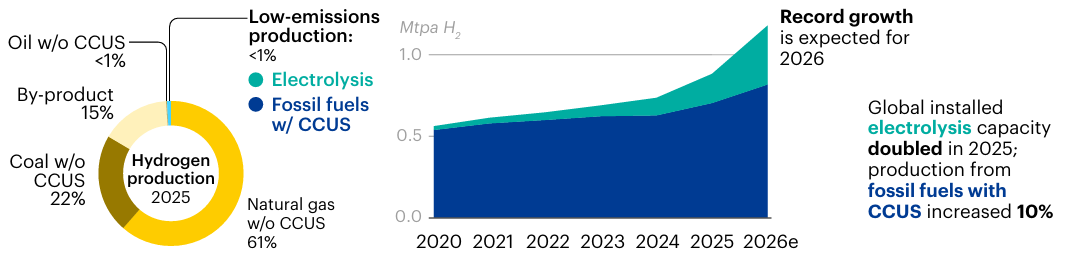
The IEA reports that overall, in 2025 hydrogen production generated around 1000 Mt of CO2, even when excluding upstream and midstream emissions for fossil fuel supply. This scale of emissions clarifies the current reality of global hydrogen production, where currently 99% of hydrogen production is not low-emissions. Here, “low-emission hydrogen” refers to hydrogen produced either through water electrolysis using renewable energy or with fossil fuels, after which the emitted CO2 is captured, utilized and stored.
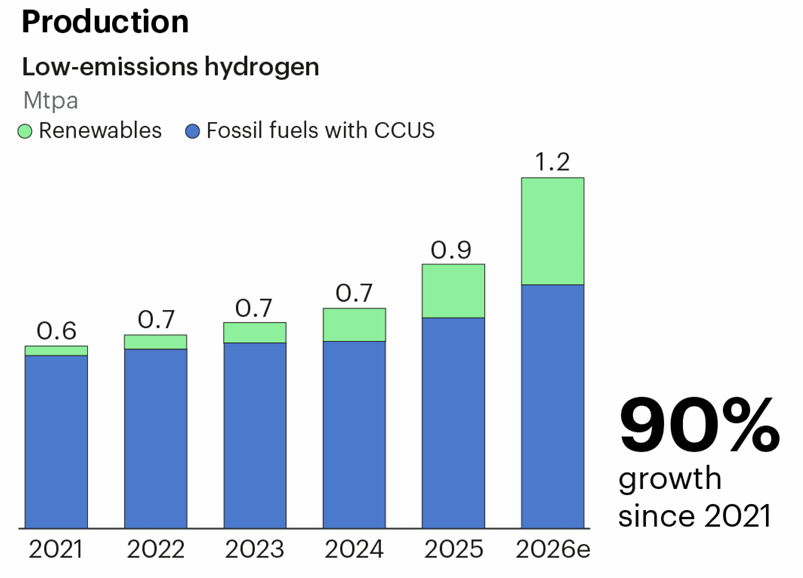
The production of low-emissions hydrogen grew by 20% globally in 2025 to reach almost 1 million tonnes, but this progress is concentrated in a few projects. In 2026, low-emissions hydrogen production is expected to reach more than 1% of global production for the first time. However, it has been pointed out that investment momentum weakened in 2025, with delays in final investment decisions and reduced project announcements.
Source: IEA, Global Hydrogen Review 2026 (pg. 82)
Furthermore, the majority of low-emission hydrogen is produced by fossil fuels with CCUS (carbon capture, utilization and storage) which stores or reuses captured CO2. While numerous plans have been announced for upcoming low-emission hydrogen projects, most countries are not on track to meet their announced targets for production of low-emissions hydrogen by 2030.
Japan positions hydrogen as a non-fossil fuel energy source in its efforts towards decarbonization, and aims to utilize blue hydrogen (produced from natural gas and capturing emitted CO2) and green hydrogen (produced through water electrolysis with renewable energy) as a fuel in power generation as well. However, according to the IEA, low-emissions hydrogen faces significant barriers to its widespread adoption.
Source: IEA, Global Hydrogen Review 2026
(First graph of “Global Hydrogen Review Summary Progress” on pg. 15)
Uncertainty of hydrogen demand remains a major challenge
Fundamentally, the uncertainty of low-emissions hydrogen demand remains a major barrier for investment, which leaves demand growth reliant on specific support schemes and policies. Demand growth in the power sector remains slow and concentrated in Japan and Korea. The IEA points out that the Middle East conflict further makes the short-term outlook for hydrogen uncertain, due to disruptions to production and export shipping routes.
Cost competitiveness of hydrogen relies on governmental support schemes
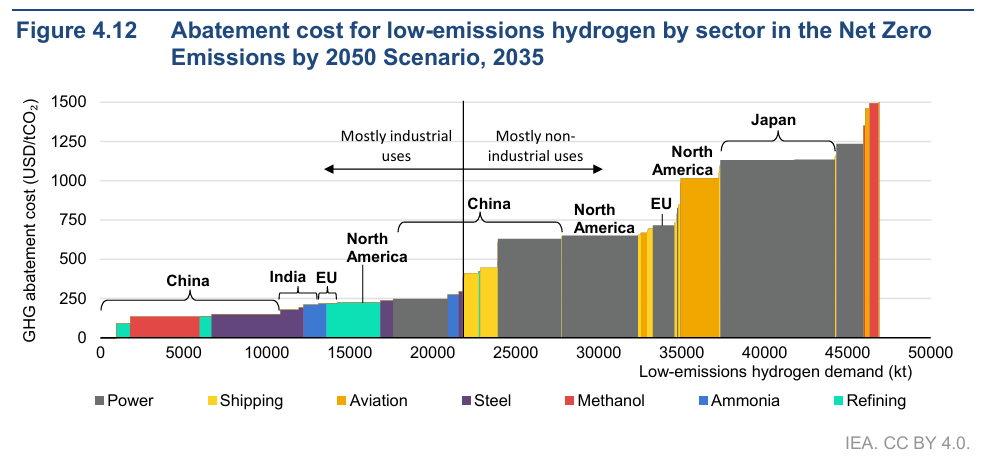
The IEA report acknowledges that low-emissions hydrogen remains significantly more expensive than conventional hydrogen alternatives in most regions and sectors. Policy support and incentives for different markets by governments are estimated to be necessary in the near term to close the price gap. The IEA analysis shows the maximum acceptable cost for hydrogen and ammonia use in the power sector to follow the energy cost trends across regions, similarly to other energy-intensive industries. For example, in Japan, high gas prices could encourage the continued operation and restart of coal-fired power plants, enabling the promotion of a higher volume of ammonia co-firing.
Source: IEA, Global Hydrogen Review 2026 (pg. 138)
The IEA also reports on the ammonia co-firing projects in coal power plants pursued in Japan. Cases of such projects benefiting from government support programmes are currently concentrated in Japan and Korea. Examples of such support schemes in Japan are financing by the Japanese government’s Contracts for Difference (CfD) scheme, which addresses the cost gap between hydrogen/ammonia and fossil fuels such as LNG/coal, and financial support from the long-term decarbonization capacity auction (LTDA), which this year (2026) for the first time included successful bids on hydrogen/ammonia monofiring.
Low-emissions hydrogen presents challenges to contribute to strengthening energy security
The IEA points out that while interest in hydrogen and hydrogen-fuels is growing as an option for strengthening long-term energy security due to the impact of the conflict in the Middle East, low-emission hydrogen is far from the scale needed for an immediate response. Moreover, Japan is forced to rely on imports of hydrogen from overseas, leaving the core issue of energy security unresolved.
Policies in Japan and other countries that have funded a small number of low-emission hydrogen projects are still insufficient to reduce costs, as additional development of storage, transport and distribution infrastructure is a prerequisite for creating scale. This means that currently, nearly all hydrogen production is high-emissions, making ambitious low-emissions hydrogen goals unrealistic.
IEA, Global Hydrogen Review 2026 (June 18, 2026)
IEA Press Release: Middle East crisis exposes vulnerabilities in global hydrogen supply chains as low-emissions alternatives struggle to ramp up (June 18, 2026)
Related Reports
【Report】IEA report assesses hydrogen based on GHG emission intensity
Written/Published by: International Energy Agency (IEA)
Published: June 18, 2026