As part of the “Tokyo Metropolitan Area CCS Project,” which aims to transport carbon dioxide (CO2) across Chiba Prefecture via an 80-kilometer pipeline and store it off the coast of Kujukuri, test drilling began this past July at the proposed storage site. However, several accidents occurred in August, causing widespread concern among local residents and others. In response to those accidents, the Association for the Protection of the Kujukuri Coast, along with JBC’s partner organizations—the Tokyo Bay Association for Considering Climate Change, FoE Japan, and Kiko Network—submitted a written request for the immediate halt of test drilling and a public inquiry to the Tokyo Metropolitan Area CCS Corporation (MCCS), the entity operating the project.
Tokyo Metropolitan Area CCS Project
This Project involves MCCS, a company established and funded by INPEX and Kanto Natural Gas Development Co., transporting CO2 emitted from Nippon Steel’s East Nippon Works Kimitsu Area on the western side of the Boso Peninsula (Tokyo Bay side) to the eastern side of the peninsula (Kujukuri side), via an 80 km pipeline passing through the cities of Kisarazu, Sodegaura, and Ichihara, as well as the towns of Nagara, Mobara, Shirako, and Kujukuri, and storing it underground in the seabed off the coast of Kujukuri Town. The annual CO2 storage volume is projected to be approximately 1.2 million metric tons in the first year and is expected to reach approximately 5 million metric tons annually in the future. After the first test drilling “Offshore Kujukuri J-1” was started on July 6, a series of accidents (a heavy oil spill and a fire) occurred in quick succession the following month.
Accidents at the Drilling Site
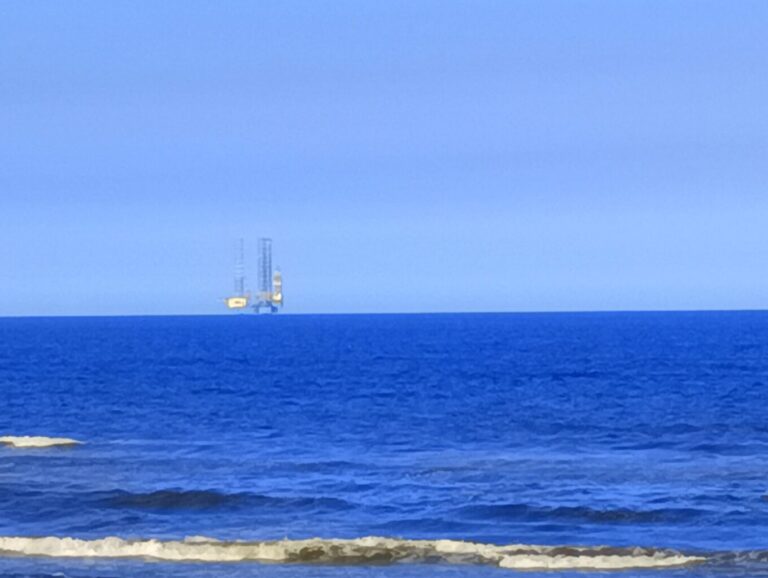
July 6 Off the coast of Kujukuri, approximately 5 km offshore, test drilling for the “Offshore Kujukuri J-1” began to identify suitable CCS storage layers.
August 22 A fuel supply hose ruptured on a support vessel, resulting in the spill of approximately 37 liters of fuel oil A into the sea.
August 29 An air filter inside the power generation equipment on the drilling rig caught fire, causing it to char.
Although the operator insisted that none of these incidents had any impact on the surrounding waters, the purpose of this test drilling survey is, in fact, to assess whether there are geological formations in the area capable of safely storing CO2 underground over the long term, and to evaluate their storage capacity.
Regarding this Project, local residents and environmental NGOs have pointed out various issues, including the lack of an environmental impact assessment (EIA) and the absence of sufficient agreements with the local communities. However, the project operator has failed to provide clear explanations or responses, merely reiterating the necessity of CCS. Under these circumstances, it is natural for local residents to feel anxious when accidents and incidents occur in quick succession shortly after test drilling has begun.
Requests and Questions from 4 Organizations
The requests and questions submitted by the four organizations on this occasion challenge whether the current operational setups, safety management, emergency response, and environmental protection measures are adequate, and call for a thorough review.
They have urged the operator not to continue test drilling until the following matters are clarified, and have sent questions to confirm the situation.
- For all accidents and incidents that have occurred to date, clarify the causes, circumstances, allocation of responsibility, and measures to prevent recurrence, with verification by a third party.
- Disclose all matters requiring permits, licenses, and notifications, and proceed in a manner that third parties can also verify that there were no procedural errors.
- Insufficient information regarding a series of accidents causes anxiety among residents. The company must reevaluate the impact on the marine environment, fisheries, tourism, the landscape, and the lives of local residents, while taking the local economy into consideration.
- Provide a thorough explanation of the evaluation results and measures to prevent recurrence to local residents and solicit their opinions.
Please note that while each of the four organizations has issued a press release, they are all available in Japanese only.
t should be noted that, in response to the open letter sent on September 7, MCCSC posted a response on its website on September 18; however, it has since come to light that the company had resumed test drilling on September 6.
CCS Projects Promoted under National Policy
Although the operator had temporarily suspended drilling operations following a fuel oil spill during test drilling and a fire at a power generation facility, it restarted drilling on September 6, stating that it had “identified the causes and implemented measures to prevent recurrence, and confirmed that future operations can be conducted safely.”
The Tokyo Metropolitan Area CCS Project is designated as one of the “Advanced CCS Projects” selected by the Ministry of Economy, Trade and Industry (METI). Under the preliminary budget request for FY2027, announced by METI on September 1, 10.1 billion yen for CCS-related projects has been requested. This 10.1 billion yen includes support for all domestic “Advanced CCS Projects,” including the Tokyo Metropolitan Area CCS Project, as well as surveys for suitable CO2 storage sites overseas; however, neither METI nor the project operator has disclosed the amount allocated to the Tokyo Metropolitan Area CCS Project or the total budget for this project. It can be said that regardless of the future prospects and feasibility concerns of CCS projects or the occurrence of accidents (and the associated risks), METI intends to continue supporting CCS-related projects while maintaining its position that CCS is one of the key policies for decarbonization.
CCS technology itself has not been established yet, and there are very few successful storage cases worldwide. We must closely monitor the operator’s response, including its explanations to residents regarding these accidents and incidents, as well as the breakdown of the requested budget of 10.1 billion yen and the amount of support allocated to each “Advanced CCS Project.”
Note: On September 1, MCCS issued a special edition of the “Umi to Mirai” newsletter titled “Fuel Oil Spill and Response Status.
Each Organization’s Press Release (all written in Japanese):
The Association for the Protection of the Kujukuri Coast
Tokyo Bay Association for Considering Climate
FoE Japan/Kiko Network
Related Article
JBC: 【News】Protest Against Approval for CCS Exploration Drilling Off the Coast of Chiba Prefecture