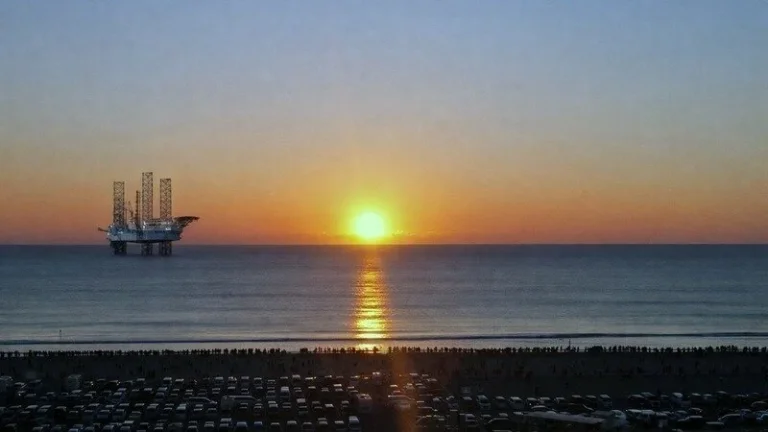
On April 15th, the Minister of Economy, Trade and Industry (METI) announced its approval for exploration drilling in a designated area by the coast of Kujukuri Town, Chiba Prefecture. The purpose of this exploration drilling is to determine whether there are suitable geological formations for CO2 storage. In response to this decision to grant a drilling permission—intended as a preliminary survey for a large-scale domestic Carbon Capture and Storage (CCS) project, the Metropolitan Area CCS Project*—environmental protection organizations and local civil groups have issued a statement of protest and are calling for withdrawal
*The Metropolitan Area CCS Project is a plan to transport CO2 emitted from Nippon Steel’s East Nippon Works Kimitsu Area on the western side of the Boso Peninsula (Tokyo Bay side) to the eastern side of the peninsula (Kujukuri side), via a pipeline passing through the cities of Kisarazu, Sodegaura, and Ichihara, as well as the towns of Nagara, Mobara, Shirako, and Kujukuri, and store it underground in the seabed off the coast of Kujukuri Town. This Project is proceeding despite numerous unresolved problems.
ーーーーーーーーーーーーーーーThe following is the statement of objectionーーーーーーーーーーーーーーー
To: Minister of Economy, Trade and Industry Ryosei Akazawa
CC: Agency for Natural Resources and Energy
Protest and Request for Withdrawal of the Approval for CCS Exploration Drilling Off the Coast of Boso
April 21st, 2026
Tokyo Bay Association for Considering Climate Change
The Association for the Protection of the Kujukuri Coast
FoE Japan
Kiko Network
On April 15th, the Minister of Economy, Trade and Industry (METI) approved exploration drilling in a designated area by the coast of Kujukuri, Chiba Prefecture, based on the Act on Carbon Dioxide Storage Businesses (CCS Business Act).[1] We strongly protest this decision and request its withdrawal. This permit was approved without sufficient explanation or consideration for the concerns regarding the serious environmental and social impacts of the exploration drilling off the coast of Kujukuri, and we believe that there are significant problems with the procedure’s legitimacy and the validity of the policy decision.
First, although specific concerns regarding the environmental and social impacts of the
Project were raised through public comments, the government has not adequately addressed these submissions.[2] In particular, the government is treating the exploration drilling and the Metropolitan Area CCS Project[3] separately, explaining that “conducting exploration drilling does not imply the implementation of the Metropolitan Area CCS Project”, but this contradicts the reality. Since the exploration drilling is conducted for assessing geological suitability and feasibility, based on the premise of implementing the Metropolitan Area CCS Project, these two cannot be evaluated separately. Even if separate hearings regarding the future implementation of this project are held, it is clear that decisions at the exploration drilling stage will effectively determine the direction of project implementation. With this connection, METI’s answers to the concerns raised regarding the Project are insufficient.
Second, the exploration drilling requires construction of a drilling rig with a derrick that rises more than 100 meters above sea level in the ocean.[4] Such construction raises concerns about its impact on marine ecosystems, fisheries, and the coastal environment. However, the METI simply responded that “we require the operator conducting the exploration drilling to establish specific plans in advance, including adequate consideration for the surrounding environment,” without providing concrete details. If the intention was to guarantee consideration of environmental impact, the specific drilling plan, environmental conservation measures, and survey and monitoring methods should have been disclosed, and opinions of the public and relevant stakeholders should have been requested. The information released during the public comment period was only 5 pages of a PDF document and was missing necessary details.[5] Granting drilling approval without releasing the Project’s contents to the residents of the affected region lacks transparency and accountability.
Third, while it is explained that the sea covered by the plan is “an area designated by the government as a specific zone where the geological formations capable of stably storing CO2 possibly exist and where the preservation of the marine environment has been considered,” and that “We reviewed whether the plan complies with national standards, including ensuring that it does not harm the interests of agriculture, fisheries and other industries, as well as not conflict with the public welfare”, the specific contents of the review have not been clarified.[6] Detailed information disclosure and explanations on the kind of data and evaluation methods used, as well as the anticipated impacts and the decision-making process are essential. Particularly, transparent information disclosure is required regarding the evaluation methods for impact on fisheries, coastal tourism and other industries, the lives of residents, earthquake and leakage risks, and the long-term environmental impact outlook.
Fundamentally, CCS is a technology that involves many uncertainties, including long-term leakage risks, liabilities, impacts on the marine environment and local communities. Furthermore, it is high-cost and has hardly any greenhouse gas reduction effect, which makes the promotion of it as a climate change countermeasure unsuitable. Moreover, the CCS Business Act does not require environmental impact assessment (EIA) or agreement from the residents. Proceeding with the CCS Projects, including test drilling, under such a framework, could cause significant negative impacts on the environment, society, and economy. This approval was hastily granted, without addressing concerns of local residents and stakeholders, and is problematic from the standpoint of democratic procedure.
We protest this decision and request the withdrawal of the permit.
Contact information for this statement:
FoE Japan
info@foejapan.org
Footnotes
- 経済産業省(METI) 「CCS事業法に基づき、千葉県九十九里沖の特定区域における試掘を許可しました」2026/4/15 (This document is only available in Japanese.)
- 「二酸化炭素の貯留事業に関する法律第4条第1項の規定に基づく試掘の許可(千葉県九十九里沖)に係る公告及び縦覧において寄せられた御意見の概要と考え方」PDF(written in Japanese)
- INPEX “Metropolitan Area CCS” operator website:
- Mentioned in materials provided at the residents’ briefing session.
- 経済産業省(METI) 2026年1月7日 「二酸化炭素の貯留事業に関する法律第4条第1項の規定に基づく試掘の許可(千葉県九十九里沖)に係る公告及び縦覧について」2026/1/7, (PDF)
- 経済産業省(METI) 「第4回 二酸化炭素地中貯留評価検討会」2025/12/23(This document is only available in Japanese.)
Petition to Halt the Project、Protect the Kujukuri
Relate article
【News】METI Quietly Seeks Public Comments on – Test Drilling Permit for Kujukuri Offshore CCS Project