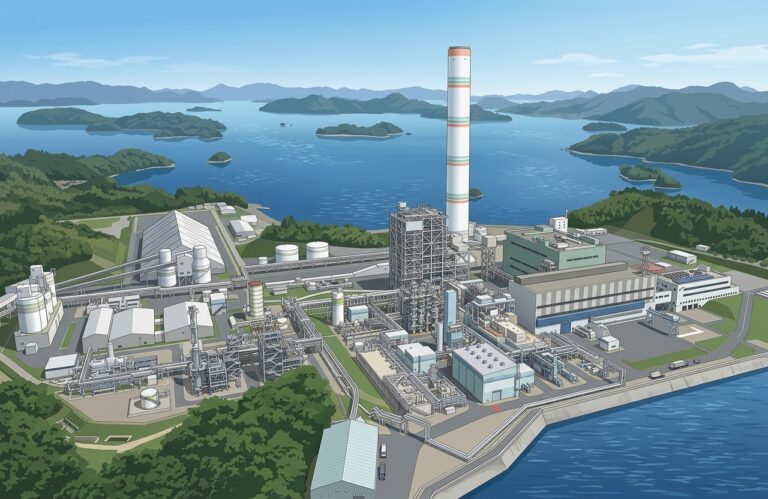
It has been confirmed that a fire broke out in the early hours of April 14, 2026, at Osaki CoolGen’s integrated coal gasification combined cycle (oxygen-blown IGCC) demonstration power plant. Osaki CoolGen Corporation is a joint venture between J-POWER and Chugoku Electric Power and is based in Osakikamijima Town, Hiroshima Prefecture.
According to the company’s announcement at the time, the fire broke out around 4:45 on April 14 and was confirmed as extinguished at 10:15 the same day, after the fire department had been notified and the facility was shut down. No injuries or impacts outside the plant premises were reported.
While the fire may appear to be a minor incident that was handled promptly, the fact that operations have not resumed for months indicates that this was a serious accident. This incident highlights significant structural risks inherent in low-carbon technologies for coal-fired power generation, and raises concerns about the operator’s approach.
Fire in the central “char recovery system”
This fire has been publicly announced to have occurred near the gasification furnace equipment (char recovery system outlet piping).
Char refers to unburned carbon particles produced when the gasification reaction is incomplete during the gasification of coal in a high-temperature, high-pressure gasifier. By recovering this char with a recovery device and repeatedly feeding it back to the gasification furnace until it is completely burned, it is possible to improve power generation efficiency.
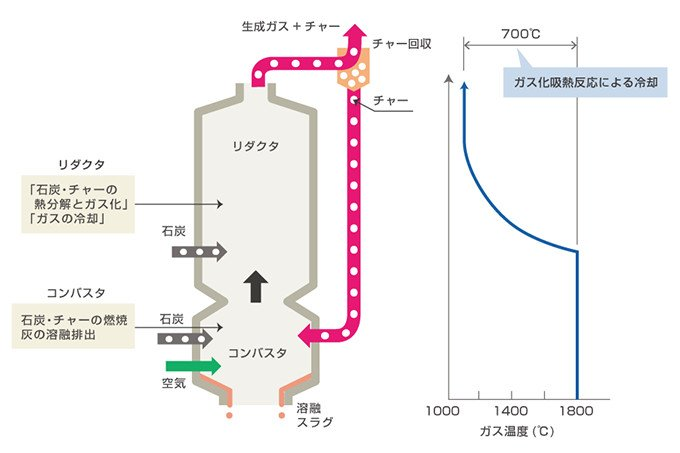
In other words, the fire is a notable incident because it occurred near the piping of the char recovery unit, one of the core processes in IGCC power generation. Although Osaki CoolGen also experienced a fire in November 2017, that incident involved smoke and fire damage in the “gypsum storage warehouse” and was not an accident directly related to the power generation process itself. However, the latest incident is fundamentally different. It can be said that the risks associated with complex technology, such as combustible gas leaks, piping damage under high temperatures, and the spontaneous combustion of char, have become apparent.
Responsibility in public projects funded by taxpayer money
The Osaki CoolGen Project, promoted by Osaki CoolGen, is a large-scale demonstration project being advanced by the New Energy and Industrial Technology Development Organization (NEDO) as a part of the national demonstration test and research project (CoolGen) aimed at realizing “innovative low-carbon coal-fired power generation.” The first stage of the demonstration research will involve a demonstration of oxygen-blown IGCC, followed by the second stage of CO2 separation and recovery type oxygen-blown IGCC demonstration. The third stage is planned to involve a CO2 separation and recovery type integrated coal gasification fuel cell combined cycle (IGFC) demonstration. Testing has continued since the project began in 2012, and testing is entirely supported by government funding through NEDO grants.
Since the fire, the company has only offered an explanation that “there is no significant impact on the overall schedule or plan for the demonstration project.” However, even as of August 2026, approximately four months after the incident, no official announcements have been made regarding the detailed direct cause of the fire, the results of safety inspection for the entire facility, specific measures to prevent recurrence, or the timing of the resumption of operations.
The official website of Osaki CoolGen has for an extended period only displayed the message, “We are currently migrating our web server,” and most of the information, including any details from the accident, has been removed.
While this might be acceptable for an accident at a private company, in the case of a large-scale public project involving a massive amount of public funds (taxpayers’ money), failing to disclose details of inconvenient troubles and technical challenges, and instead dismissing the matter with a vague statement that “there is no impact on the project,” severely lacks transparency and credibility. Precisely because it is a national demonstration project, the operator has an obligation to maintain a high level of transparency and fulfill its social accountability regarding potential risks and malfunctions.
Not a secret weapon for decarbonization, but a symbol of technical risks and high costs
The government and major power companies are promoting carbon capture and storage (CCUS) technology and IGCC projects, such as Osaki CoolGen, as “clean coal-fired power.”
However, as accidents like this one demonstrate, IGCC has an extremely complex structure, a high risk of malfunction, and requires enormous maintenance and development costs. Even if some CO2 is captured, the emissions reduction effect over the entire life cycle is limited, and will not be nearly enough to achieve the dramatic emissions reductions needed by 2030 to meet the 1.5℃ target. Furthermore, even after massive funds and time invested in technological development, there are currently only two coal-fired power plants employing IGCC (IFCC Nakoso and IGCC Hirono). Given their difficulties to operate stably due to issues such as gasifier malfunctions, IGCC technology cannot be considered a realistic option for decarbonization.
Rather than attempting to “extend the life of coal” by pouring large amounts of public funds into a technology experiencing repeated malfunctions and a lack of transparency, shifting to renewable energy, which is already in practical use with decreasing costs, and phasing out coal-fired power by 2030 is the most reliable and safe path to decarbonization for Japan.
Japan Beyond Coal will continue to closely monitor the investigation of the incident and the progress of information disclosure at Osaki CoolGen and NEDO.
Summary of the accident (from media and news reports)
- Date and time: April 14, 2026, around 4:45 (Fire confirmed extinguished at 10:15 on the same day)
- Location: Osaki CoolGen, oxygen-blown IGCC demonstration power plant near the gasifier surrounding equipment (char recovery system outlet piping)
- Damage: No injuries, no impact outside of the plant premises
- Operator’s response: Announced the facility shutdown, an investigation into the cause, and the implementation of measures to prevent recurrence. As of August 2026, no additional information has been published regarding investigation results etc.
Related JBC Articles
【News】 Ironic reason why Fukushima’s IGCC Coal Power Plants are “Clean”