

On March 5th, 2026, the EU Council adopted the amended European Climate Law, introducing an interim target of a 90% reduction in greenhouse gas (GHG) emissions by 2040, compared to 1990 levels. It has been formally established by law as a key interim target for reaching net zero greenhouse gas emissions (“climate neutrality”) by 2050.
Note: “Climate Neutrality” refers to the actions and commitments of achieving net zero GHG emissions, including CO2, methane and other gases that contribute to global warming and environmental degradation, by balancing emissions after subtracting absorption and reduction amounts from total GHG emissions to equal or less.
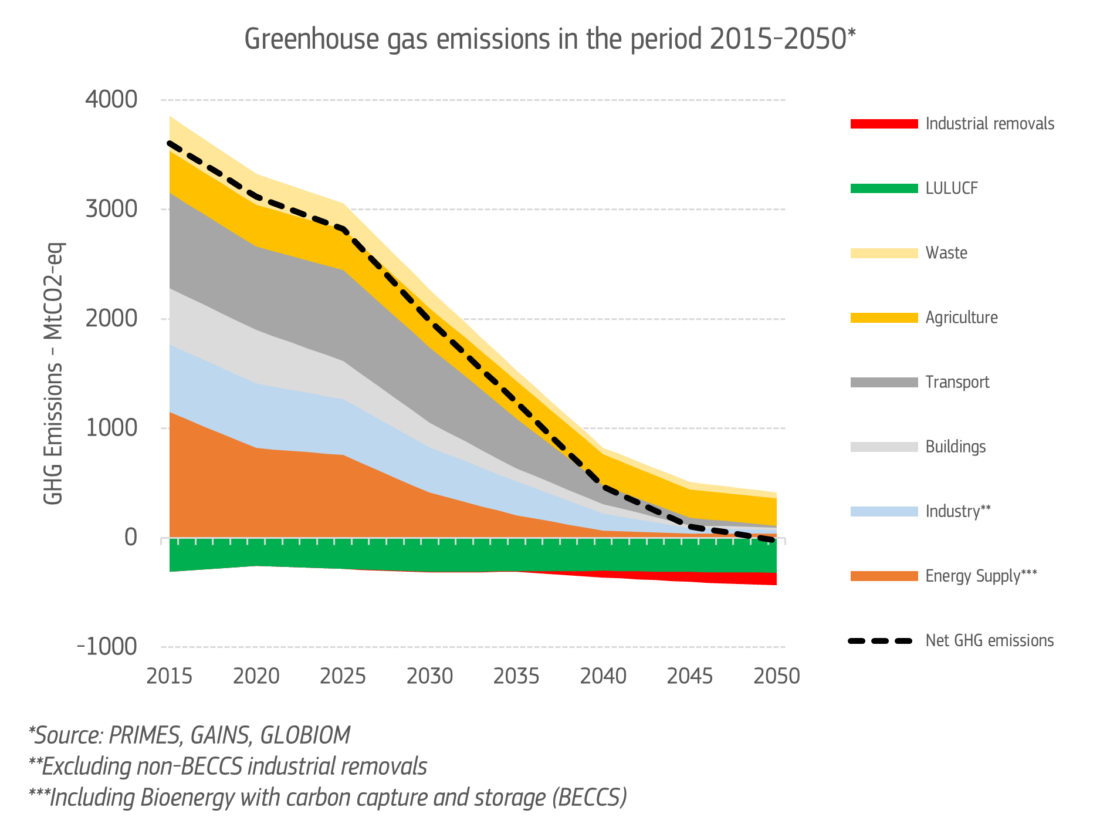
The European Climate Law, which is the core of the European Green Deal, was adopted in 2021 and set interim targets to reduce 55% net GHG emissions by 2030. With this amendment, a reduction target for 2040 has been established and it has strengthened the EU’s pathway to climate neutrality.
To achieve the 90% reduction target, the use of “high-quality” carbon credits from abroad equivalent to 5% is allowed, but at least 85% of the 90% reduction target must be achieved within the EU.
Challenges with International Carbon Credits and EU Emissions Trading System (ETS)
While the European Commission had proposed capping the use of international carbon credits at 3%, the new target allows up to 5%, which weakens the signal of the original proposal.
In addition, under this amendment, the full-scale launch of the newly established EU ETS 2 has been postponed by one year from the originally planned date of 2027 to 2028. The EU ETS 2 is a system designed to complement the existing EU Emissions Trading System (EU ETS) and to cover CO2 emissions from fuel combustion in road transport (such as gasoline-powered vehicles), buildings (such as those using fossil fuels for heating) and other sectors (mainly small industries not covered by the existing EU ETS). This system should have been aimed to be implemented sooner.
In response to this amendment, the EU’s advisory body, European Scientific Advisory Board on Climate Change (ESABCC), has stated that the EU’s emissions reduction by less than 90% by 2040 is not consistent with limiting global warming to 1.5°C. In June 2025, the ESABCC released a report and recommended that a 90–95% net domestic GHG emissions reduction by 2040 would “provide policy certainty beyond 2030, supporting clean technology deployment – such as electrification, while strengthening energy security by reducing fossil fuel imports, and accelerating innovation and investment across the EU economy.” Also, the Advisory Board advised against using international carbon credits to meet the 2040 target, as they risk diverting resources from domestic investments and could undermine environmental integrity.
In a statement issued in response to this amendment, the Climate Action Tracker recommended that the EU ramps up ambition to at least a 90% emission reduction achieved domestically by 2040, and ideally a 95% reduction, in order for the EU to achieve climate neutrality by 2050. Furthermore, regarding international carbon credits, the Climate Action Tracker stated that “it will very likely substantially slow the phase-out of fossil fuels within the EU.” It also called on the EU to ensure the achievement of its 2040 targets through domestic emission reductions and to allow the use of international carbon credits only for mitigation beyond an ambitious EU target.
The European Parliament has called on the Commission to report progress every two years, taking into account the latest scientific data, technological advancements, and the EU’s international competitiveness. Following the review, it is stated that the Commission may propose an amendment to the EU Climate Law as necessary, suggesting taking additional measures to strengthen the supporting framework.
Key points for Japan
Although the EU’s target may not be in line with limiting warming to 1.5°C and not enough to align with the Paris Agreement, establishment of a legally binding goal to reduce emissions by 90% is noteworthy .
Japan’s current 2040 reduction target is 73% (compared to fiscal year 2013 levels), but the Climate Action Tracker recommends that Japan should aim for an 81% GHG reduction by 2035. It means that the 2040 target must be even more ambitious. Currently, Japan has no regulations governing the use of international carbon credits, leaving the practice unchecked. Strict limits on this should be imposed at an early stage. Additionally, this amended European Climate Law has once again highlighted the importance of third-party evaluation bodies, such as the ESABCC, which can clearly demonstrate the scientifically required standards for emission reduction targets.
Using the EU as an example, it is time for Japan to introduce measures to establish scientifically based emission reduction targets.
Reference
- Council of the EU “2040 climate target: Council gives final green light”
- ESABCC “Scientific advice for amending the European Climate Law – Setting climate goals to strengthen EU strategic priorities”
- Climate Action Tracker “RESPONSE: EU 2040 target approval”
- Climate Action Tracker: JAPAN