
In the Reuters’ article dated September 15, “Japan’s J-Power expects delay to 2030 start of Ohma nuclear power plant,” J-POWER indicated plans to extend the operation of inefficient coal-fired power plants in Japan. Following this, the Australasian Centre for Corporate Responsibility (ACCR), an Australian organization that has consistently engaged with J-POWER, issued a statement opposing the life-extension of these coal-fired power plants.
The Reuters article begins by noting that the construction of J-POWER’s Ohma nuclear power plant* is expected to be delayed. The plant, currently under construction in Aomori Prefecture, was scheduled to be completed in 2029 and begin operations in 2030. However, J-POWER’s website currently states that the start of operations is undetermined (to be determined based on construction progress and other factors). J-POWER President Hideaki Kato said the company expects the schedule to be delayed due to the complexity of construction planning.
* The Ohma nuclear power plant is designed to be the world’s first nuclear power plant capable of using MOX (mixed-oxide) fuel, a blend of plutonium and uranium, throughout its entire core. Construction began in May 2008, was suspended due to the 2011 Great East Japan Earthquake, and resumed in 2012. While the project was originally scheduled to begin operations in 2021, the start date has been repeatedly postponed, including in 2014.
ACCR raised concerns over J-POWER’s plan to announce a new Medium-Term Management Plan that includes a revision of the phase-out of inefficient coal-fired power plants in response to the delay in the restart of nuclear power plant. While President Kato stated that J-POWER has not changed its goal of achieving carbon neutrality by 2050, he indicated that the company intends to review its roadmap that aims to phase out inefficient coal-fired power plants by 2030. The increase in electricity demand from data centers may make it more desirable to extend the operational life of coal-fired power plants. In response, ACCR argues that extending the operational life of the four coal-fired power units that J-POWER planned to decommission by 2030 is not a solution to the increase in electricity demand.
J-POWER’s “Direction of thermal power generation transition in Japan”
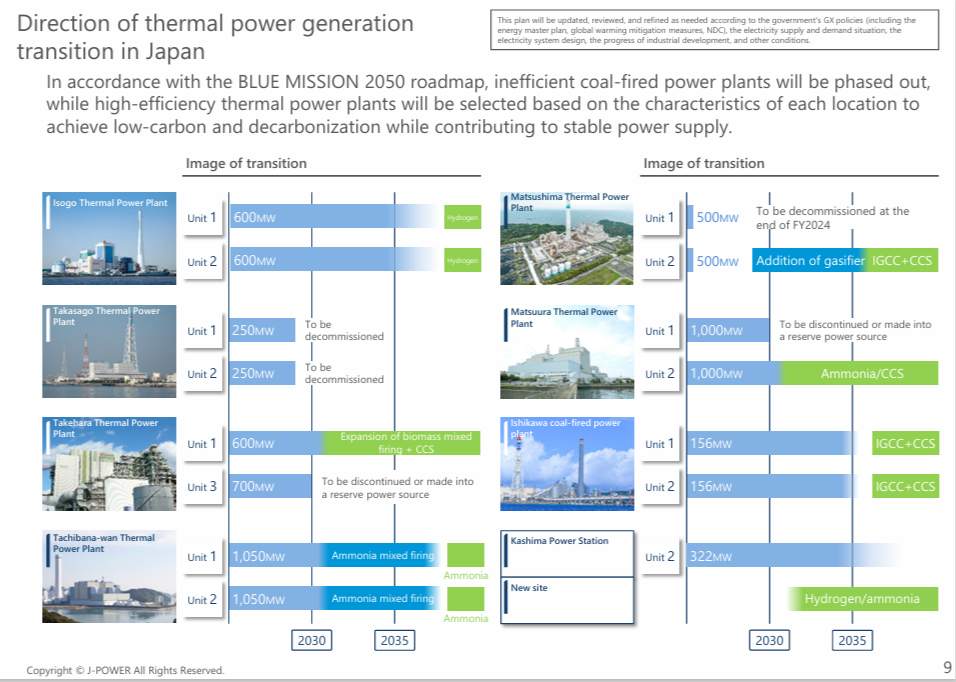
Among the units shown in the figure, J-POWER has already decommissioned Matsushima Thermal Power Plant Unit 1, while Unit 2 has been temporarily shut down in preparation for the GENESIS Matsushima project. J-POWER’s plan to “upcycle” a unit to a lower carbon emission facility is currently undergoing environmental impact assessment (EIA), but has faced delays due to soaring construction costs, labour shortages, and extended lead times for gas turbines.
According to ACCR’s calculations, the remaining four coal-fired units** that J-POWER plans to decommission by 2030 emit approximately 10 Mt CO2e annually. Therefore, ACCR points out that revising the retirement plan for coal-fired power plants would raise concerns among investors regarding the credibility and durability of J-POWER’s transition strategy. ACCR adds that to meet increasing electricity demand, J-POWER should accelerate investments in cleaner power generation and improved flexibility.
** Takasago Units 1 and 2 are scheduled for decommissioning by the end of FY 2028, and Matsuura Thermal Power Plant Unit 1 is scheduled for discontinuation and conversion to a reserve power source in 2030. Takehara Unit 3 is also scheduled for discontinuation or conversion to a reserve power source by 2030.
ACCR submitted shareholder proposals to J-POWER in 2022 and 2023. In 2023, ACCR, together with Amundi and HSBC Asset Management, filed a resolution calling for J-POWER to set and disclose credible short- and medium-term emissions reduction targets aligned with the Paris Agreement. 21% of shareholders voted in favor of this proposal. Subsequently, J-POWER released its Medium-Term Management Plan 2024-2026, pledging to decommission five domestic coal-fired power units by FY2030.
Is it appropriate for J-POWER to scrap that plan and extend the life of inefficient coal-fired power units? All eyes are on the upcoming Medium-Term Management Plan.
Related Information
- ACCR: Investors question J-POWER over extension of inefficient coal plants
ACCR is responding to reports that J-POWER is considering extending the operation of its domestic inefficient coal-fired power plants beyond its previously disclosed closure timeline(Link) - ACCR: Investor Briefing – Electric Power Development Co., Ltd (J-POWER) 2023 AGM(Link)
- Reuters: Japan’s J-Power expects delay to 2030 start of Ohma nuclear power plant(Link)