| Key Points |
|---|
| The scheme favours thermal and nuclear power over renewable energy. The auction’s design is oriented more toward extending the operating lives of thermal and nuclear power plants than toward expanding renewable energy. The auction serves as a mechanism for extending the life of coal-fired power. Retrofits involving 20% ammonia co-firing or equipment capturing only 20% of CO₂ emissions are eligible for support, enabling existing coal-fired power plants to continue operating. |
Various measures are being introduced that could extend the operating lives of Japan’s coal-fired power plants. One of these is the Long-Term Decarbonization Power Source Auction. Why, then, is a mechanism intended to encourage new investment in “decarbonized” power sources instead helping to prolong coal-fired generation?
What is the Long-Term Decarbonization Power Source Auction?
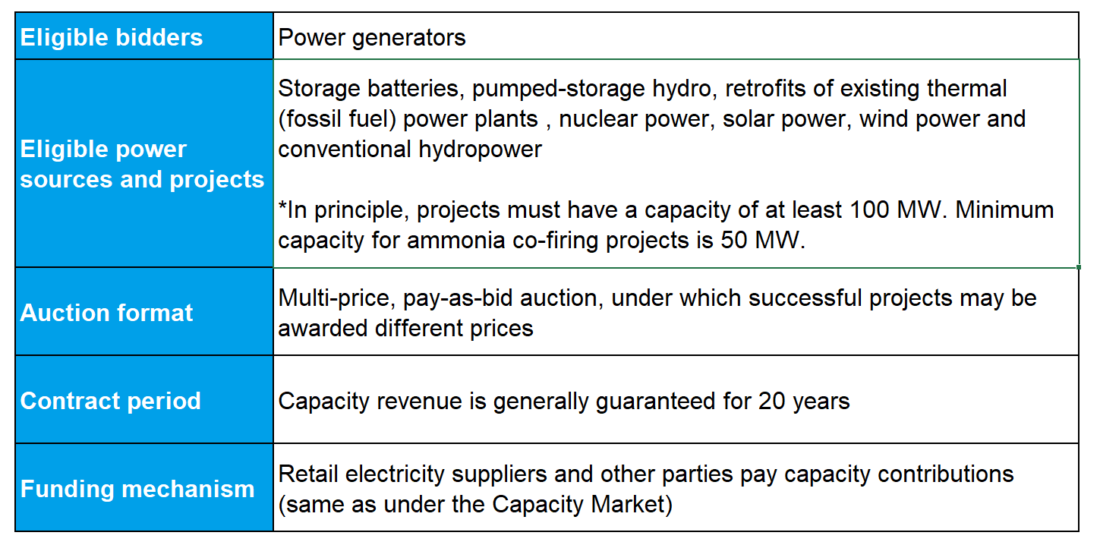
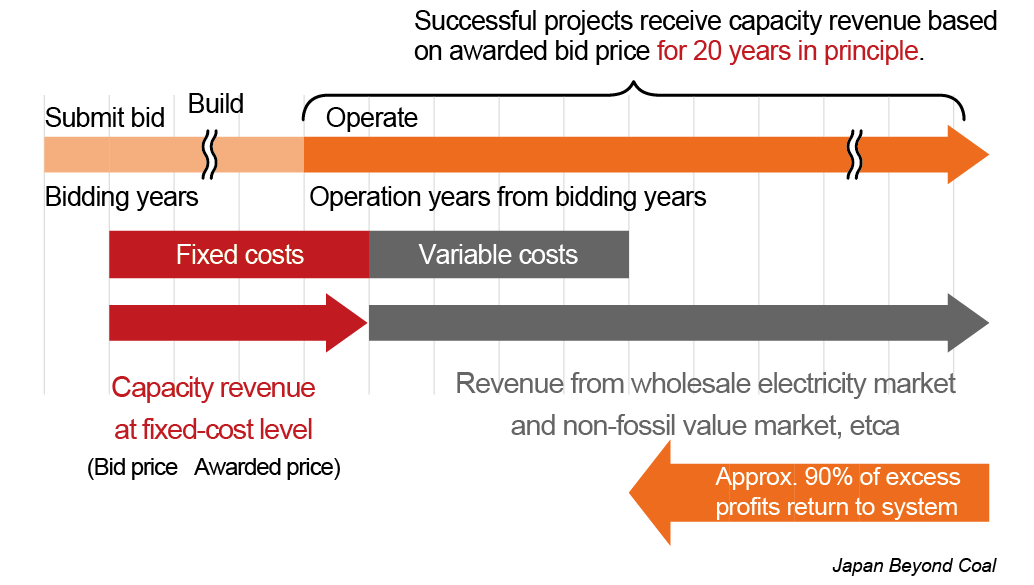
Introduced in FY2023, the Long-Term Decarbonization Power Source Auction was intended to encourage new investment in power-generation facilities that contribute to decarbonization. Power generators submit bids through an auction process, and successful projects are generally guaranteed to have “capacity revenue” for 20 years. This provides greater certainty that initial investment costs can be recovered, thereby encouraging new capital investment. Despite the “decarbonization” label, eligible projects are not limited to renewable energy. They may also include retrofits enabling ammonia co-firing at existing coal-fired power plants and the construction of new LNG-fired plants. Fossil-fuel-based generation is therefore also classified as a “decarbonized power source” under the auction scheme.
Trends to date: Winning bids concentrated in LNG and nuclear
1. FY2023: Almost entire 3-year LNG allocation awarded in 1st auction
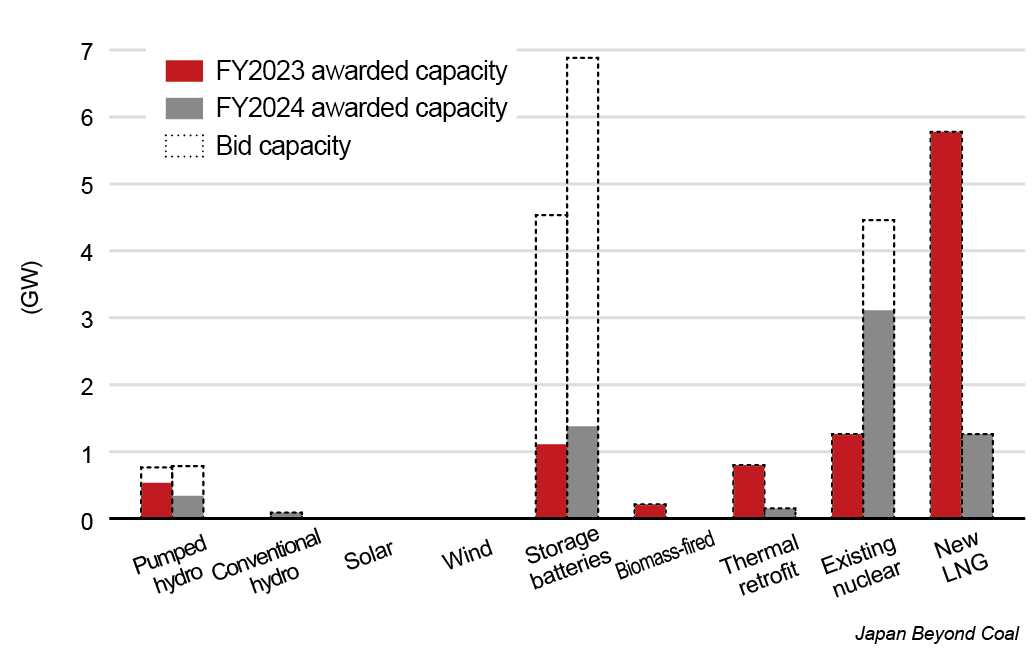
The total procurement volume the first year was set at 4 GW. This included separate caps of 1 GW for retrofits of existing thermal (fossil fuel) power plants and 1 GW each for storage batteries and pumped-storage hydropower, with the remaining volume available for other “decarbonized power sources.” In addition, a separate 6 GW allocation was established for new dedicated LNG-fired capacity over the three years from FY2023 to FY2025. Storage-battery projects submitted bids totalling 5.14 GW, but only approximately 20% of this capacity was successful. By contrast, 5.756 GW of dedicated LNG-fired capacity was awarded in the first auction alone, using up almost the entire three-year allocation. In the nuclear category, the already-constructed Shimane Nuclear Power Plant Unit 3 was also successful.
2. FY2024: Existing nuclear power secures more than 3 GW
As in the previous year, the basic procurement volume was set at 4 GW. Because bids for dedicated LNG-fired power had greatly exceeded the original allocation in the first auction, an additional 2 GW allocation was established for each of FY2024 and FY2025. Eligibility for nuclear power was also expanded to include investment in safety upgrades at existing nuclear power plants. For storage batteries and pumped-storage hydropower, the minimum bidding capacity had been set at 10 MW in FY2023. Following the concentration of bids in this category, the minimum was raised to 30 MW for FY2024. Successful projects included 3.15 GW of nuclear power and 1.31 GW of LNG-fired power.
3. Zero bids for solar and wind in FY2024 and FY2025
No bids were submitted for solar or wind projects for two years in a row. One apparent barrier is that the scheme excludes the smaller-scale, geographically distributed projects that are one of renewable energy’s principal strengths.
4. Scheme sweetened for coal retrofits in response to sluggish bidding
The Long-Term Decarbonization Power Source Auction provides support for retrofitting coal-fired power plants to co-fire ammonia. However, the number and capacity of successful projects have so far been limited. In the first auction, three projects totalling 825 MW were successful, and in the second auction, only one project at 95 MW. Due to this limited uptake, the scheme was revised for the third and subsequent auctions to have higher price caps and relaxed conditions for coal-fired power retrofits, making the scheme more favourable to thermal power operators.
Auction redesign: Changes benefit thermal (fossil) power operators
In the FY2023 first auction and the FY2024 second auction, bids for allocations reserved for retrofits of existing thermal power plants fell below the available procurement volume. The scheme was thus revised after the second auction to make participation easier and more financially attractive for thermal (fossil fuel) power operators.
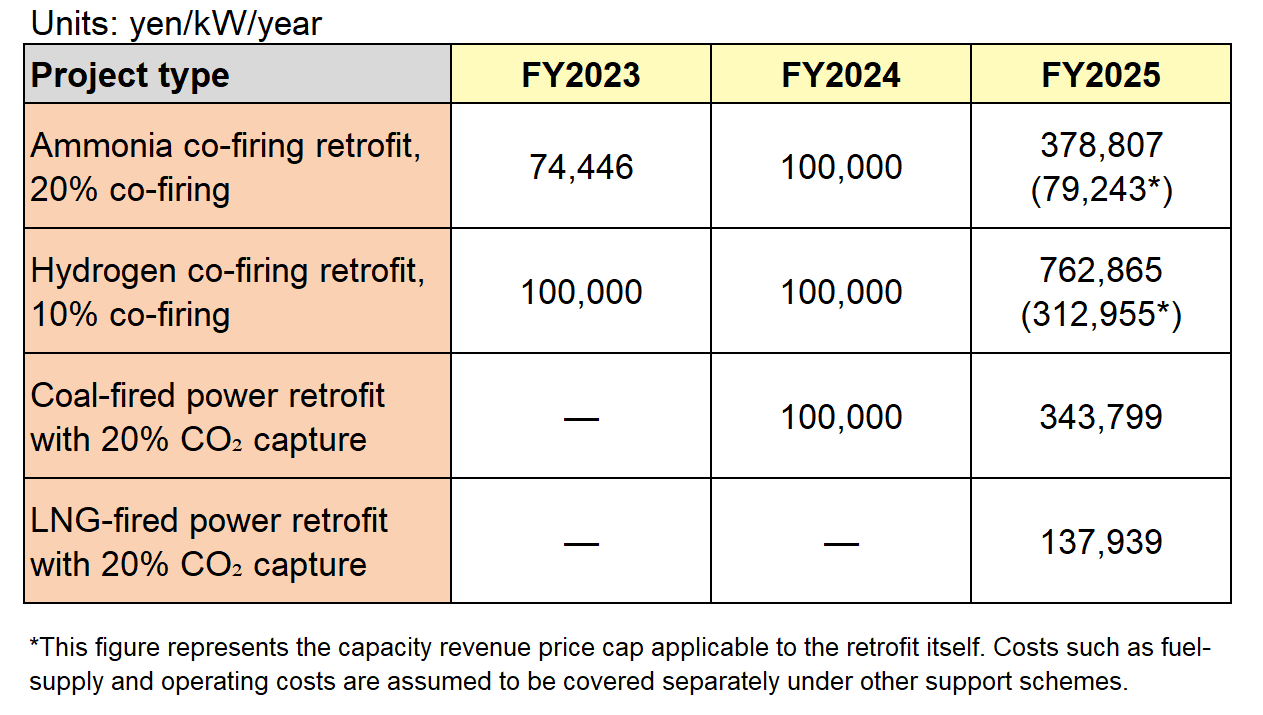
Major increases in bidding price caps
Power-plant construction costs have risen substantially because of higher materials costs, rising interest rates and depreciation of the yen. The previous bidding price caps, averaging ¥100,000/kW/year, were considered insufficient to make projects commercially viable, discouraging companies from bidding. For the third auction, the overall average price cap was therefore doubled to averaging ¥200,000/kW/year. This will substantially increase the burden on electricity consumers.
Addition of CCS-equipped projects
Retrofits adding carbon capture and storage, or CCS (Carbon dioxide Capture and Storage), to existing coal- and LNG-fired power plants were added to the list of eligible projects. This category was introduced following operators’ announcements of plans to install CCS at facilities, including JERA’s Yokosuka Thermal Power Station. However, the minimum CO₂ capture requirement is only 20%. This would allow plants to continue emitting approximately 80% of their CO₂, so this therefore cannot reasonably be regarded as full decarbonization.
Inclusion of variable costs
Variable costs, mainly fuel and operating costs, may now be included for hydrogen and ammonia firing or co-firing and for CCS-equipped projects. Once these variable costs are included, the average price cap for hydrogen, ammonia and CCS projects rises to approximately ¥400,000/kW/year. This is substantially higher than the average price cap of approximately ¥200,000/kW/year for other eligible technologies. It is also approximately five times the price-cap range for storage batteries, which is ¥76,205–¥80,657/kW/year.
Automatic adjustment of awarded prices
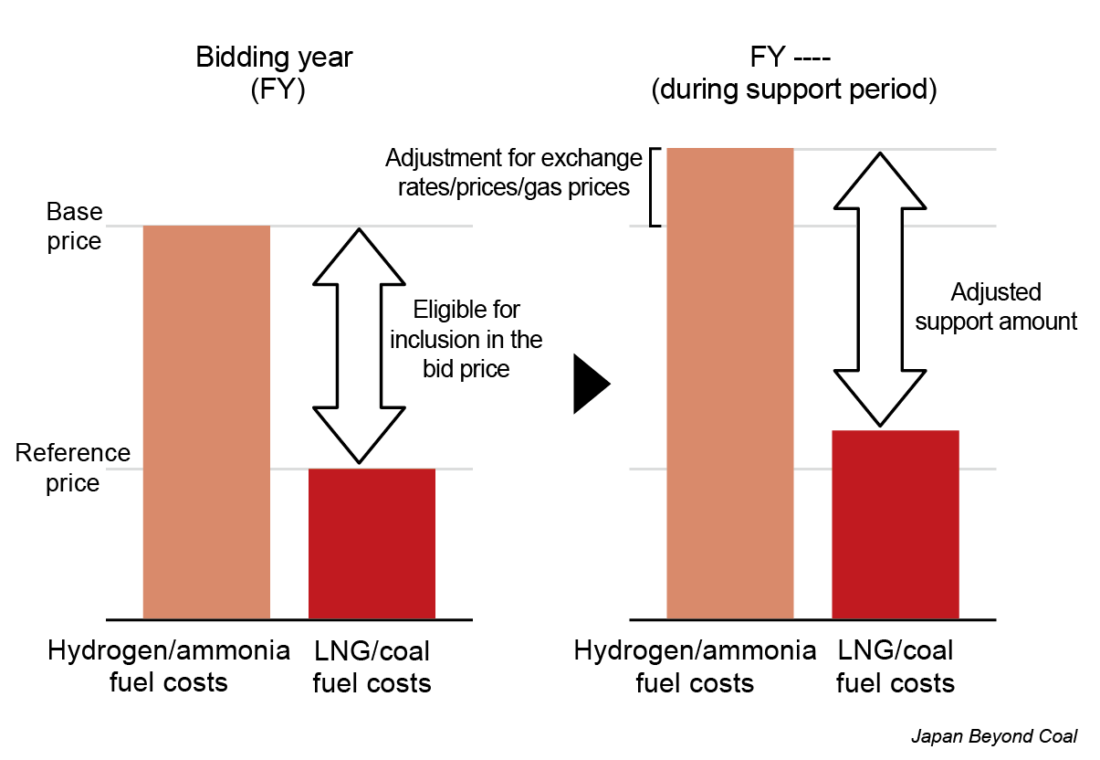
Although variable costs for hydrogen, ammonia and CCS projects are calculated when bids are submitted, the scheme allows them to be adjusted automatically each year during the support period. These adjustments may be either upward or downward and may reflect changes in exchange rates, general price levels, and gas prices (Fig 5). Awarded prices could therefore rise substantially after projects begin operating, further increasing the burden on electricity consumers.
There is no reasonable justification for maintaining coal-fired power from the standpoint of energy security, environmental protection or economic efficiency. Nevertheless, when such projects are successful in the Long-Term Decarbonization Power Source Auction, construction can proceed and support may continue for 20 years from the start of commercial operation. As more projects begin receiving payments, the annual cost could continue to grow, placing an increasing burden on electricity consumers.
Published December 2025.
The original Japanese version is in PDF.