| Key Points |
|---|
| To achieve net-zero emissions by 2050, Japan urgently needs to establish a clear target year and develop a concrete roadmap for phasing out coal power. |
To prevent the worsening of the climate crisis, many countries and local governments are moving to phase out coal-fired power generation. Developed countries need to phase out coal power by 2030, and at least 14 OECD countries have already done so. Efforts to move beyond coal are continuing around the world.
International action to phase out coal power
Following the adoption of the Paris Agreement in 2015, the Powering Past Coal Alliance (PPCA) was launched in 2017 as an international initiative to eliminate coal power generation. PPCA members declare their commitment to phasing out coal-fired power generation, with target dates of 2030 for OECD and EU countries and 2040 for the rest of the world. As of November 2025, the alliance included 65 national governments, 52 local subnational governments, and 66 global organizations. To help achieve the 1.5°C goal, PPCA members make the following commitments:
- Government members commit to phasing out existing unabated coal power generation and to a moratorium on any new coal power stations without operational carbon capture and storage, within their jurisdictions.
- Businesses and other non-governmental members commit to powering their operations without coal.
- All members commit to supporting clean power generation through their policies (whether public or corporate, as appropriate) and investments, and to restricting financing for unabated coal power generation (without carbon capture and storage).
Coal phase-out progress across OECD countries
Of the OECD’s 38 member countries, 14 have already phased out coal power (Fig. 1). In the United Kingdom, the birthplace of the Industrial Revolution, the closure of the country’s last coal-fired power plant in September 2024 made international headlines. By 2024, renewable energy sources such as wind and solar supplied about half of the country’s electricity.
The shift away from coal is also accelerating in jurisdictions that previously relied heavily on coal power. In the early 2000s, coal supplied about 80% of the electricity used in Alberta, Canada. The province adopted a target of ending coal power generation by 2030, but achieved this goal more than five years ahead of schedule, on June 16, 2024. In South Korea, eight local governments with coal-fired power plants had already joined the PPCA, and the national government followed in November 2025.
At the 29th Conference of the Parties to the United Nations Framework Convention on Climate Change (COP29), held in 2024, 25 PPCA member countries and the European Union launched the Call to Action for No New Coal. As part of their national climate strategies, participating governments committed not to develop new coal-fired power capacity, and they called on other countries to take similar action. The initiative is also gaining support among developing countries.
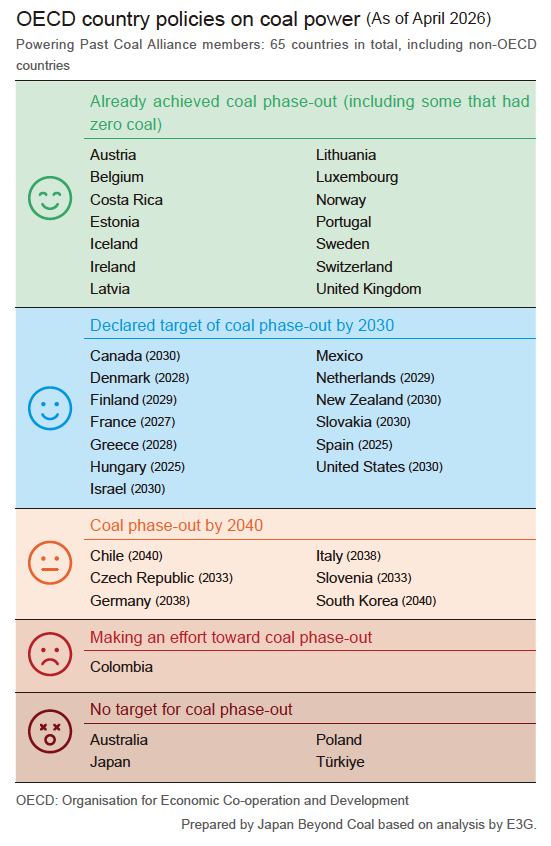
As of April 2026
Powering Past Coal Alliance members: 65 countries in total, including non-OECD countries
Germany
Germany is one of Europe’s leading coal-producing countries but has set a target of phasing out coal power by 2038. Coal supplied more than 45% of the country’s electricity in 2013. By 2024, its share had fallen to about 20%.
India
India has the world’s second-largest number of coal-fired power plants, after China. More than 50% of the country’s electricity is generated from coal. In recent years, however, the economics of coal power have deteriorated, and many planned projects have been cancelled. New renewable-energy capacity is now being added more rapidly than coal-fired capacity.
China
China is the world’s largest consumer of coal and has indicated that it will continue constructing coal-fired power plants through 2027. At the same time, it is rapidly expanding renewable energy. By the end of March 2024, China’s installed wind and solar power capacity had exceeded its fossil-fuel power capacity, which consists predominantly of coal-fired generation.
South Korea
The share of coal power in South Korea’s electricity mix fell from 42.5% in 2015 to 30.5% in 2024. South Korea joined the PPCA in 2025, committing to halt the construction of new coal-fired power plants and phase out existing unabated facilities by 2040. Local governments hosting about 80% of the country’s coal power capacity have also joined the alliance.
Australia
Australia is the world’s second-largest coal exporter. Although the national government has not announced a coal phase-out target, the roadmap for the National Electricity Market prepared by the Australian Energy Market Operator projects that 90% of existing coal-fired capacity will close by 2035 and all remaining coal-fired power plants will close by 2040.
United Kingdom
The United Kingdom closed its last coal-fired power plant in September 2024, ending 142 years of reliance on coal-fired electricity and becoming the first G7 country to complete a coal phase-out. The government has also announced a policy of prohibiting the development of new coal mines. Following the announcement of its coal phase-out plan, investment in renewable energy expanded rapidly. By 2024, renewables supplied about half of the country’s electricity.
United States
The United States joined the PPCA in December 2024. Coal’s share of the US electricity generation mix continued to decline, falling to 14.9% in 2024. However, on April 8, 2025, President Trump signed an executive order aimed at revitalizing what the order called America’s “beautiful clean coal” industry.
Japan
Coal accounted for 28.5% of Japan’s electricity generation mix in FY2023. The Seventh Strategic Energy Plan does not specify a separate share for coal in the 2040 electricity mix. Instead, it sets a combined share of about 30% to 40% for thermal power as a whole. The government plans to “decarbonize” thermal power through measures including ammonia co-firing and carbon capture and storage (CCS). Japan currently has the highest level of dependence on coal power among the G7 countries.
From coal phase-out to fossil fuel phase-out
Many countries are moving first to phase out coal and then to move beyond fossil fuels more broadly. The United Kingdom was the first G7 country to complete a coal phase-out. Japan, by contrast, has not even established a target year for ending coal power generation. To close the widening gap with other countries, Japan should reconsider its policy of maintaining coal power through measures such as ammonia co-firing. Instead, it should boost energy-efficiency and conservation measures and accelerate the expansion of renewable energy.
Citizen and NGO action driving the global coal phase-out: The “Beyond Coal” campaign
The Beyond Coal campaign is active in the United States, Europe, Australia, South Korea and Japan under a shared message: phase out coal-fired power generation by 2030. In Europe, the movement has achieved significant progress in reducing reliance on coal. It has now developed into a broader campaign seeking to phase out all fossil-fuel-fired power generation.
Originally published December 2020
Updated January 2026
The original Japanese version is in PDF.