| Key Points |
|---|
| Amid a visibly intensifying climate crisis, Japan has steadily expanded its coal-fired power capacity, further cementing its reliance on coal. |
Since the 1970s, Japan has grown increasingly reliant on coal-fired power generation. Key features of this dependency include: (1) About 20% of Japan’s total greenhouse gas (GHG) emissions originate from utility-scale coal-fired power plants, (2) the use of coal for power generation has failed to decrease, still accounting for roughly 30% of the national power mix, and (3) Japan relies on imports for nearly 100% of its coal supply.
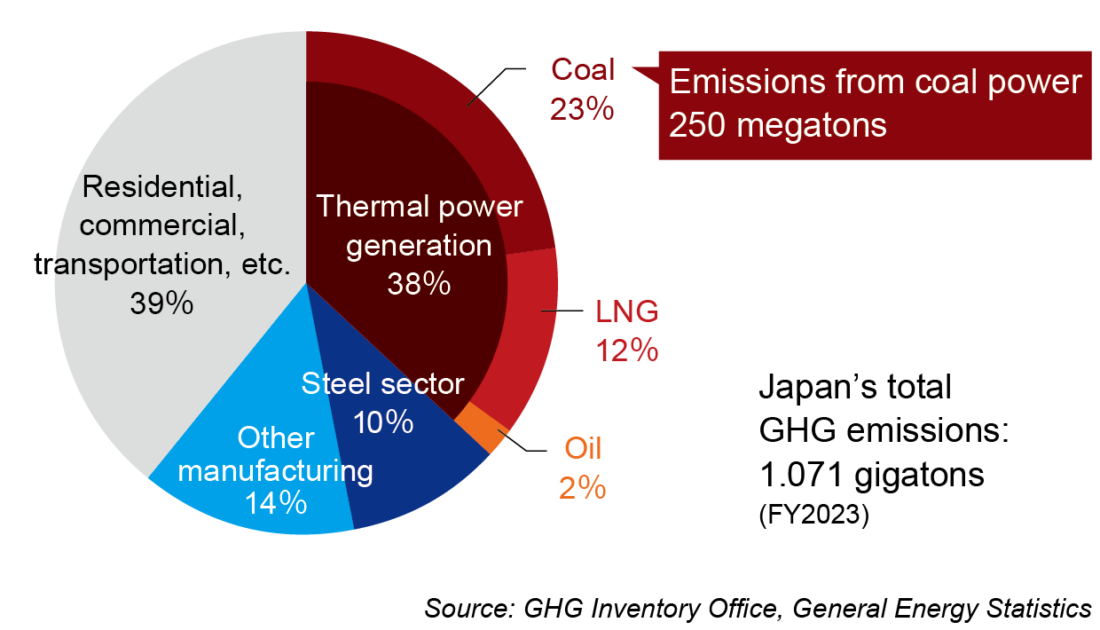
Coal power accounts for roughly 20% of Japan’s GHG emissions
Japan is the world’s fifth largest GHG emitter. Thermal power plants burning fossil fuels account for more than one-third of Japan’s total GHG emissions, with coal-fired generation alone driving about 20% of the country’s overall carbon footprint.
More than 160 coal-fired units in operation nationwide
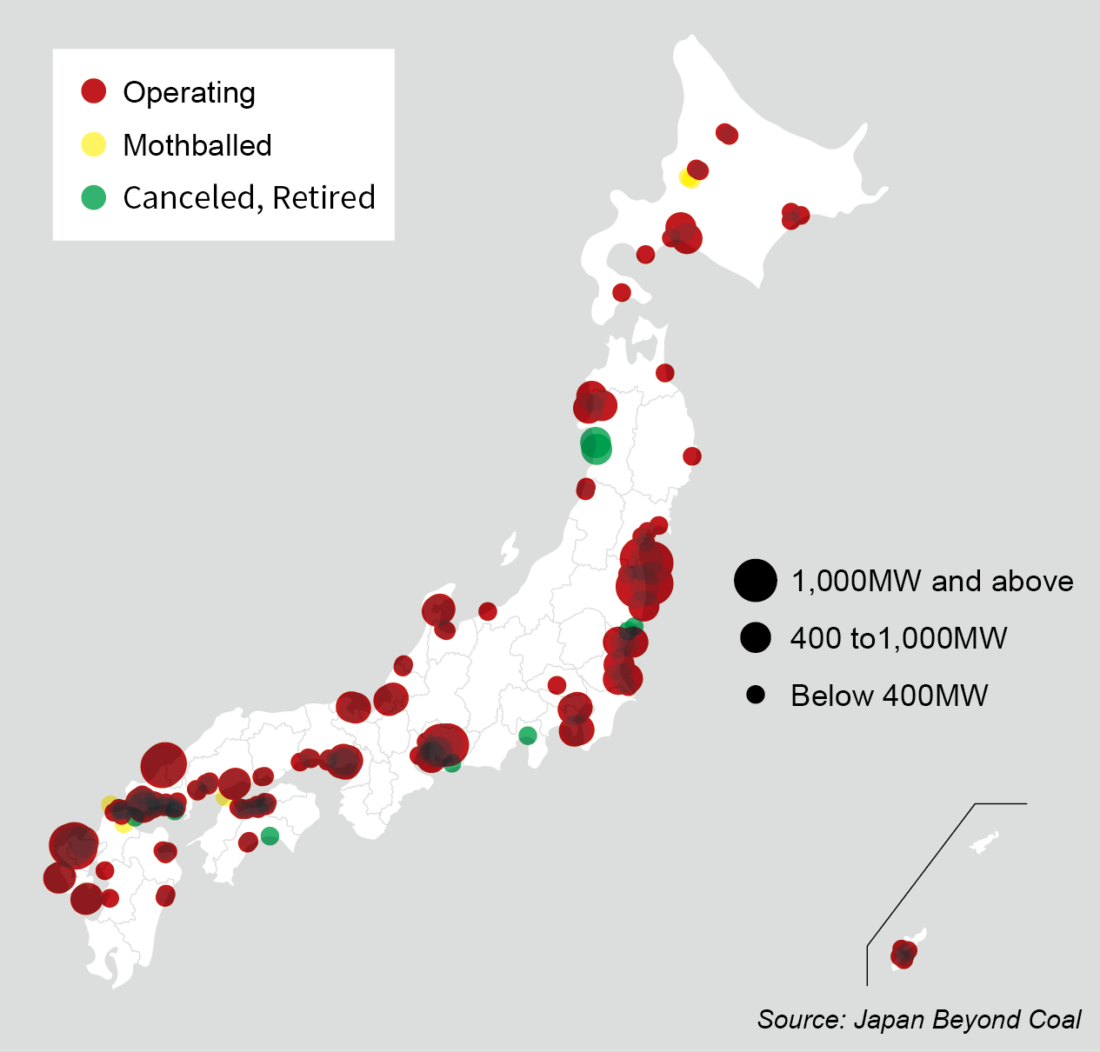
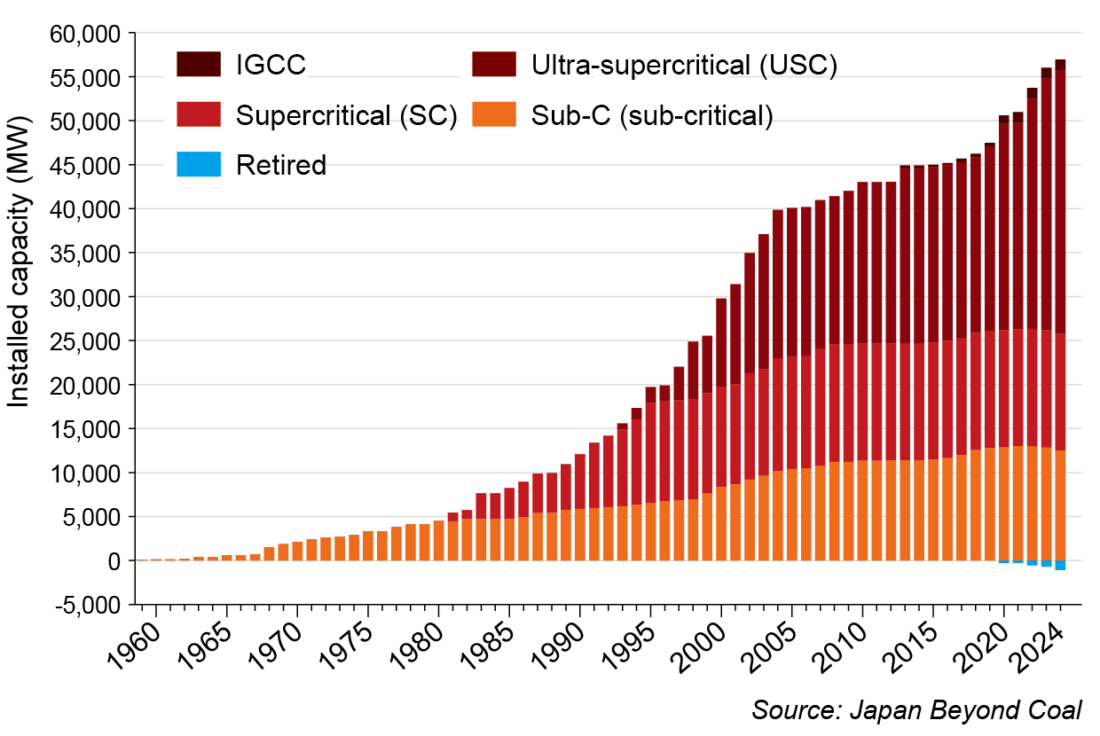
Japan operates more than 160 coal-fired units nationwide, with a combined capacity of nearly 50 gigawatts (GW) (Fig. 2, Fig. 3). Plans to build 50 new coal units surfaced in the wake of the 2011 Great East Japan Earthquake. While factors including strong opposition from local communities ultimately forced the cancellation of 20 units, 30 new units had successfully entered commercial operation by 2023.
Japan’s active fleet spans a wide technological gap, ranging from older, smaller, and inefficient units built in the 1960s and 1970s to ultra-supercritical, high-capacity plants. Today, these facilities generate roughly 30% of Japan’s total electricity.
Continued coal expansion post-Paris Agreement
Historically, Japan expanded its coal-fired fleet and increased power output to keep pace with rising energy demands. This expansion was heavily incentivized by the Japanese government, which historically designated nuclear and coal power as critical “baseload power sources” for a resource-scarce nation.
Even after the Paris Agreement entered into force in 2016, new coal plants continued to come online one after another, drawing widespread international condemnation. Although the Government announced a policy in 2018 to “fade out inefficient coal-fired power,” actual generation capacity has yet to see any meaningful decline.
Japan imports virtually all coal, with 70% sourced from Australia
Following the closure of domestic mines, Japan now imports virtually all of the coal it consumes. The power sector alone burns through more than 100 million tons of coal annually, over 70% of which is shipped from Australia (Fig. 4).
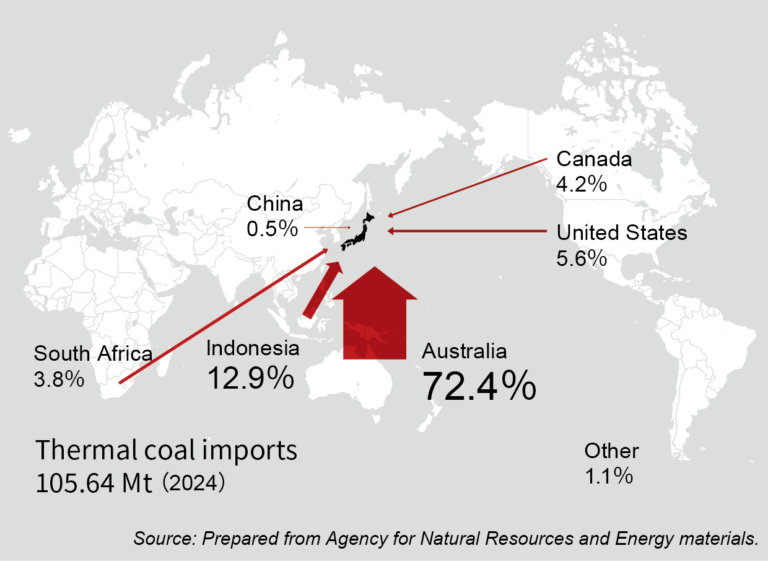
The government and utility operators frequently defend coal by highlighting its geopolitical advantages, noting that its supply chain avoids the Middle East and offers relatively stable availability compared to other fossil fuels. However, a near-total reliance on imports—coupled with climate-driven market volatility and carbon pricing risks—undermines the argument that coal is a secure energy source.
In FY2023, Japan’s thermal coal imports totaled approximately 2.7 trillion yen. This represents a massive financial flow out of the country. Transitioning from coal to renewable energy would bolster Japan’s energy self-sufficiency, and redirecting these funds into the domestic economy would stimulate domestic investment and generate significant economic benefits.
No complete phase-out in sight: 2030 climate targets at risk
The Japanese government has pledged to phase out older, inefficient coal-fired power generation by FY2030. However, progress remains sluggish due to a lack of concrete milestones and legally binding frameworks.
Several aging, low-efficiency units from the 1960s and 1970s continue to run today. Despite emitting significantly more CO2 per megawatt-hour than state-of-the-art facilities, these units operate with no definitive decommissioning timelines. Under these circumstances, Japan is in danger of missing even its modest 6th Strategic Energy Plan target to cap coal’s share of the electricity mix at 19% by FY2030—let alone completely phasing out the fuel.
How the capacity market artificially prolongs the life of coal
Japanese Government continues to treat coal-fired power as a necessary source for stable supply of electricity. To support this stance, the Government launched the “capacity market” framework in 2020. This system issues financial payments to utilities simply for securing power generation capacity (kW) to theoretically safeguard future electricity supplies.
Under this mechanism, operators earn revenue just for keeping a power plant available, regardless of whether it actually generates electricity. Consequently, inefficient, aging coal units that would otherwise be unprofitable are being financially thrown a lifeline. In fact, roughly a quarter of the winning bids in the FY2024 capacity market auction went to coal-fired generation, including aging infrastructure. Ultimately, this structural framework creates a perverse incentive and a severe drag on Japan’s transition from coal to renewable energy.
COLUMN
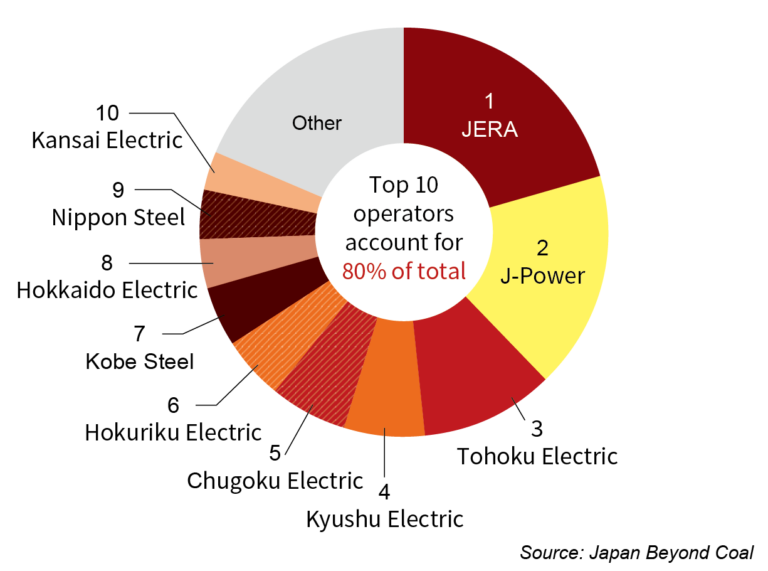
Top 10 coal-fired power operators
The bulk of Japan’s coal-fired capacity is held by the country’s major electric power utilities and Electric Power Development Co. (J-Power). Leading the pack is JERA, a 50-50 venture between Tokyo Electric Power Company (TEPCO) and Chubu Electric Power. Japan Beyond Coal is calling for a coal phase-out by 2030, but for that to occur, it is critical that these corporate giants strengthen their climate actions and pivot away from coal.
Originally published November 2020, revised December 2025.
The original Japanese version is in PDF.