Rainforest Action Network (RAN) and other NGOs published the 17th annual research analysis report, “Banking on Climate Chaos 2026 (BOCC 2026).”
This report summarizes the financing provided to the fossil fuel industry by the world’s 65 biggest private banks from 2021 to 2025. An analysis of loans and underwriting for approximately 2,900 fossil fuel companies revealed that in 2025, these banks committed $906 billion to the fossil fuel industry, an 8% increase from 2024. It also revealed that over the 10 years since the Paris Agreement, a staggering $8.7 trillion in funding had been provided to the fossil fuel sector (oil, gas, and coal).
Key Points
- The world’s largest banks on balance committed $906 billion to companies conducting business in fossil fuels in 2025 — up $64 billion, or an increase of nearly 8% from 2024.
- Fossil fuel financing from the 65 largest banks has reached nearly $8.7 trillion in the ten years since the adoption of the Paris Agreement in oil, gas, and coal operations.
- In the face of policy backsliding in various parts of the banking sector, 26 of the 65 top global banks reduced their fossil fuel financing in 2025.
- Six financial centers, “Big Six” —the United States, China, Canada, Japan, the United Kingdom and the European Union (EU) — account for 87% of total fossil financing. Notably, US banks’ share of all global bank fossil fuel financing increased to 32%, up from 28% in 2021, and represents the single largest source of fossil capital in the world. On the other hand, European banks show the clearest downward trend. (Figure 1)
- “Dirty Dozen” banks provide more than a third of global fossil finance. Bank fossil financing is highly concentrated amongst a small oligopoly.
- In 2025, bank financiers provided $508 billion to companies expanding fossil fuel developments, up 27% in just one year.

Following the collapse of the Net-Zero Banking Alliance (NZBA) in 2025, banks accelerated their policy rollbacks. Of the 15 North American banks analyzed, 12 banks have no meaningful fossil fuel policies. JPMorgan Chase and Goldman Sachs abandoned their coal and Arctic exclusions entirely, converting them into case-by-case due diligence standards. Furthermore, the energy crises of the 2020s, such as Russia’s invasion of Ukraine and attacks on Iran by the United States and Israel, led to an increase in funding for fossil fuel projects, particularly those related to LNG.
Fossil fuel finance by the Japanese 3 Megabanks
Japan’s three megabanks (MUFG, Mizuho, and SMBC) not only rank among the “Dirty Dozen” for financing in 2025 (Fossil Fuel Finance Rankings: MUFG 3rd, Mizuho 4th, SMBC 9th) (Figure 2), but they have also ranked up compared to last year. The total amount provided by these three banks to fossil fuel projects was $125 billion (a 17% increase, or $18 billion, from the previous year); funding for fossil fuels since 2021 totals $562 billion, and funding for companies expanding their fossil fuel operations amounts to $69 billion.
The total of $125 billion from these three banks accounts for 13.7% of all the funding provided to the fossil fuel sector by the world’s 65 largest banks.
As shown in Figure 1, the share of fossil fuel financing provided by Japanese financial institutions to the fossil fuel industry between 2021 and 2025 was 10.71%, which has not changed much since 2021; however, this scale of financing makes Japan one of the “Big Six” at the center of fossil fuel financing. All three megabanks increased their financing for fossil fuels during 2024-2025, but the primary reason for the $18 billion increase compared to last year was MUFG. MUFG’s increase in fossil fuel financing was over $8.2 billion, which was the largest among the 65 banks (a 21.1% increase from the previous year).

Client Profile of the 3 Megabanks
More than half of the expansion in fossil fuel financing in 2025 has gone to customers with large-scale oil and gas, LNG, and pipeline expansion plans, with financing for clients in the United States particularly accounting for a significant portion.
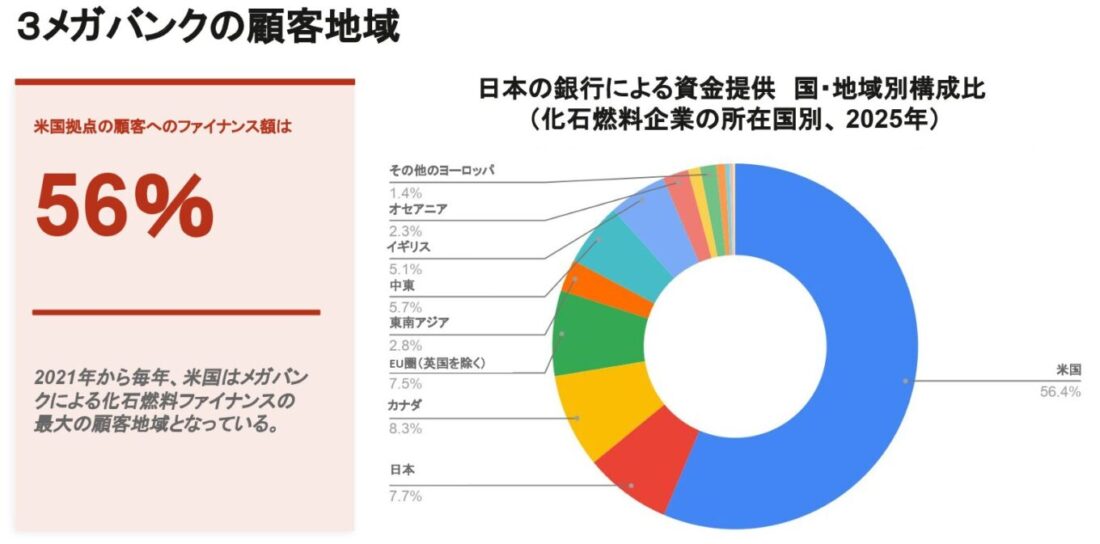
Reflecting the efforts of the Japanese government to diversify its LNG supply sources and its positioning of LNG as a transition fuel toward decarbonization, along with its ongoing infrastructure investments, the figures show an increase in funding for companies expanding their LNG operations. All three megabanks rank among the top 10 banks providing funding to clients undertaking large-scale LNG business expansions, but MUFG’s funding ($8.9 billion) stands out even among the top 10 (Mizuho: $5.6 billion, SMBC: $4.0 billion).
Amid the 2020s Energy Crises
This report points out that dependence on fossil fuels is one of the key elements of contributing to global instability. Amid the 2020s energy crises, some banks are further expanding their financing of fossil fuels instead of shifting toward financing cheaper and safer renewable energy options. Already, the increase in global electricity demand is being covered by renewable energy. Banks around the world, including Japanese megabanks, must immediately halt financing for the expansion of fossil fuels, scale back financing across all fossil fuel sectors, and increase funding for proven renewable energy.
Banking on Climate Chaos 2026
Report downroad page: Banking on Climate Chaos 2026
RAN PR: Global banks financed fossil fuels with $8.7 trillion since the Paris Agreement; $906 billion in 2025 alone; JPMorgan Chase, Bank of America, and MUFG are the world’s three worst funders
Written/Published by: Rainforest Action Network (RAN)
Published: June 8, 2026