Amid frequent natural disasters such as heat waves and floods, countries around the world are switching to and expanding renewable energy. This article introduces the current situation in China and the United Kingdom.
CHINA: Peak-out Coal?
Although China is the world’s largest emitter of carbon dioxide (CO2), it has been noted that its coal consumption and coal-fired electricity generation capacity may have reached their peak (a turning point toward decline). This is due to the rapid expansion of renewable energy, particularly solar power.
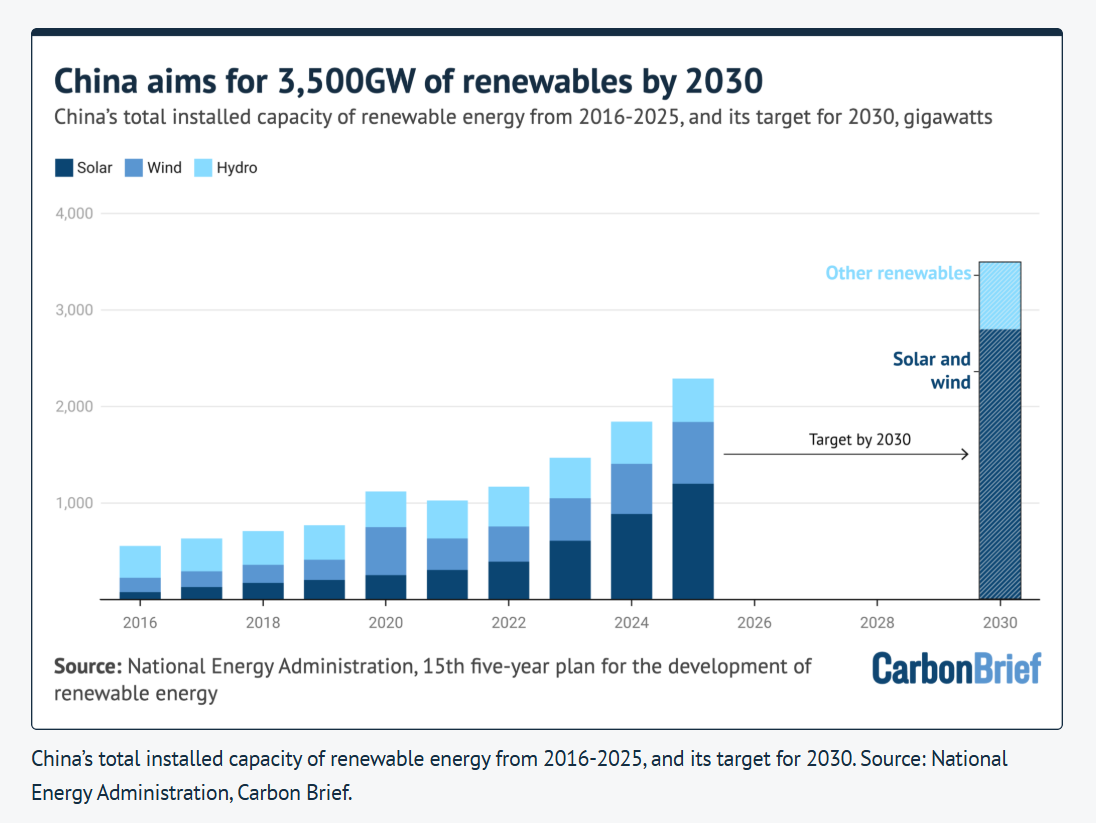
According to an announcement by the National Energy Administration (NEA), China’s total installed electricity generation capacity (the power generation capacity with 100% operation) reached 4.04 billion kilowatts (kW) in the first half of 2026, increasing 10.8% year-on-year. Of this total, solar power generation capacity accounted for 1.274 billion kW (up 15.8% year-on-year), while wind power generation capacity reached 679 million kW (up 18.5% year-on-year), bringing total renewable energy capacity to 2.455 billion kW (60.8% of all capacity). This exceeds the coal-fired power generation capacity of 1.275 billion kW (31.6%) during the same period.
Looking at actual electricity generation figures for the first half of 2026, coal-fired power accounted for 49.7% of China’s total electricity output, marking the first time its share has fallen below 50%, while the share of renewable energy rose steadily to 41.2%. This fact indicates that China has reached a new milestone in its transition toward a green and low-carbon energy system.
During the 14th Five-Year Plan period (2021–2025), China rapidly expanded solar power generation by upgrading technologies, such as PV conversion efficiency, and achieving rapid cost reductions. Furthermore, the “15th Five-Year Plan for Renewable Energy Development (2026–2030),” issued on July 23 by the National Development and Reform Commission (NDRC) and other agencies, notes that “China’s renewable energy sector will enter a new development stage featuring scale expansion, quality improvement, and reliable substitution” during this period. As a specific target for 2030, the plan calls for a total of 3.5 billion kW of renewable energy, of which 2.8 billion kW will be supplied by solar and wind power.
Although coal-fired power still accounts for nearly half (49.7%) of total electricity generation, the Chinese government emphasizes the development of renewable energy in its 15th Five-Year Plan and has set a target of about 3.5 billion kW in total installed capacity of renewable energy and roughly 6 trillion kilowatt-hours (kWh) in annual power generation by 2030.
China has made decarbonization a national goal and is accelerating its energy transition. Through its policy, the Chinese government shows that it places great importance on renewable energy as a key driver of economic and social decarbonization.
UK: Solar Power Generation Hits All-Time High
Solar power generation in the UK reached a new record over the summer of 2026. It rose by 23% compared to the same period in 2025.
Driven by rising temperatures across the country from June to August, and a prolonged period of record-breaking sunshine, electricity generation from solar power facilities (solar farms and rooftops) reached 8.8 terawatt-hours (TWh). In particular, solar energy generation in July reached 3.3 TWh, marking a new all-time high for a calendar month, and Carbon Brief estimates that it met 15% of overall electricity demand for the month. In July, solar energy provided 14.4% of all power generated, overperforming May’s record of 12.4%.
According to an announcement by the British government, solar installations have accelerated in every UK nation and English region since the start of 2026, with UK solar installations approaching 172,000 in 2026. For the first time, the government has unveiled a regional breakdown of Britain’s solar revolution, revealing which parts of the country are making the switch to clean power. Wales recorded the highest growth rate (18%) and contributed to an increase in installations across all regions.
By the close of 2025, solar accounted for one-third of the total renewable capacity, and solar generation is expected to increase further in 2026. Additionally, new statistics released by the UK government showed that renewables generated a record 52.5% of the UK’s electricity in 2025, demonstrating that renewable energy has become the backbone of the UK’s electricity system.
What is going on in Japan?
Amid ongoing geopolitical tensions, such as global conflicts and the closure of the Strait of Hormuz, and heightening energy security uncertainty worldwide, many countries are working on expanding renewable energy. The expansion of low-cost renewable energy helps reduce dependence on coal and natural gas, which are susceptible to price fluctuations. That is why renewable energy is growing steadily worldwide.
On the other hand, Japan continues to cling to fossil fuels, and the government is putting the brakes on the expansion of renewable energy. Isn’t Japan clearly falling behind the global trend?
The Share of Renewable Energy in Electricity Production by Country
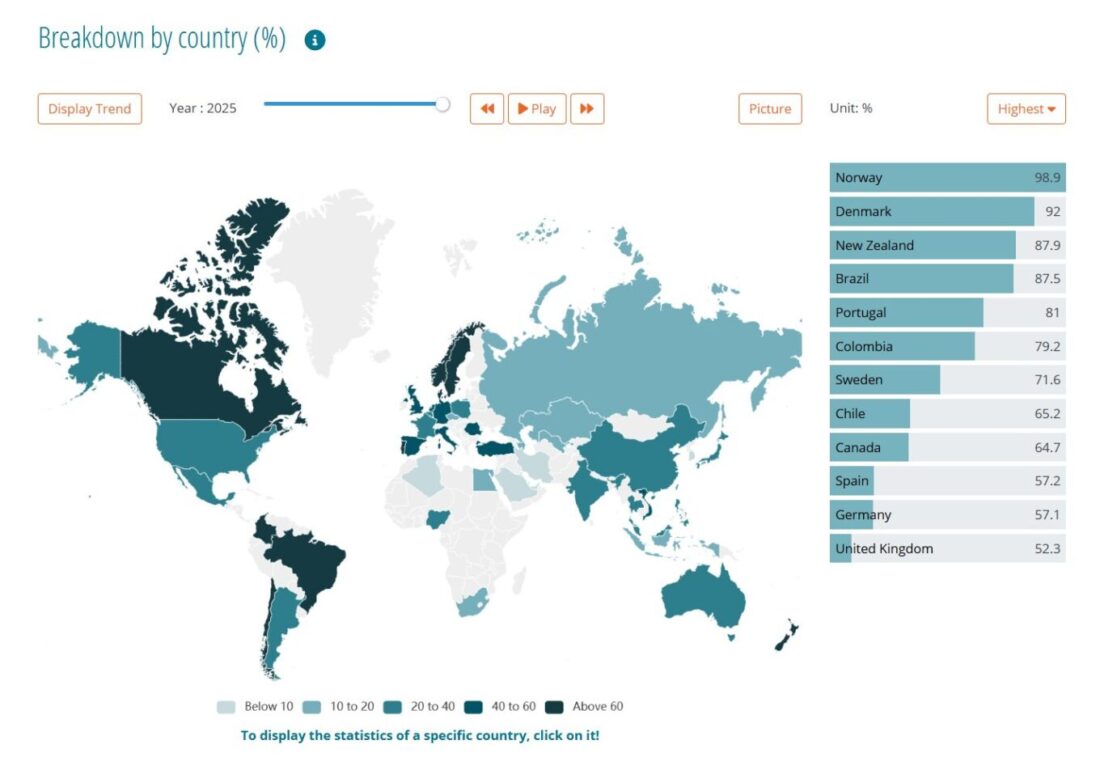
(On the website, you can see how the percentages have changed over time.)