
Renewable energy output curtailment is increasing nationwide. On March 1, 2026, such curtailment occurred in the Tokyo area as well. As renewable energy generation increases, there will naturally be times when it becomes necessary to curtail renewable energy output to ensure stability of the power grid. However, was it truly a situation that required curtailing renewable energy output?
This article, using the Tokyo area as an example, shows that while renewable energy output was being curtailed, operation of thermal power plants remained unrestricted.
Article summary
- Since the first renewable energy output curtailment in the Tokyo area on March 1, 2026, output curtailments of solar and wind power generation occurred frequently from March through May.
- In May 2026, nearly 6% of the total monthly solar power generation in the Tokyo area was curtailed.
- While renewable energy generation is increasing and nuclear power plants are operating, thermal power plants are failing to provide sufficient balancing capacity. As a result, renewable energy, which has no fuel costs, is being wasted nationwide.
- To reduce renewable energy output curtailment, the electricity system should incorporate a policy prioritizing the use of renewable energy combined with battery storage.
Renewable energy output curtailment finally begins in the Tokyo area
The first renewable energy output curtailment in Japan occurred in the Kyushu region in 2018. Subsequently, power companies in each region also began implementing output curtailment of renewable energy; Shikoku, Tohoku, and Chugoku (from April 2022), Hokkaido (from May 2022), Okinawa (from January 2023), Chubu and Hokuriku (from April 2023), and Kansai (from June 2023). Only the Tokyo area was unaffected.
Output curtailment was first implemented in the Tokyo area on March 1 this year, which triggered frequent output curtailments of solar and wind power from March through May. While most curtailments took place on weekends, the volume of curtailment increased in May, leading to its implementation on weekdays as well.
The table below shows the dates and times when output curtailment was actually implemented, the time when the maximum surplus occurred, the amount (MW) of solar and wind power curtailed during those time periods, and the total amount curtailed on each day.
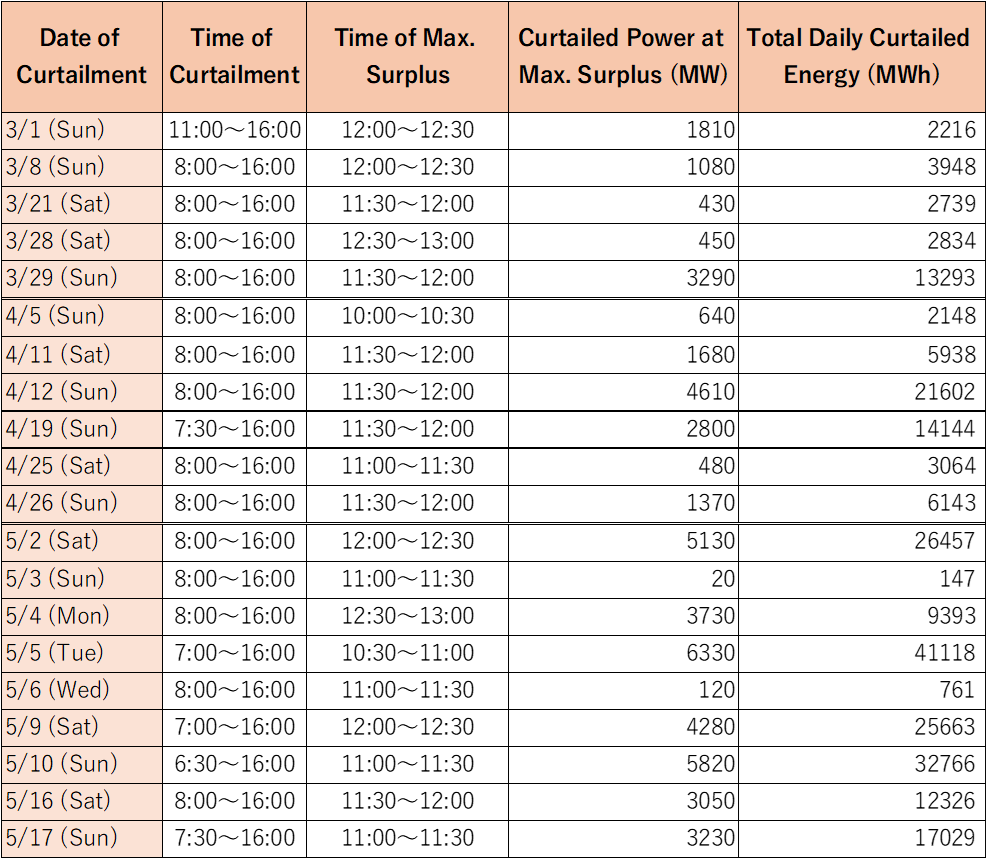
The highest 30-minute curtailment of solar and wind power generation occurred on Tuesday, May 5, 2026, at 6,330 MW. On that day, the amount of renewable energy output equivalent to the output of more than six large-scale thermal power plants was curtailed.
Furthermore, throughout May 2026, a massive solar power output of 165,670 MWh was curtailed. This means that nearly 6% of the total monthly solar power generation was wasted.
Thermal power fails to function as a balancing source and increases nuclear power plant output
The Organization for Cross-regional Coordination of Transmission Operators (OCCTO) reviewed the output curtailment from March to May and concluded that “instructions of output curtailment of renewable energy power generation were issued because a lack of downward adjustment capability was anticipated, and deemed appropriate.”
However, our review of the data showed thermal power plants operating at a significant level while renewable energy output was being curtailed. Using data from May 5, the day with the largest curtailment, as an example, we will provide an overview of the supply and demand situation on that day.
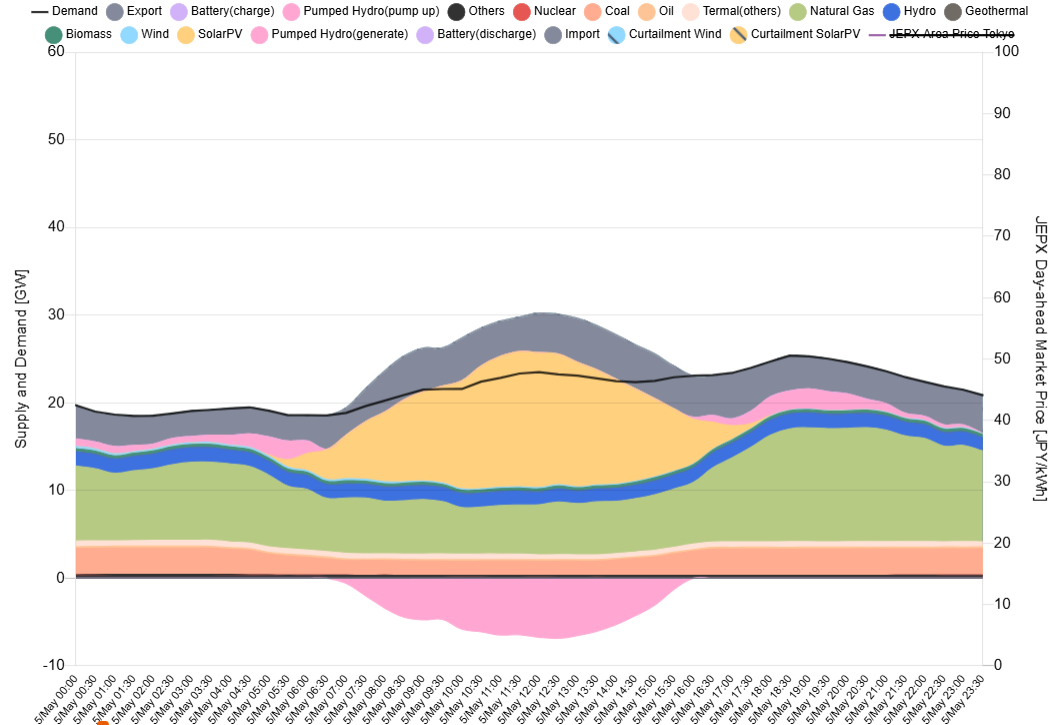
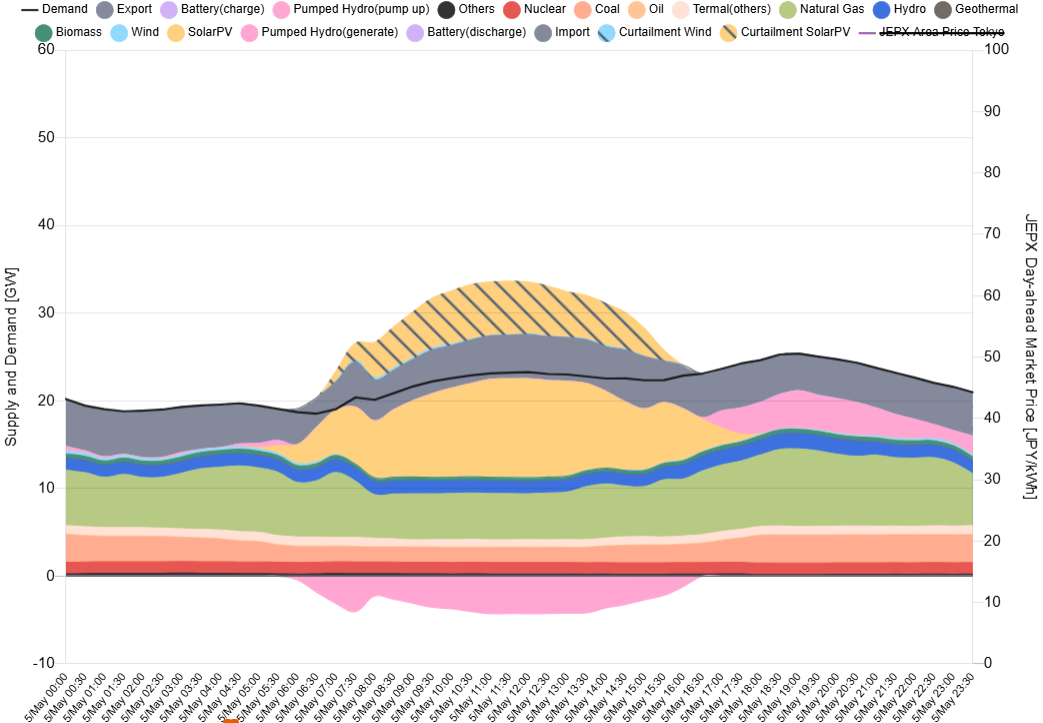
Renewable Energy Institute Power Supply & Demand Chart
The left figure is from May 5, 2025, and the right figure is from May 5, 2026.
In the right figure (2026), the yellow-striped section at the top represents solar power output curtailment, and directly below it, the light blue-striped section represents wind power output curtailment. When comparing the output on May 5 in 2025 (left) and 2026 (right), it is clear that solar power output curtailment has increased significantly in 2026. Why has it increased so much?
The table below shows the supply amount for each power source between 10:30 AM and 11:00 AM on May 5 of each respective year, when output curtailment was at its highest. (Colors correspond to the chart above.)

The first point is that the restart of the Kashiwazaki-Kariwa Nuclear Power Plant on May 5, 2026 added 1,310 MW to nuclear generation capacity. The second point is that LNG and coal thermal power plants operate at roughly the same level as last year. If LNG and coal-fired power plants were truly serving as the “balancing capacity” claimed by the government, output curtailment of renewable energy could have been significantly reduced. Wind power was barely able to contribute to the grid at all due to output curtailment.
This illustrates the current reality where nuclear and thermal power are prioritized over renewable energies.
Fuel cost-free renewable energy is curtailed while costly thermal power plants operate
Let’s focus on thermal power and take a closer look at which specific thermal power plants were operating that day.
The charts below show how thermal power plants in various regions were operating on May 5, 2026.
【Coal-fired power】
In the Tokyo area, five coal-fired power units were in operation on May 5. The figure below shows that four units operated at reduced capacity during the daytime, while Kashima Power (50% owned by Nippon Steel and 50% by J-POWER) maintained stable operation.
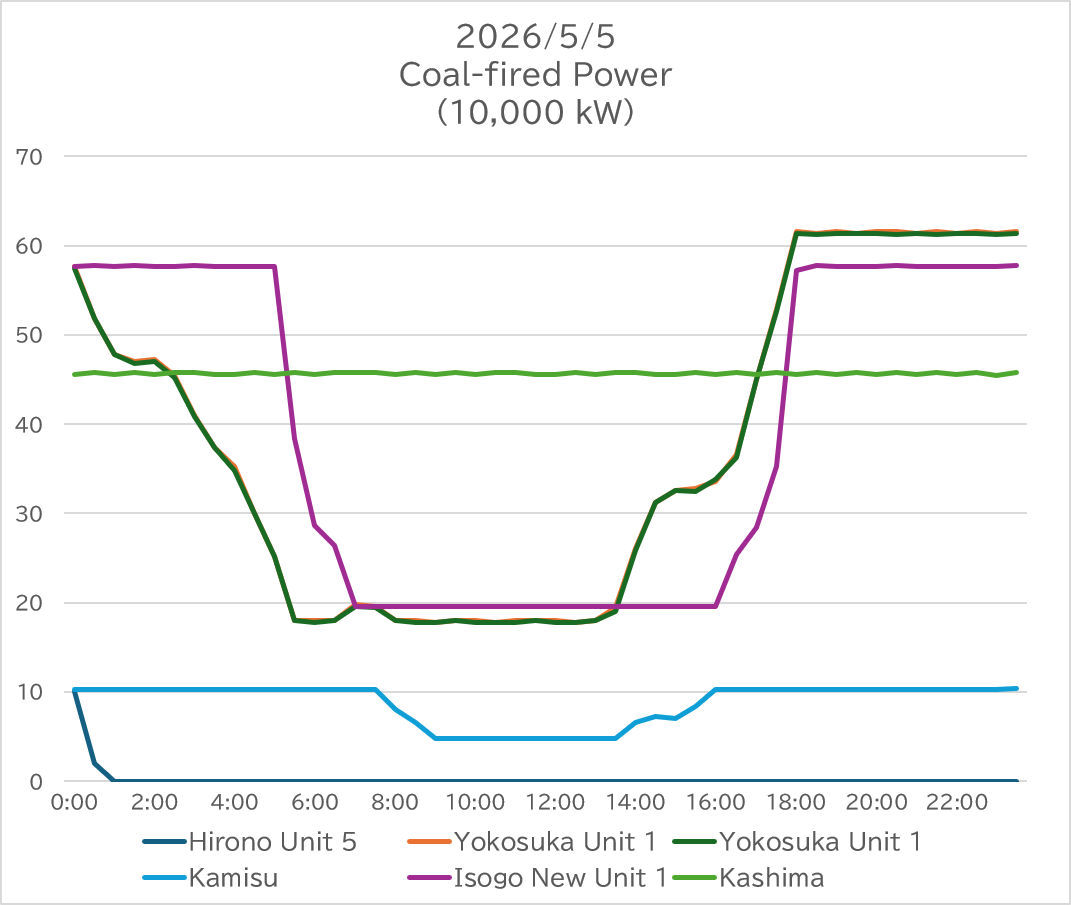
“Power Generation Performance by Unit”
【LNG-fired power】
In the Tokyo area, 19 units (in terms of the number of shafts, there are 24) were operating on May 5. Only four had significantly reduced their daytime operations: Chiba 1-1 and 2-3, Kawasaki LNG 1, and Kashima 7-2.
It is clear that no other power plants made adjustments to their outputs to prioritize renewable energy and prevent its waste. Some power plants even operated at a constant rate. All LNG-fired power plants operating on May 5 in the Tokyo area, except the Moka Power Plant (operated by Kobelco Power Moka), are operated by JERA.
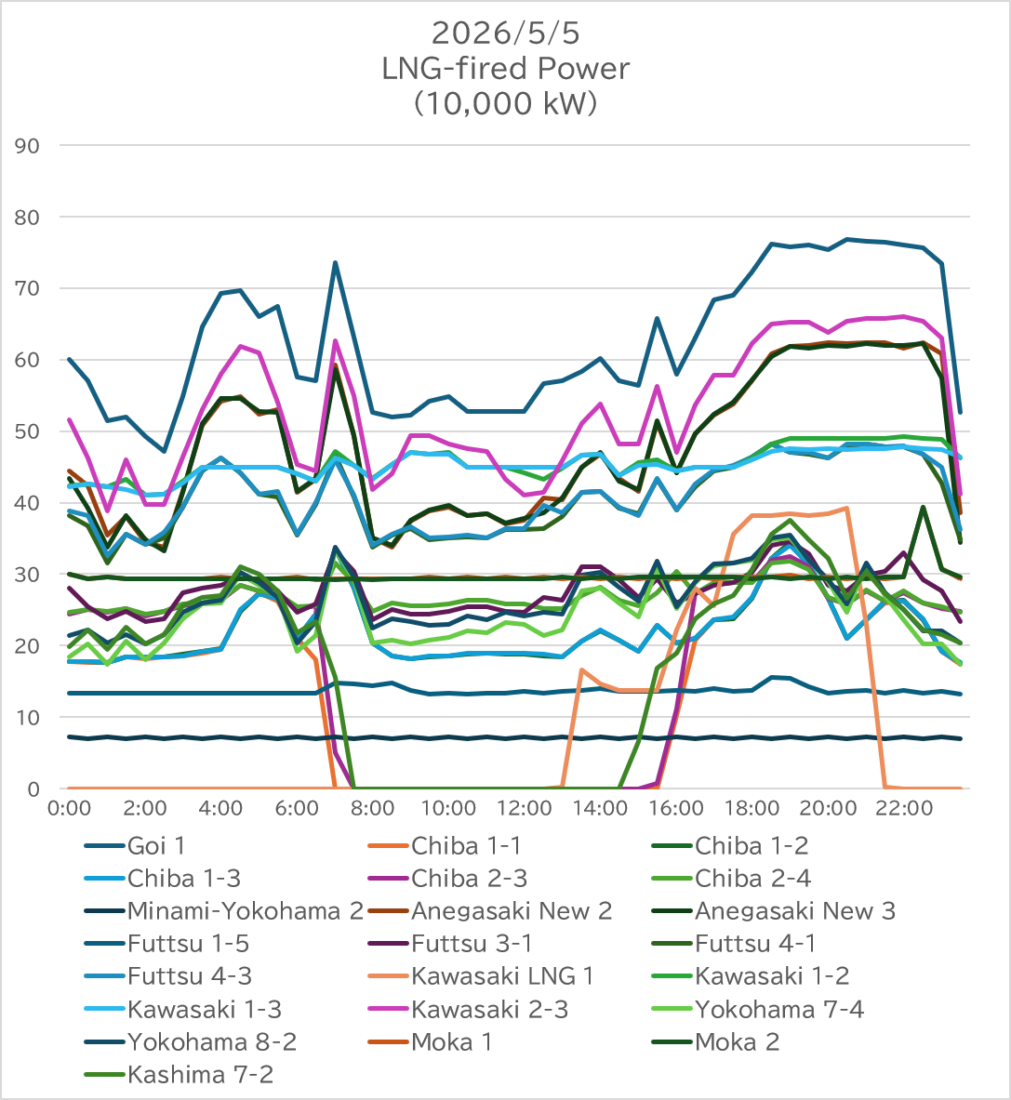
“Power Generation Performances by Unit”
With fossil fuel prices on the rise, why is renewable energy, which incurs no fuel cost, being curtailed, while thermal power plants are operating at roughly the same level as last year? Furthermore, was it necessary to start operating nuclear power plants, where there is such a surplus of renewable energy?
It is possible that thermal power plants were operated at a certain level under long-term contracts. Even in that case, given the condition where renewable energy output is being curtailed, clear rules are needed even within the bilateral contracts. Unlike in European countries, in Japan, there is no compensation provided for renewable energy output curtailment.
This is because the policy of prioritizing renewable energy has not been firmly established within the electric policy framework. The Institute for Sustainable Energy Policies (ISEP) published a report (only available on the website in Japanese) to address and summarize this issue.
As long as thermal and nuclear power plants are prioritized in terms of policy and operational practices, the curtailment of renewable energy output will not decrease. In fact, this situation risks undermining the incentive to develop new renewable energy projects.
While this article focuses on the Tokyo area (primarily within the Tokyo Electric Power Company’s service area), the Tokyo area was the last region where output curtailment began. Regions such as Kyushu, where output curtailment began earlier, are experiencing an even greater amount of renewable energy being curtailed. Immediate action is necessary.
Although the notion that “renewable energy is unstable” and “thermal power is necessary to balance renewable energy” remains strong in Japan, a game-changer has now emerged: battery storage. Renewable energy combined with battery storage not only provides a stable power supply, but has also become more cost-effective than thermal power.
Japan should reform its policies to prioritize flexible operations that rely on renewable energy combined with battery storage over fossil fuel-fired power, which exacerbates climate change and increases geopolitical risks. Doing so would bring us one step closer to an economically rational society that leverages electricity from renewable energy with no fuel costs.
References
TEPCO: Renewable Energy Output Control Outlook (in Japanese)
TEPCO Power Grid: Regional Supply & Demand Performance Data (in Japanese)
OCCTO: Verification Results Regarding Output Curtailment of Renewable Energy Power Generation Facilities (in Japanese) (May data)