| Key Points |
|---|
| 1. The most common method currently used to produce large quantities of ammonia generates large volumes of CO₂ emissions. 2. Ammonia co-firing prolongs the life of coal-fired power plants and locks in CO₂ emissions for decades. 3. If ammonia is produced overseas, CO₂ is emitted not only during manufacturing but also during transportation (import). |
The Japanese government, electric utilities, and other actors are promoting the co-firing of hydrogen and ammonia at coal-fired power plants, with the eventual aim of converting these plants to dedicated hydrogen or ammonia firing. The current plan is to achieve 20% ammonia co-firing at coal-fired power plants by 2030 and move toward 100% ammonia firing by 2050. But can this really be considered an effective climate measure?
What are hydrogen and ammonia fuels?
Hydrogen (H₂) and ammonia (NH₃) contain no carbon and therefore do not emit CO₂ when burned. For this reason, power generation using these fuels is sometimes described as “Zero-Emission Thermal Power.” At present, however, most hydrogen and ammonia are produced from fossil fuels such as coal, oil, and natural gas, resulting in large volumes of CO₂ emissions during production. Hydrogen and ammonia are sometimes classified by color according to how they are produced. The only genuinely CO₂-free and environmentally sustainable method is to produce hydrogen by using renewable electricity to electrolyze water.
Hydrogen and ammonia imported from overseas
Japan’s Sixth Strategic Energy Plan promotes the use of hydrogen and ammonia as fuels as part of its efforts to achieve “carbon neutrality.” However, the hydrogen and ammonia supply chains currently under consideration would rely on fossil fuels produced overseas, including in Southeast Asia, Australia and the Middle East. As long as these fuels are produced from fossil fuels, they will emit CO₂ in their lifecycle. They also do not provide a solution from the standpoint of energy security or help raise Japan’s energy self-sufficiency rate.
Ammonia production
Ammonia has a pungent odor and is toxic. In Japan, it is legally designated as a deleterious substance. Approximately 200 million tonnes of ammonia are consumed worldwide each year, around 80% of this amount being for use as agricultural fertilizer. The dominant industrial production method uses the Haber–Bosch process, in which hydrogen and nitrogen react under high temperature and pressure in the presence of a catalyst. Since energy derived from burning fossil fuels is used to produce fuel ammonia, this results in significant CO₂ emissions.
Japan consumed approximately 1.08 million tonnes of ammonia in 2019. If ammonia co-firing at coal-fired power plants is expanded domestically, an estimated 20 million tonnes would be required for 20% co-firing, while approximately 100 million tonnes would be needed for 100% ammonia firing. Producing and transporting such quantities would require enormous amounts of energy.
If the fuel ammonia is produced outside Japan, the associated emissions are not counted as part of Japan’s national CO₂ emissions. However, increasing emissions overseas in order to achieve supposed “zero emissions” in Japan defeats the purpose of climate action.

Large emissions during production mean only about a 4% reduction vs coal
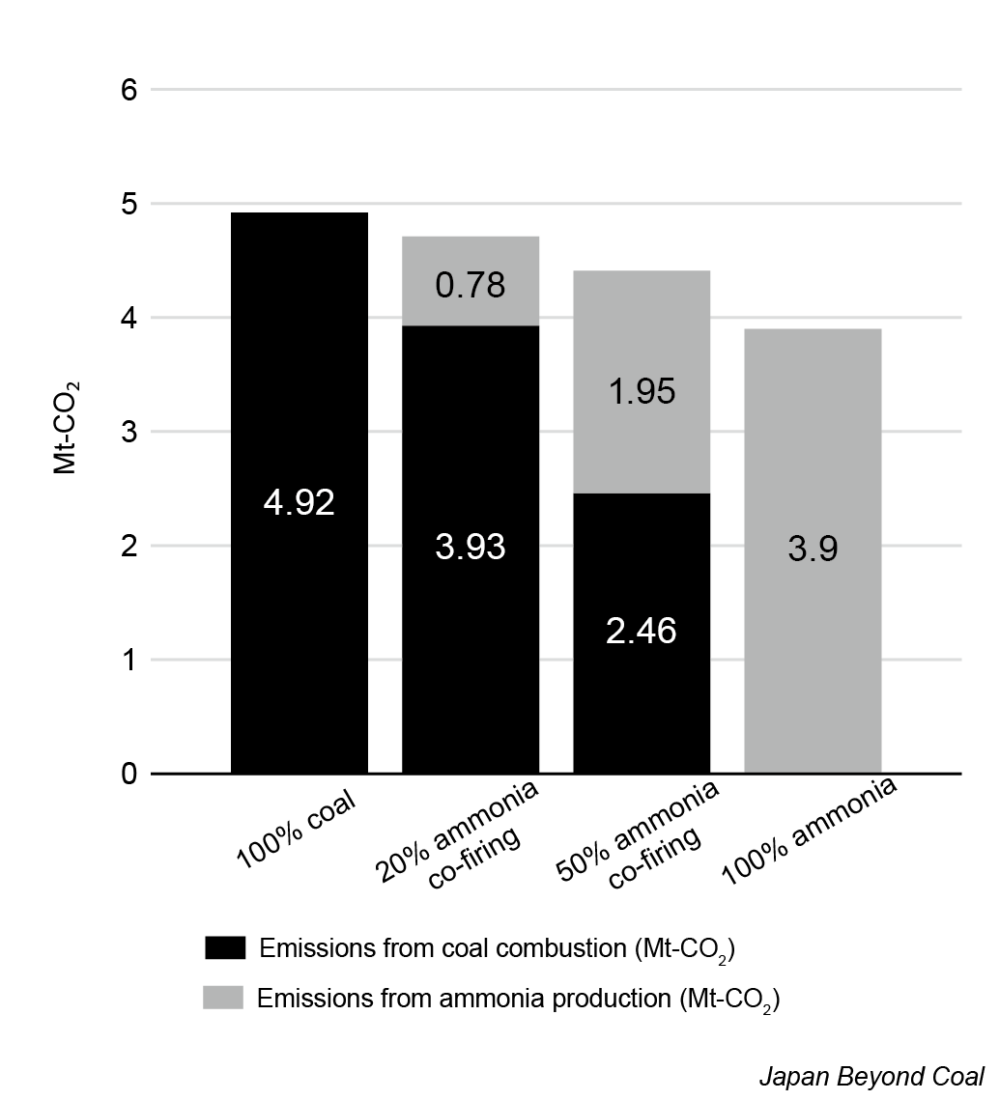
The Japanese government claims that co-firing 20% ammonia at a coal-fired power plant reduces CO₂ emissions by 20%. However, this calculation does not take into account the CO₂ emitted during the production of hydrogen or ammonia. The government’s approach does not distinguish between different currently-used production pathways for either fuel. As a result, grey hydrogen and grey ammonia are also eligible for government support and promotion.
According to estimates by Kiko Network, if ammonia is co-fired at a 20% ratio in a coal-fired power plant, the overall reduction from the original coal-fired generation is only about 4% once CO₂ emissions from ammonia production are included.
Even 20% co-firing could triple total fuel costs
Source: TransitionZero
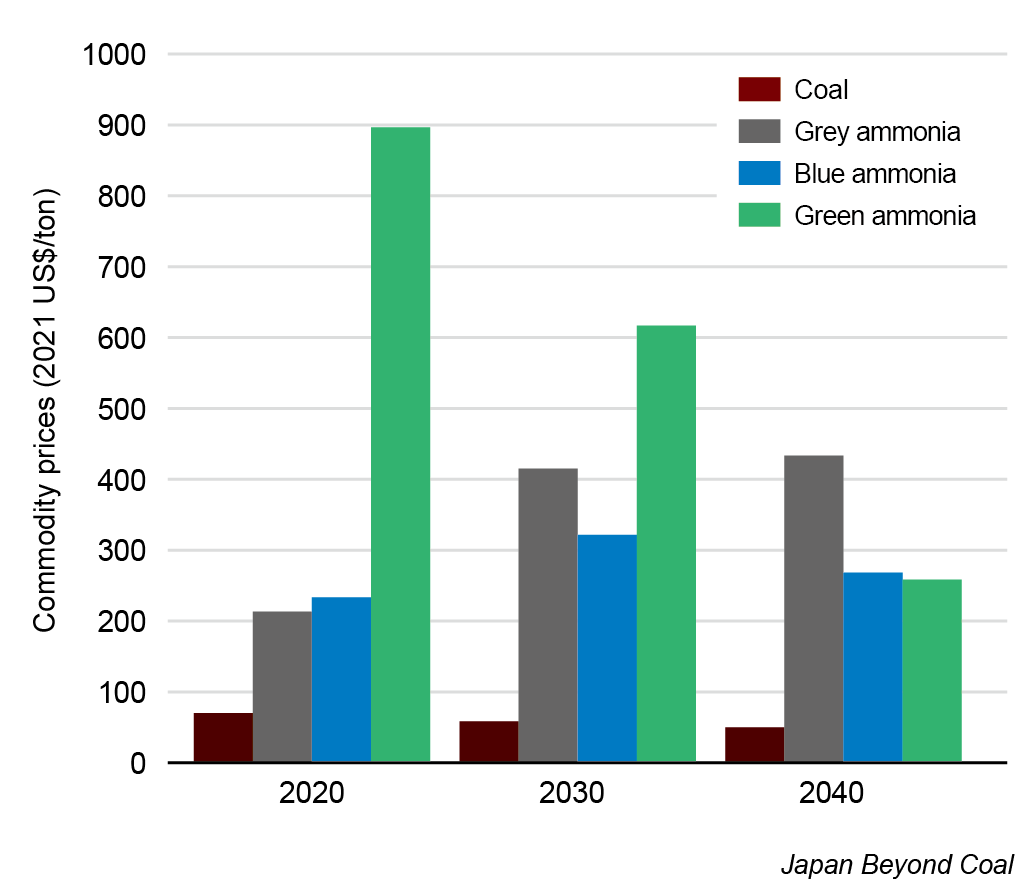
Hydrogen and ammonia are extremely expensive, even when produced through grey, fossil-fuel-based pathways. According to a report published by the UK think tank TransitionZero, the fuel cost of 20% grey ammonia co-firing in 2030 would be twice that of coal. For 20% green ammonia co-firing, the cost would be 15 times higher. By 2030 and 2040, rising fuel prices on an energy-equivalent basis could mean that total fuel costs for 20% ammonia co-firing are three times those of coal. If the carbon price rises to US$205 per tonne of CO₂, the cost could become prohibitively high by 2040. These costs would ultimately be passed on through higher electricity prices. The government aims to make hydrogen and ammonia cost-competitive, but their prices cannot fall below the cost of the fossil fuels used as feedstocks.
Prolonging coal power and accelerating climate change
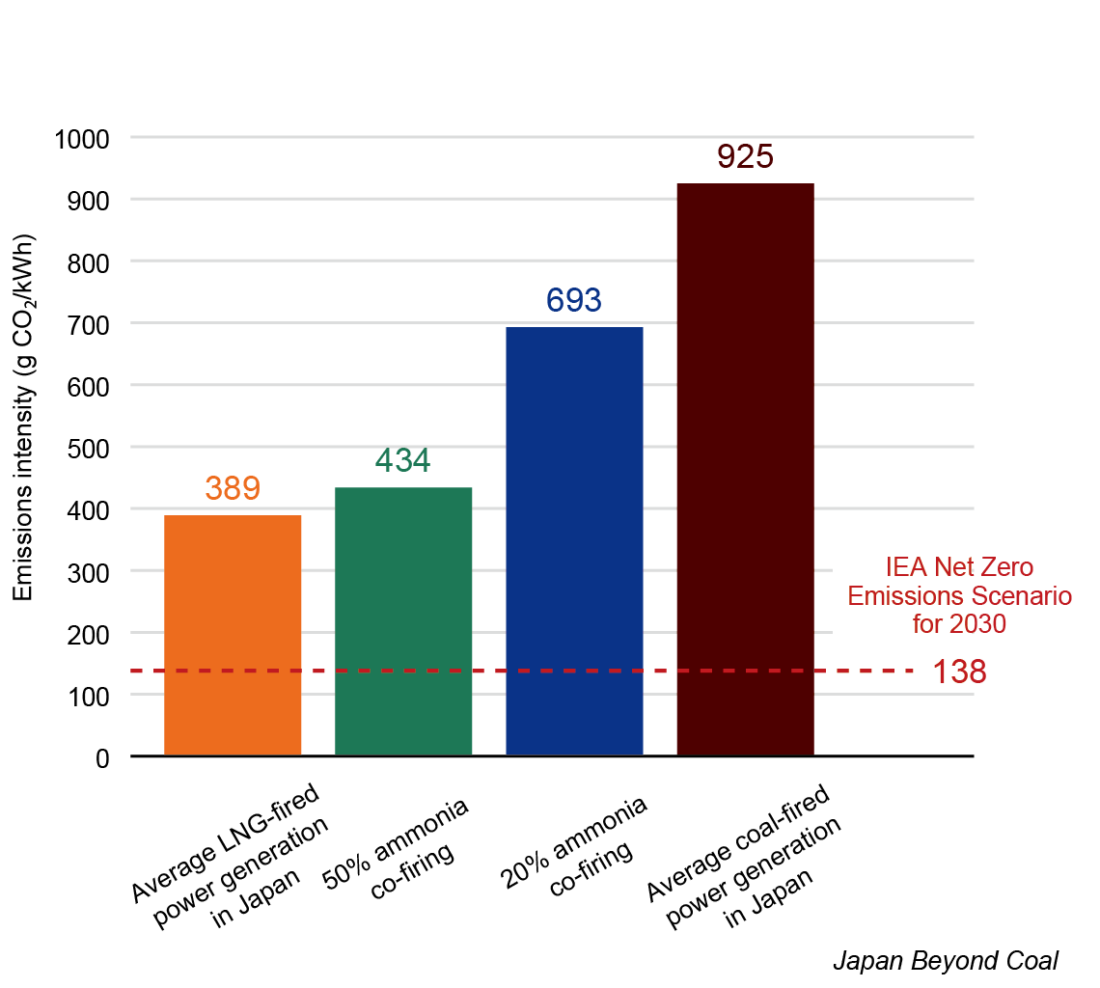
The level of greenhouse gas emissions reductions considered consistent with the 1.5°C goal for Japan is a 62% reduction from 2013 levels by 2030. Hydrogen and ammonia cannot deliver this level of reduction. Ammonia co-firing achieves virtually no meaningful reduction in CO₂ emissions, while extending the operating lives of coal-fired power plants and allowing them to continue emitting large volumes of CO₂.
Source: TransitionZero
This is also clear from the government’s ammonia fuel roadmap. Under the International Energy Agency’s Net Zero Emissions Scenario, the emissions intensity of electricity generation consistent with the 1.5°C goal falls to 138 g CO₂/kWh by 2030. By contrast, a coal-fired power plant co-firing 20% ammonia would have an emissions intensity of 693 g CO₂/kWh, far above the level required. Ultimately, this remains coal-fired power. Unless Japan ends coal-fired power generation by 2030, it will be too late to implement climate measures consistent with the 1.5°C goal.
Published August 2022
The original Japanese version is in PDF.