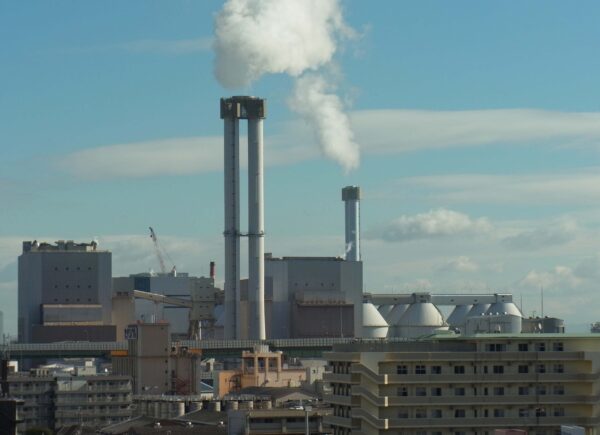
In May 2026, Kobe Steel announced that it had won the bid in the long-term decarbonization power source auction (LTDA) for a plan to retrofit the coal-fired Kobe Power Plant No.1 unit, operated by its wholly owned subsidiary Kobelco Power Kobe, to incorporate 20% ammonia co-firing. However, this same project has already won a bid before, in the FY2023 Auction.
Re-bidding on a previously withdrawn project
Winning bidders in the LTDA are guaranteed to receive capacity revenue to cover fixed costs such as construction and renovation expenses for a period of 20 years in principle. Kobe Power Plant No.1 and 2 units had already won bids in the initial auction in FY2023. However, the company subsequently withdrew its bid for the No.1 unit alone and then re-bid in the auction in FY2025, winning the bid once again.
A trick that made re-bidding possible
Behind this perplexing phenomenon lies the existence of an institutional disclaimer. According to Denki Shimbun’s article on May 18, three companies*, including Kobelco Power Kobe, which owns and operates the Kobe Power Plant, had withdrawn their winning bids prior to the auction in FY2025. All three reportedly planned to retrofit their existing thermal power plants for hydrogen/ammonia co-firing. Normally, withdrawing after winning a bid incurs severe penalties, but under specific conditions, such as the application of the hydrogen/ammonia supply chain support system being undetermined, the penalties are exceptionally waived. Taking advantage of this rule that can be described as a “loophole,” two of the three companies that withdrew from the bidding earlier, successfully re-bid in this latest auction for the same project and won. However, Kobe Steel is the only company to win the bid with an identical proposal.
*Apart from Kobelco Power Kobe, the other two winning bidders were Shikoku Electric Power Company’s Saijo Power Station and CEF H2 Co.’s Miike Power Station, with the latter successfully re-bidding in this auction. While the Miike Power Station was originally planned for hydrogen co-firing, in the third auction (in FY2025) it was replanned for dedicated hydrogen monofiring.
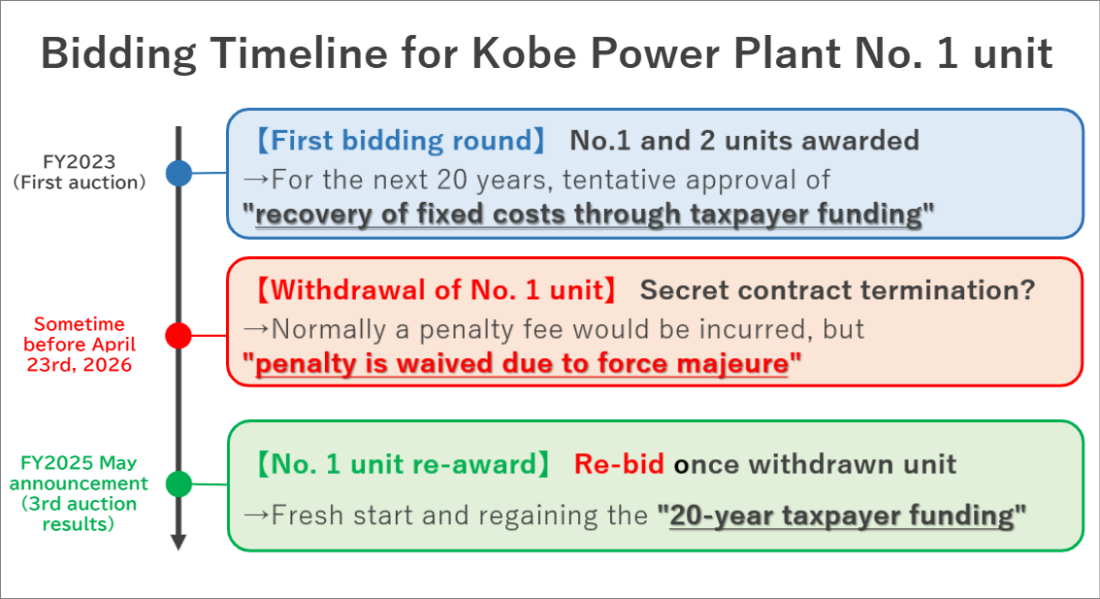
Normally, if a company withdraws a project after winning a bid, it incurs substantial penalties (breach-of-contract fees). However, the rules include a disclaimer that explains that in the case of unavoidable circumstances beyond the company’s control that are recognized, the company is permitted to withdraw without penalty.
According to the auction guidelines (in Japanese), the rule states the following:
“If within three years after concluding a contract following a successful bid in this auction, it is not determined that the project will receive support from both or either of the desired support systems* […] and the project exits the market due to said reason, it will be treated as a force majeure event, and no market withdrawal penalty will be imposed.” (Tentative translation of the excerpt from the capacity market long-term decarbonization power source auction guidelines)
*Here, “both support systems” refers to “price gap support system” or the “hub infrastructure development support system.”
Re-bidding to aim for more favorable conditions
There is a lingering suspicion that Kobe Steel used this mechanism to essentially “reset” the contract for No.1 unit, aiming to re-bid under more favorable conditions or at a more convenient time.
To reiterate, the long-term decarbonized support system is a mechanism in which the government guarantees the recovery of fixed costs (such as construction, maintenance, etc.) for power plants for a period of 20 years, with the aim of encouraging new investments in decarbonized power sources and retrofits of existing ones. These resources are funded by the “public burden,” costs that are included as “transmission fees” in the electricity bills paid by ordinary consumers. In other words, it creates a structure where consumers are burdened with a 20-year long-term loan for decarbonization projects endorsed by the government.
In principle, accelerating decarbonization efforts in energy should encourage a transition to an energy system centered on renewable energy and storage batteries. However, LTDA heavily favors co-firing measures in thermal power plants, making it difficult to ignore the drastic disconnect between the name of the system and its reality.
In this auction, the total bidding capacity nationwide was 10.856 GW, and the successful bid capacity was 7.299 GW. Out of this, Kobelco Power Kobe’s Kobe Power Plant No.1 unit was awarded 131 MW. Although the retrofit is intended for transitioning to next-generation fuels, mixing only 20% of ammonia into coal means that the remaining 80% will still be coal. Furthermore, Kobe Steel has not clearly disclosed the reason why it withdrew the initial bid for No.1 unit. Despite this, the fact that a project intended to prolong the life of coal-fired power generation was re-bid on through an opaque process after being once withdrawn and the subsequent 20-year public burden cannot be overlooked.
Reference
Organization for Cross-regional Coordination of Transmission Operators: Results of the 3rd long-term decarbonization power source auction in FY2025, announced May 13, 2026 (in Japanese).