On April 23, Shikoku Electric Power Company announced that it would withdraw its successful bid for the Saijo Power Station Unit1 (500 MW output), a coal-fired power plant, in the FY2024 Long-term Decarbonization Power Source Auction (LTDA, detailed below). This power plant was planned to co-fire ammonia with its primary fuel, coal, and was expected to receive 20 years of financial support through the LTDA. The company explained the reason for the withdrawal as the low likelihood of the development of the ammonia supply chain proceeding as originally planned.
▼Shikoku Electric Power Company’s PR (available only in Japanese) https://www.yonden.co.jp/notice/__icsFiles/afieldfile/2026/04/23/20260423.pdf
While the LTDA claims that it is to promote decarbonization, its function is to invest in thermal power plants, providing 20 years of support for projects such as LNG-fired power plants and ammonia co-firing. The funding comes from capacity contributions paid by retail electricity providers, which originally come from consumers’ electricity bills. The LTDA also covers fuel and operational expenses (variable costs) for thermal power, including ammonia co-firing thermal power, and it is designed to compensate for the effects of inflation and exchange rate fluctuation.
What kind of plan was it? Ammonia co-firing at the Saijo Power Station
The Saijo Power Station Unit 1 began operation in June 2023 and currently uses coal as its primary fuel, co-firing with woody biomass and sewage sludge. Shikoku Electric Power had won a bid for 94.6 MW, planning to retrofit the Saijo Power Plant Unit 1 for 20% ammonia co-firing starting in the 2030s. As shown in the upper part of the diagram below, Shikoku Electric Power plans to begin retrofitting Unit1 for 20% ammonia co-firing starting in the 2020s (2026-2030).
In the 2030s, the company aims to begin 20% co-firing operations using blue ammonia for the time being, with the goal of eventually achieving 50% co-firing in the later 2030s. This roadmap anticipates that the company will participate in long-term decarbonized power auctions in the early 2030s and 2040s.
Decarbonization roadmap of Saijo Power Station Unit 1
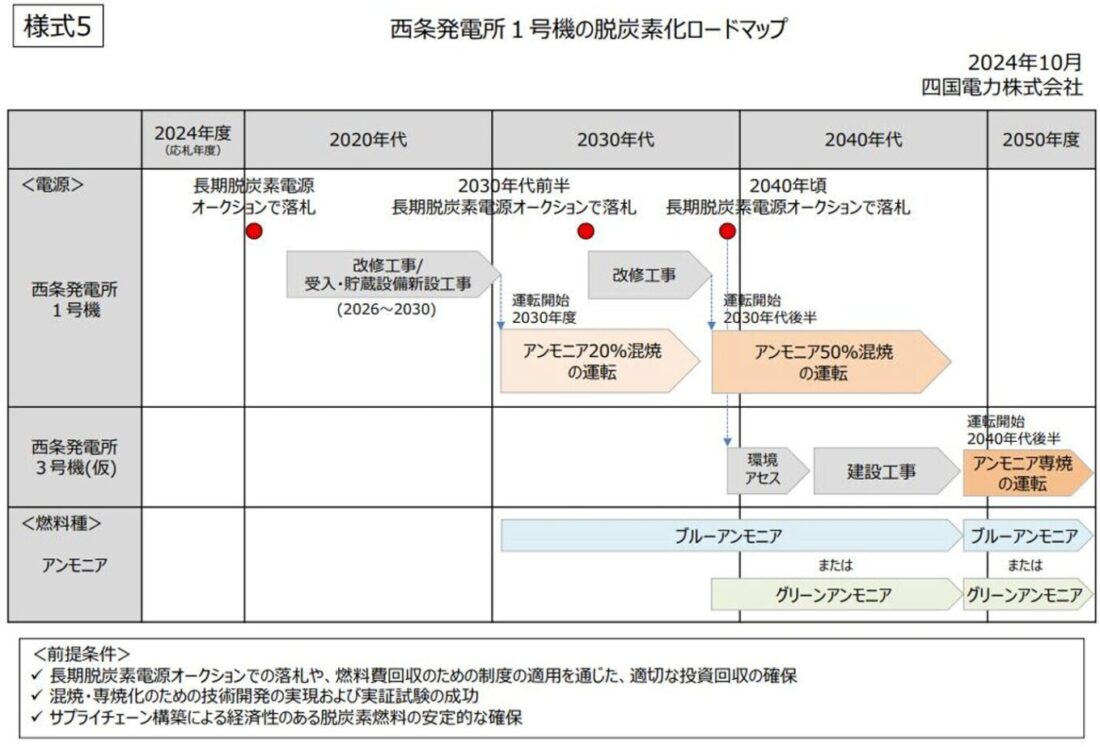
The withdrawal of this bid indicates challenges in the feasibility of the plan. Specifically, it is thought that the plant was unable to meet the “prerequisite” of “securing stable supply of economically viable decarbonized fuel through supply chain development” indicated as one of the footnotes of the roadmap above.
As a general rule, power sources that have been successfully bid on in the LTDA are not permitted bid withdrawal. Although it appears that a reasonable justification was accepted in this case, it remains unclear whether financial penalties will be imposed. Shikoku Electric Power Company withdrew its successful bid awarded in the LTDA for this time, it is unclear whether it will completely abandon the ammonia co-firing plan at the Saijo Power Station Unit 1 in the future.
Challenges in ammonia procurement exposed
Shikoku Electric Power Company has not disclosed details regarding the reasons preventing the supply chain development from progressing as planned.
Originally, Shikoku Electric Power Company, alongside Taiyo Oil, Taiyo Nippon Sanso, Mazda, Mitsubishi Corporation, Namikata Terminal Co., and Mitsubishi Corporation Clean Energy, aimed to establish the Namikata Terminal in Imabari City, Ehime Prefecture, as an ammonia hub. Among these companies, Mazda had planned to convert its inhouse coal-fires power plant to ammonia mono-firing and transport ammonia from the Namikata Terminal via domestic shipping to fuel it. However, in September 2025, Mazda announced that it had abandoned its plan to switch to an ammonia-fired power plant and would instead transition to a gas cogeneration system.
It is thought that the Namikata Terminal anticipated Shikoku Electric Power Company and Mazda becoming big ammonia consumers, and had requested support for the development of an ammonia hub under the Hydrogen Society Promotion Act. However, this support has not yet been secured.
Overview of the Hydrogen and Ammonia Introduction
and Utilization Council Based at Namikata Terminal
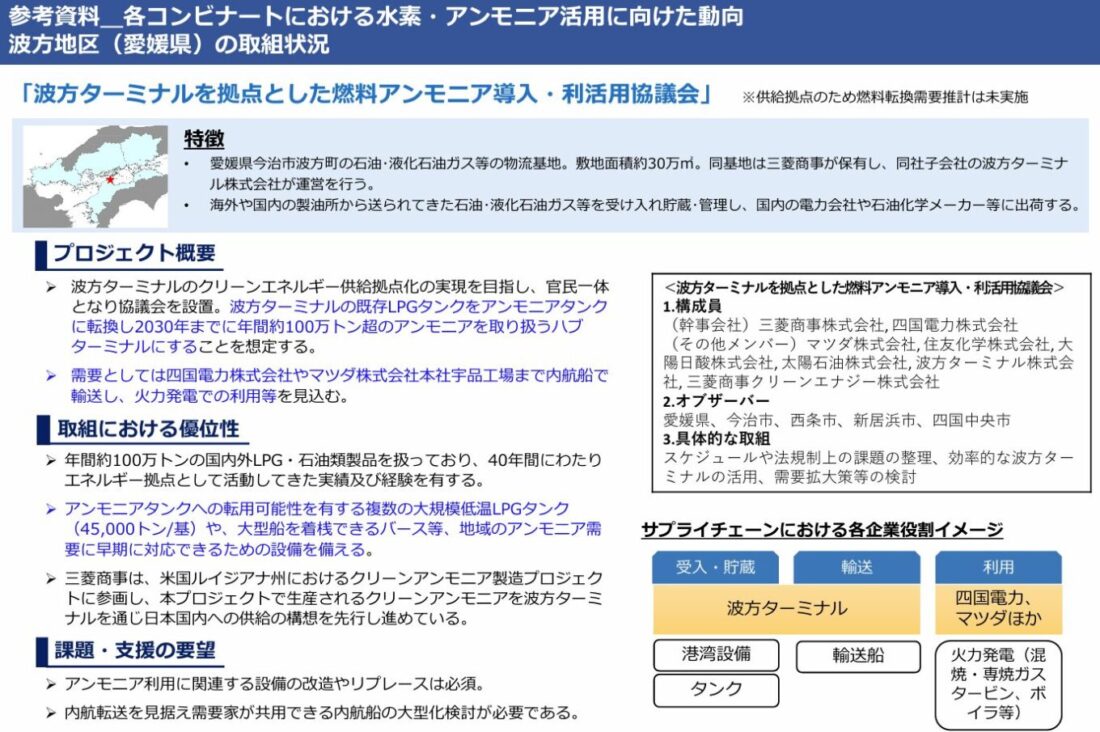
The news of Saijo Power Station’s withdrawal of a successful bid from the LTDA and Mazda’s abandonment of its ammonia mono-firing project highlight the difficulty of procuring ammonia fuel for thermal power plants. Saijo Power Station Unit 1 has a generating capacity of 500 MW, and a 20% co-firing rate would require approximately 250,000 tons of ammonia annually. This represents about a quarter of the current domestic ammonia demand in Japan (just over 1 Mt).
Given the high cost of ammonia and considering the corporate economic rationality of those projects, it is possible that other projects that have won bids to retrofit for ammonia co-firing might follow Saijo Power Station and withdraw from their bids in the future. This withdrawal has revealed how heavily the supply chain affects “decarbonization” fuels for thermal power generation.
Furthermore, as both domestic and international environmental NGOs have repeatedly pointed out, ammonia co-firing merely replaces a portion of the primary fuel, coal, with ammonia, and is not a technology that fundamentally reduces lifecycle greenhouse gas (GHG) emissions. On the contrary, it is problematic that by promoting “ammonia co-firing,” making it easier to extend the operational lifespan of coal-fired power plants while claiming to be working toward decarbonization. Even from an investor’s perspective, it is reasonable to withdraw from investing based on the logic of climate change countermeasures.
Summary: Stop supporting thermal power through the LTDA
This time, the withdrawal of Saijo Power Station Unit 1 from the LTDA prevented money from being diverted toward extending the lifespan of the thermal power plant. However, many thermal power plants are still awarded winning bids, and retrofits of LNG and coal-fired power plants will likely continue to be eligible for the LTDA for some time. While claiming “decarbonization,” the LTDA has become a mechanism that diverts large amounts of funds into thermal power, and its existence needs to be fundamentally re-evaluated.
The difficulties of ammonia co-firing, including the establishment of the supply chain, are becoming increasingly clear in various ways. We should immediately cease the practice of using ammonia coal-firing as a pretext to prolong the life of coal-fired power plants and instead consider mechanisms that redirect funds toward technologies with established GHG reduction effects, such as energy conservation and renewable energy.
Reference
List of projects being successfully bid on in the LTDA. (FY2025) (in Japanese)
Related Articles
【News】Mazda canceled “Ammonia Mono-firing Power Plant” Plan (Japan Beyond Coal)