
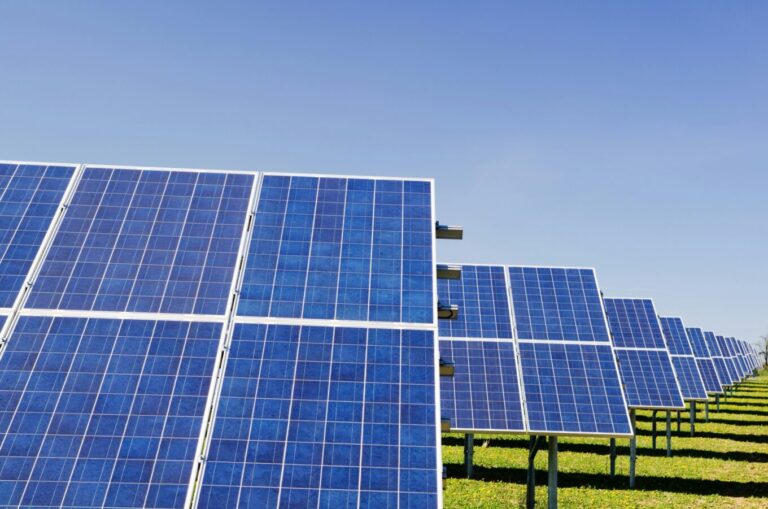
The expansion of renewable energy is accelerating worldwide. China has long relied on coal and argued that coal is indispensable for energy security like Japan, but the country is approaching a major turning point.
China’s rapid expansion of solar capacity outstrips coal
Recently released data shows solar capacity in China is on track to overtake coal in 2026. Coal capacity is expected to climb to around 1,333 gigawatts (GW) by the end of 2026. By comparison, solar capacity is expected to reach approximately 1,200 GW by the end of 2025, increasing at an average annual rate of 270 GW over the past three years. Since 2015, utility -scale solar capacity in China has surged by 1,554%. The solar share in China’s total capacity has expanded from 2.4% in 2015 to 18.3% in 2025. Consequently, the share of coal-fired power of the overall generation mix has fallen from 64% in 2015 to a record low of 42.7% share last year.
Furthermore, according to data from Global Energy Monitor, China is expected to have 1,494 GW of “clean power” in operation by 2025, which exceeds the 1,420 GW capacity by fossil fuels (coal, gas, and other fossil fuels). Already, 51% share of China’s energy fleet is derived from “clean energy*,” indicating that the country joins major economies that are primarily powered by clean energy, following Brazil, France, and Germany.
*Clean energy includes wind, solar, hydro, and bioenergy, as well as nuclear power.
The trend of expanding renewable energy is spreading to local regions as well. Even in Shanxi Province, which is rich in coal resources and has long played a key role in energy supply through thermal power generation, renewable energy is on the rise. It has been reported that by 2025, the installed renewable capacity has surpassed coal and renewable energy has become the largest source of electricity in the province.
Renewable energy is steadily increasing in worldwide
The growth in renewable energy is also clear in the report “Electricity 2026” released by the International Energy Agency (IEA) on February 6. According to the IEA, driven by the rapid expansion of renewable energy worldwide and significant cost reductions, renewable capacity is expected to rise by roughly 1,050 terawatt-hours (TWh) each year. More than 600 TWh on average is set to come from solar PV alone annually by 2030, and renewable energy and nuclear power together are expected to account for more than half of the generation mix in 2030 (increasing from 42% in 2025 to 51% in 2030). In contrast, coal is projected to gradually decline, falling from 34% in 2025 to 27% in 2030.
The IEA forecasts that global electricity demand will increase at a brisk average annual rate of 3.6% over the five-year period from 2026 to 2030. The IEA also reports world-wide electricity demand rising to 33,600 TWh in 2030, with renewables supplying about 16,000 TWh. This trend suggests that the “Age of Electricity” predicted by the IEA is indeed beginning to take shape. Renewables such as solar and wind power surpassed the one-third threshold in 2025, putting it on par with coal-fired power.
The expansion of renewables in China contributes to reducing CO2 emissions
While coal is the cornerstone of China’s energy sector, the country’s transformation into the world’s largest solar market demonstrates the cost and scale advantages of renewable energy. At least in China, the growth of renewables is outpacing the growth in electricity demand, and this trend is pushing the share of fossil fuels down and leading to CO2 emission reduction. According to an analysis by the Center for Research on Energy and Clean Air (CREA) commissioned by Carbon Brief, China’s CO2 emissions in 2025 declined 0.3% compared to the previous year. This is the first decline since 2022, when economic activity was stagnant due to the COVID-19 pandemic. While it has been pointed out that China must reduce its carbon intensity by approximately 23% over the next five years to meet the Paris Agreement targets, the country aims to peak out CO2 emissions by 2030. It is noteworthy that emissions, which had remained flat since 2023, began to decline in 2025.
China’s coal demand decline is affecting global coal trade volumes
Although China produces coal domestically, it also imports coal from countries such as Russia, Indonesia, and Australia to meet domestic demand. China consumes over 4 billion tons of coal annually, accounting for more than 50% of the entire world’s coal consumption. According to the National Bureau of Statistics, raw coal production from January to December 2025 was 4.83 billion tons, a 1.2% increase from the previous year and a record high. Coal imports in 2025 (including both sea and land transport) totaled 490.27 million tons, down 9.6% year-on-year, due to a slowdown in domestic coal-fired power generation.
According to Clarksons Research, a leading British firm which provides maritime and shipping research services, global coal seaborne coal trade fell 4% from the previous year stood at 1.33 billion tons, due to a combination of declining demands in major coal-importing countries, including China, and Indonesia’s policy-driven restrictions on coal exports. In Europe and OECD member countries, the growth of renewable energy is expected to lead to a decline in coal-fired power and, consequently, a reduction in coal demand. Coal trade volumes have remained resilient thus far, but coal demand is projected to decline further in the future as renewable energy continues to grow globally.
Although there is uncertainty about China’s coal demand, the country’s renewable energy sector is expected to expand continuously. Given that thermal power generation is unlikely to increase again in 2026, some experts believe that the upward trend in global CO2 emissions is reaching a turning point.
Japan, which continues to rely on thermal power, is lagging far behind.
Reference
- Carbon Brief : Analysis: China’s CO2 emissions have now been ‘flat or falling’ for 21 months
- Global Energy Monitor : Explore data in the Global Integrated Power Tracker
- Global Energy Monitor and CREA: Built to peak : Coal power expansion runs out of room in China
- IEA : Electricity 2026