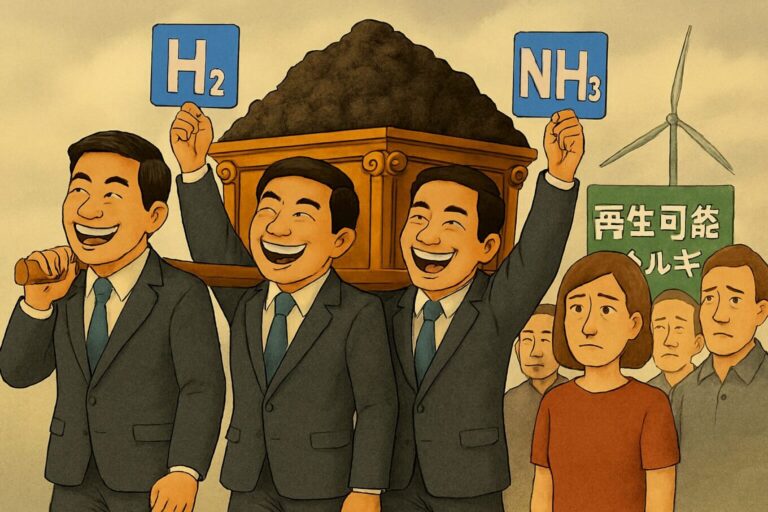
On December 19, 2025, the Hydrogen Society Promotion Act clarified that the price differential support system for hydrogen and ammonia (hydrogen derivatives) would, for the first time, provide support for co-firing ammonia at two coal-fired power plants. The Hydrogen Society Promotion Act is designed to promote the supply and use of “low-carbon hydrogen and hydrogen derivatives” with low CO2 emissions aiming at the transition toward a decarbonized society. This time, under the price differential support system established by that Act, the power generation sector—specifically coal-fired power plants, which should be phased out—will receive support.
※To read more info about the price differential support system, please see here.
Ammonia co-firing in coal-fired power plants is noted to be extremely costly and to have little practical greenhouse gas reduction effect, or may even worsen climate change. The table below shows outlines and issues of the two ammonia co-firing projects that will receive support.
Two projects based on ammonia co-firing in coal-fired power plants
| Certified operators and suppliers | Outlie of project | Amount of ammonia | Term |
| JERAToyota InsdustriesAGCNGK InsulatorsAISIN FukuChubu Electric Power Mirai | JERA will supply low-carbon ammonia produced in Louisiana, USA to JapanMost of those ammonia will be used for ammonia co-firing at JERA’s Hekinan Thermal Power StationSome will be used as fuel for industrial furnaces at Toyota Industries, AGC, NGK Insulators, and AISIN Fukui. | 492,144 tons/year | Feb. 2030 – Jan. 2055 |
| MITSUI & COHokkaido Electric Power (HOKUDEN)Mitsubishi UBE CementTosoh | Mitsui & Co. will supply low-carbon ammonia produced in Louisiana, USA, transport to japanMost of those ammonia will be used for ammonia co-firing at HOKUDEN’s Tomato-Atsuma Power StationSome will be used as fuel for industrial furnaces at Mitsubishi UBE Cement and as raw material for Tosoh. | 280,000 tons/year | Jan. 2031 – Dec. 2055 |
Low-carbon ammonia produced in Louisiana, USA (Blue Point Project) will be shipped by vessel to Japan and co-fired at JERA’s Hekinan Thermal Power Station (Hekinan City, Aichi Prefecture) and Hokkaido Electric Power’s Tomato-Atsuma Power Station (Atsuma-cho, Yufutsu District, Hokkaido).
At JERA’s Hekinan Thermal Power Station, Unit 4 is scheduled to start operations in FY2027, and Unit 5 starting in FY2029. At Hokkaido Electric Power’s Tomato-Atsuma Power Station Unit 4 is scheduled to start operation in FY2030. All of them are planning to start co-firing 20% ammonia in FY2030.
- Loadmap of ammonia co-firing at Hekinan Thermal Power Station Unit4, Unit 5 (written in Japanese)
- and at Tomato-Atsuma Power Station Unit 4 (written in Japanese)
Ammonia production for these two projects will be carried out at the “Blue Point” in Louisiana, USA, funded by CF Industries, JERA, and Mitsui & Co. According to the CF Industries website, the ammonia produced at this site will be derived from natural gas, and more than 95% of the CO2 generated in the ammonia production process will be captured and stored (CCS). This means that ammonia is “blue ammonia,” not green ammonia produced from renewable energy. Production is scheduled to start in 2029, but will it really be possible to produce “low-carbon” ammonia?
There are multiple problems with the government support for ammonia co-firing as we described below.
Problem 1: Even “low-carbon ammonia” has small GHG reduction effects
While blue ammonia production emits large amounts of CO₂, currently available commercial technologies to capture CO2 (carbon capture and storage = CCS) require significant energy, and capture rates are estimated at only 60-70%. Furthermore, when considering lifecycle emissions, calculations indicate that co-firing low-carbon ammonia yields low emission reduction effects. (Figure below)
Criticism is mounting that co-firing low-carbon ammonia appear to achieve reductions but are actually designed to prolong the life of coal-fired power plants.
Figure:Emission reduction percentage with co-firing ”low-carbon ammonia” (carbon intensity lower than 0.87kg-CO₂/kg-NH₃)
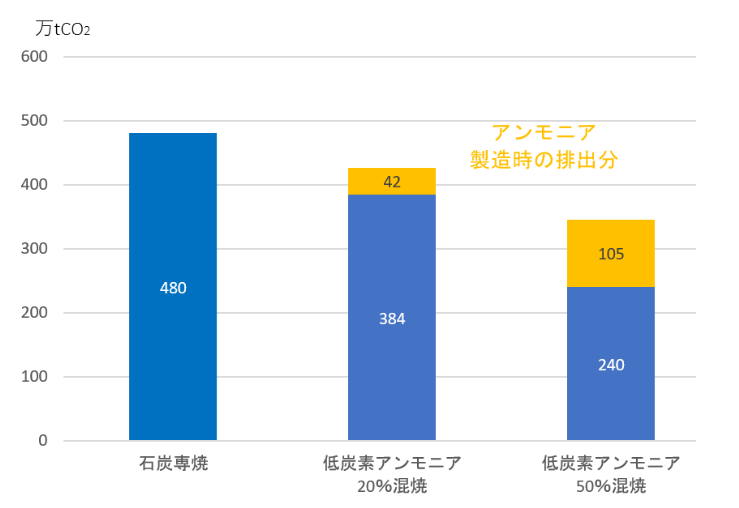
It is clear that “ammonia co-firing with coal-fired power” cannot be a true emissions reduction measure. Rather, it is increasingly criticized both domestically and internationally as a measure designed to prolong the life of coal-fired power plants.
Problem 2: Is it possible to capture 95% CO2 as the premise of “low-carbon ammonia” production?
As mentioned earlier, the Blue Point project plans to capture CO2 (CCS) emitted during ammonia production. *2 To meet the “low-carbon” requirement, over 95% of CO2 must be captured. However, according to IEEFA, no existing CCS project has consistently captured more than 80%. Clearing this high hurdle is considered extremely difficult.
At a minimum, operators should conservatively estimate the CO2 capture rate for CCS projects and then calculate the carbon intensity. Furthermore, operators should submit all of their emission data honestly.
Problem 3: Problems at ammonia production sites
CF Industries, which handles ammonia production in Louisiana, has been identified as the largest emitter of toxic substances (primarily ammonia) into the atmosphere in the United States. Ascension Parish, Louisiana, where the ammonia is produced, ranks among the top 10 most polluted areas in the U.S. Residents facing health concerns are voicing worries about further pollution. On November 5, 2025, an explosion occurred at the company’s ammonia plant in Mississippi, raising concerns about its manufacturing management and response to the local community. Can partnering with such a troubled company be considered a commitment to “clean” energy?
Problem 4: Cost concerns—Relying on multiple subsidies, yet profitability of ammonia co-firing remains unknown
The cost of ammonia co-firing is another major issue. Regardless of the method, ammonia production incurs significant cost. Even with multiple subsidy support, it does not appear economically viable. According to the report written by Asia Research & Engagement (ARE), fuel costs exceed revenues for both 20% and 50% blue ammonia co-firing scenarios. Since the price difference support system alone cannot fully offset these high fuel costs. The ammonia cofiring at previously mentioned two coal-fired power plants will be also supported through the “Long-Term Decarbonization Power Source Auction” mechanism.
Ammonia co-firing cannot be achieved without subsidies by the government. Furthermore, ammonia prices have remained higher than the government’s initial predictions. This means it is impossible to predict the level of actual support required over the 15-year period for the price differential subsidy. If business operators want to utilize systems aimed at decarbonization, it is necessary to explicitly state the underlying premise of “low carbon” (disclosing carbon intensity) and verify cost-effectiveness.
Even to do so, continuing to support ammonia co-firing through the price differential support system and long-term decarbonized power source auctions is difficult to say as it is cost-effective when considering the cost-benefit performance of emission reduction measures.
South Korea is reviewing its support for ammonia co-firing and many countries in the world advance coal power phase-out
South Korea has begun reviewing its support for ammonia co-firing. It had planned to support ammonia co-firing within its Clean Hydrogen Portfolio Standards (CHPS) bidding process; however it has announced it is considering excluding ammonia co-firing from the second round of CHPS bidding. Discontinuing support for ammonia co-firing, which prolongs the life of coal-fired power plants, aligns with the new administration’s policy to phase out coal-fired power by 2040.
In addition, South Korea clearly demonstrated its stance on phasing out coal-fired power at the 2025 United Nations Climate Change Conference in Brazil (COP30). Countries around the world continue their efforts to shut down their coal-fired power plants. Japan should follow South Korea’s lead, revise the price differential support system under the Hydrogen Society Promotion Act not to support ammonia co-firing with coal for power generation, and advance the coal phase-out.
Will Japan plan to keep using coal-fired power plants until 2055?
In July 2025, the International Court of Justice (ICJ) issued its Advisory Opinion on the “Obligations of States in respect of Climate Change.” In it, the ICJ stated that when states engage in activities such as “fossil fuel production, fossil fuel consumption, the granting of fossil fuel exploration licences
or the provision of fossil fuel subsidies producing,” may constitute an internationally wrongful act which is attributable to that State.
Looking at the project outlines approved this time, the duration of these two plans can be extended until 2055. Do operators intend to keep coal-fired power plants operational until then? In light of the ICJ’s advisory opinion, supporting thermal power generation through co-firing hydrogen or ammonia derived from natural gas carries a significant risk of constituting a wrongful act under international law.
Considering these points, the price differential support system under the Hydrogen Society Promotion Act should be reviewed as soon as possible.
Footnote
*1 CO2 emitted from overseas shipping, liquefaction, storage and other processes for ammonia production is not included in the graph. When ammonia is transported from Louisiana, USA, significant additional CO2 emissions are expected.
*2 The CCS project for low-carbon ammonia production is planned to be implemented at Pelican Hub (on the Gulf Coast) operated by Louisiana-based company 1PointFive. However, this project has recently reached the final investment decision stage and is not operational yet. The operator claims 95% CO2 capture efficiency, but as noted in the source, it remains unclear whether the figure of 95% can be guaranteed or not.
Reference
- Kiko Network [Position Paper] Position paper on fuel ammonia: Japan’s “Zero Emissions” thermal power will extend the life of coal and accelerate climate change
- Kiko Network [Briefing Paper] Japan’s Ammonia Co-firing Plans Threaten Paris Goals
- CF Industries:Blue Point Complex(Link)