On February 16, 2026, the Japan Organization for Metals and Energy Security (JOGMEC) announced its decision to award a grant to JERA under the “Price Gap Support Scheme.”
This scheme is designed to compensate for the price gap between a “base-price,” which covers the cost of production of low-carbon hydrogen, and a “reference-cost,” such as the import price for exiting fossil fuels, enabling low-carbon hydrogen suppliers certified by the Minister of Economy, Trade and Industry (METI) to maintain continuous supply in accordance with their business plans.
JERA is promoting a plan to establish a supply network by FY2029 to supply low-carbon ammonia produced in Louisiana, USA, for Hekinan Thermal Power Station (Hekinan City, Aichi Prefecture) serving as the receiving hub.
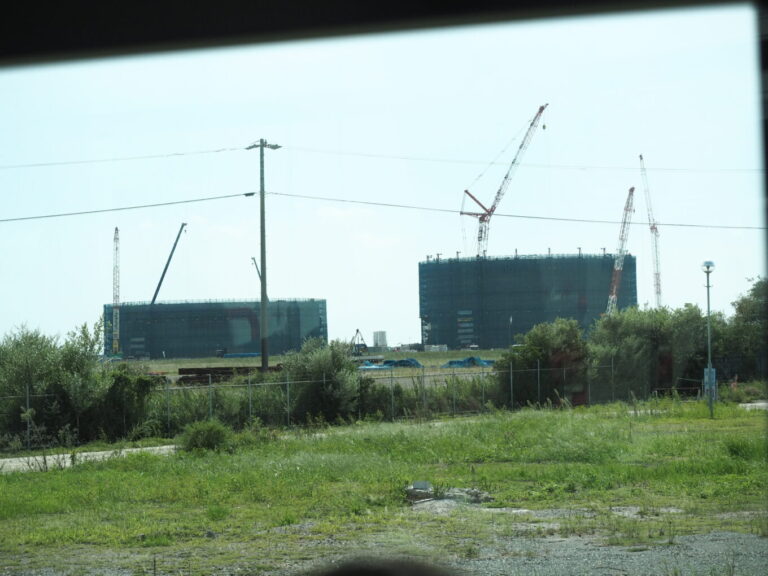
Hekinan Thermal Power Station is one of Japan’s largest coal-fired power plants, and construction of ammonia storage tanks on the site is already underway. In January 2026, JERA unveiled the progress of the construction to the press. The plan is to build four cylindrical tanks, each approximately 60 meters in diameter and 40 meters in height. The tanks will have a combined storage capacity of 160,000 tons of liquid ammonia. Commercial operation with -20% ammonia co-firing with coal (heat value ratio) – is targeted for FY2029, followed by the retrofitting of Unit 5, with the long-term goal of achieving a 50% co-firing. If both Units 4 and 5 operate with a 20% co-firing, it is estimated that approximately 1 million tons of ammonia will be required annually.
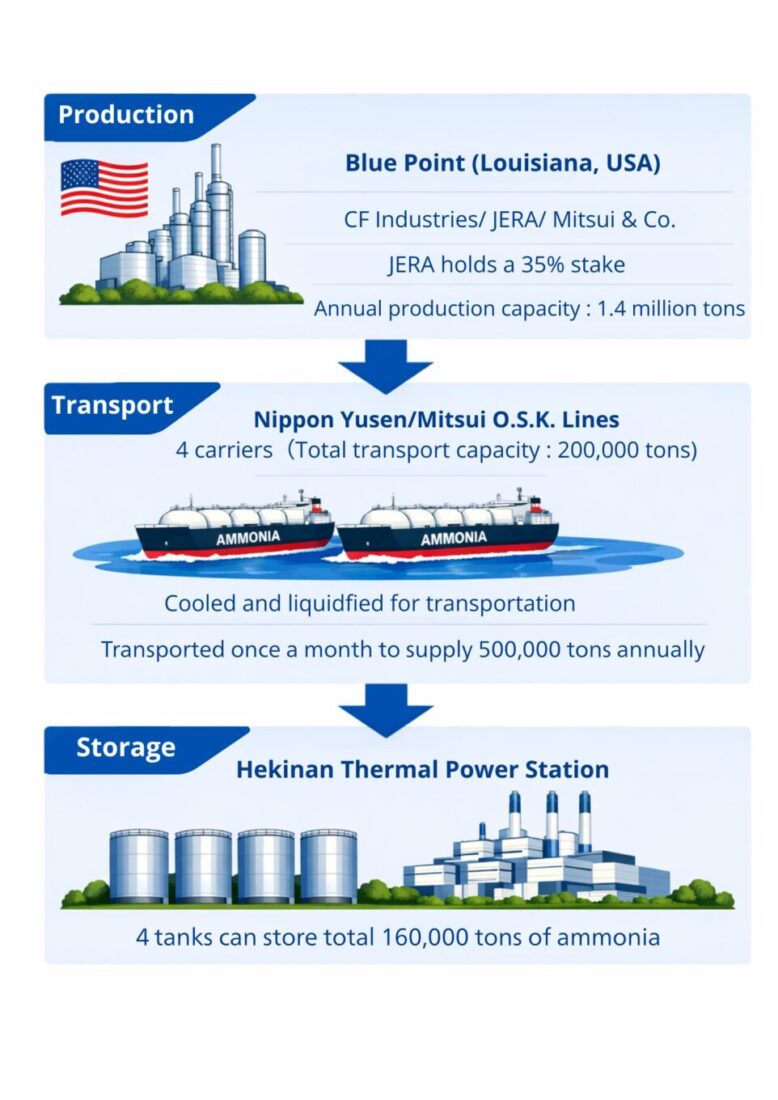
JERA is moving forward with plans to produce blue ammonia at the “Blue Point” in Louisiana, USA (JERA invests in this low-carbon ammonia project) from natural gas as a feedstock, capture and store (CCS) the CO2 emitted during production, liquefy the resulting blue ammonia, and transport it to Japan. Since the costs of producing and transporting ammonia are extremely high, the purchase price will be significantly higher than that of coal or LNG. For example, as of February 2026, US-produced blue ammonia was priced at $685 per ton (CFR USGC). Not only is there a high risk that prices will rise if demand increases in the future, but the outlook for cost reductions remains uncertain.
Given those circumstances, schemes such as price gap support are deemed necessary. JERA may want to sell blue ammonia as a “high-value-added” feedstock or fuel at a higher price than conventional ammonia or fossil fuels. However, electricity generated by co-firing 20% blue ammonia with 80% coal is by no means “decarbonized” electricity.
In the first place, the technology for co-firing ammonia was developed and demonstrated with generous support from the New Energy and Industrial Technology Development Organization (NEDO), which is one of the largest public management organizations promoting research and development of new technologies. On top of this, commercial operation requires the price gap support in order to be financially viable. In other words, co-firing ammonia cannot be sustained without government subsidies.
Despite the construction of massive tanks to store and use toxic ammonia as fuel at the Hekinan Thermal Power Station, no environmental impact assessment (EIA) has been conducted, the reason being that some equipment will be modified to accommodate the 20% ammonia co-firing, such as the installation of additional burners to spray vaporized ammonia, but the major components, including boilers, turbines, and exhaust gas treatment systems, will not need modification. According to media reports, plant staff explained that in the event of an ammonia leak, they would use ammonia’s water-soluble properties to absorb it into water. However, there is no sign that JERA explained or provided any information regarding the potential impact (danger) on the health of nearby residents or the environment.
Starting in FY 2028, the “Fossil Fuel Levy (FFL)” system will be implemented, under which importers of fossil fuels and other entities will be required to pay a levy based on the amount of CO2 derived from fossil fuels. Beginning in FY2033, the “Emissions Trading System (GX-ETS)” for power generators will also come into effect. Given that CO2 emissions will result in economic burdens, one could argue that the continued use of fossil fuels, as well as ammonia, pose risks.
It is time to seriously consider whether we will continue to use coal with various governmental support. The issue should be a subject of a national debate.