On November 4, 2025, United Nations Environment Programme (UNEP) released the “Emissions Gap Report 2025: Off target,” which tracks our progress in limiting global warming well below 2°C and pursuing 1.5°C in line with the Paris Agreement. As indicated by its subtitle, “Off Target,” this report presents a grim picture: the available new climate pledges under the Paris Agreement have only slightly lowered global temperature rise over the course of this century, while the world is heading for a serious escalation of climate risks and damages.
Overview
Despite the Paris Agreement requirement to submit new Nationally Determined Contributions (NDCs) by September 30, 2025, only 64 parties (less than one third of all parties) submitted their NDCs by the deadline. The global warming projections over this century, based on full implementation of the NDCs, are now 2.3-2.5°C compared to last year’s 2.6-2.8°C. The projection based solely on current policies is expected to rise by up to 2.8°C while it is slightly lower than 3.1°C last year. The report points out that we are far from achieving the goal of limiting warming to 1.5°C.
By the updated policy outlook, new NDCs for 2035 (NDC 3.0), and methodological updates, global warming projection has been lowered approximately 0.3°C compared to last year. However, methodological updates account for one-third of this reduction (0.1°C), and considering that this reduction is likely to be canceled by the withdrawal of the US from the Paris Agreement, the report stated that the newly submitted individual countries’ NDCs are not having a substantial effect on curbing temperature rise.
Given the size of the cuts needed, the short time available to deliver them and a challenging political climate, the report says that a higher exceedance of 1.5°C will happen, very likely within the next decade. It also states that the overshoot must be limited through faster and bigger GHG emission reduction to minimize climate risks and damages and keep the 1.5°C target within the realms of possibility, while noting that achieving that will be extremely challenging.
Pick up from the Executive Summary
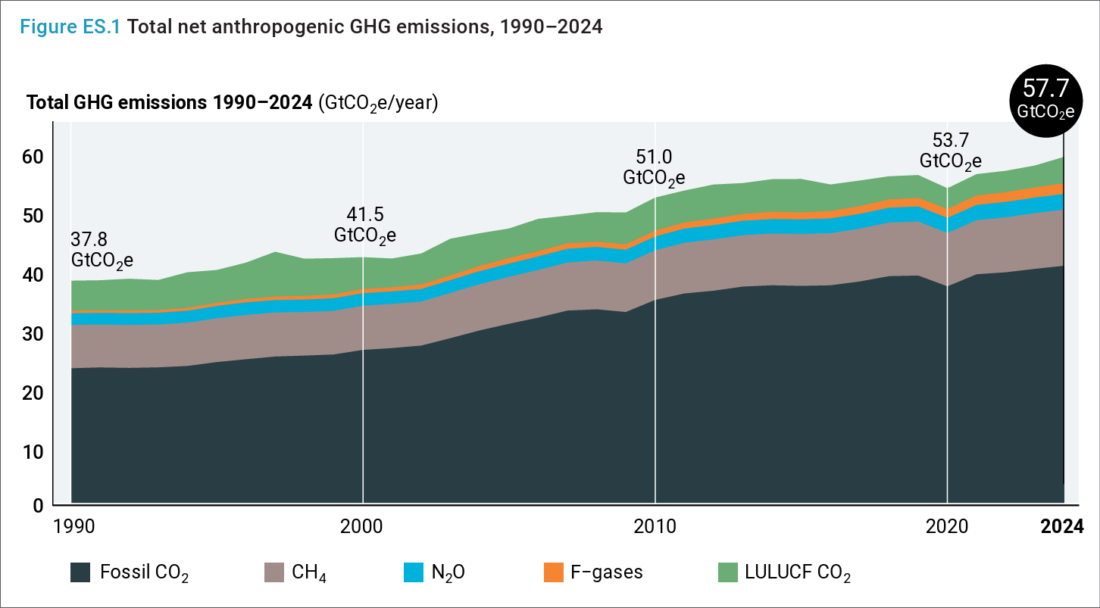
1.Another year of broken records – global GHG emissions reached 57.7 GtCO2e in 2024, a 2.3 per cent increase from 2023 levels
The 2.3% increase in total GHG emissions from 2023 levels is high compared with the 2022–2023 increase of 1.6 per cent. It is more than four times higher than the annual average growth rate in the 2010s. Furthermore, fossil CO2 emissions in 2024 showed a slight variation (0.5-1.1%) depending on multiple datasets, but overall, the change infossil CO2 emissions was substantive at +0.55 GtCO2, which accounted for 36% of the increase in global GHG emissions.
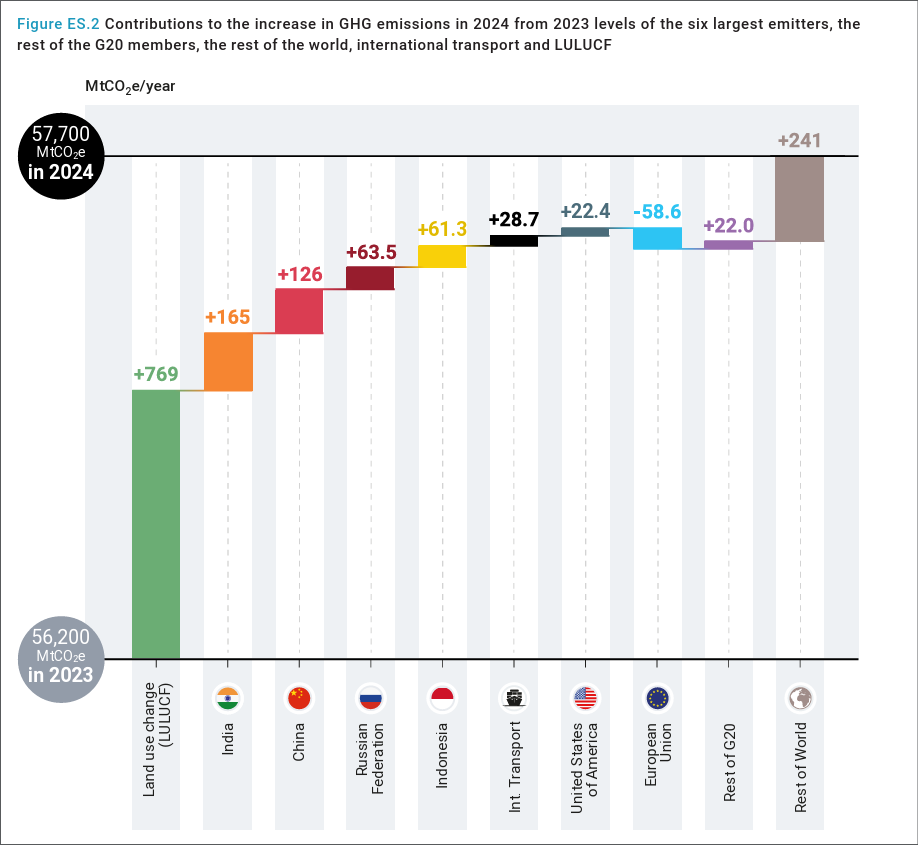
By country, among the major GHG emitters, emissions increased in India, China, Russia, Indonesia, and the United States. Decreased only in the EU. Emissions are rapidly increasing in Asia.
2.Only 60 parties, covering 63 per cent of global GHG emissions, submitted or announced new NDCs containing mitigation targets for 2035 by 30 September 2025
Despite the deadline for countries to submit new NDCs being extended from the original set date of February 2025 to September 30, only 64 parties had submitted or announced new NDCs. Only sixty of these contain mitigation targets for 2035, and 13 parties covering less than 1 per cent of global GHG emissions have updated their 2030 targets. NDCs 3.0 also fall far short of the necessary pace of emissions reductions and have done little to accelerate progress.
3.The new NDCs and policy updates of the G20 members lowered expected GHG emissions in 2035, but reductions are relatively small and surrounded by significant uncertainty
Seven G20 members have submitted new NDCs (NDC3.0) with mitigation targets for 2035 (Australia, Brazil, Canada, Japan, the Russian Federation, the United Kingdom and the United States of America), while three members have announced such targets (China, the European Union and Türkiye). None of the G20 members have strengthened their 2030 targets.
4.Seven G20 members are on track to achieving their NDC targets, but few are on a clear trajectory towards their net-zero emission pledges
Seven G20 members are likely to achieve their 2030 unconditional NDC targets with existing policies, while nine G20 members are assessed to be off track or uncertain to achieve their targets with existing policies. It is worth noting that a few countries have narrowed the implementation gap significantly and now have their target within reach, based on existing policies and measures.
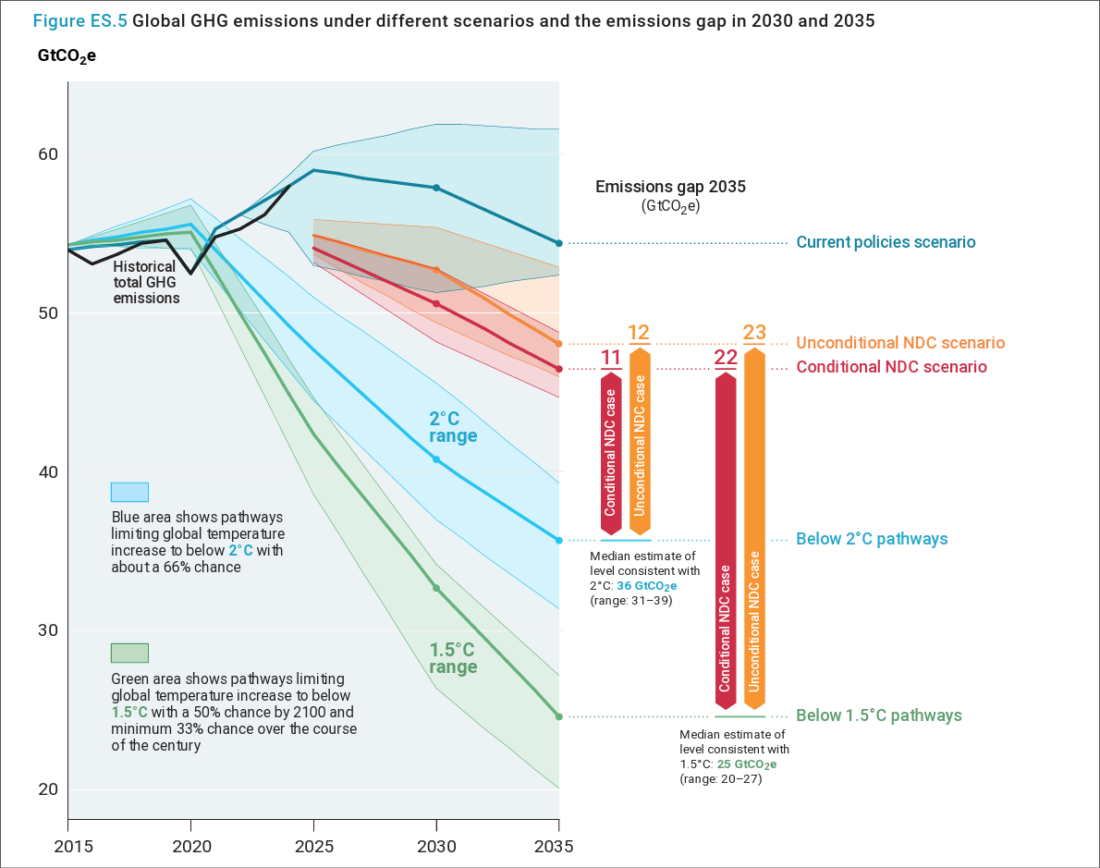
5.The new NDCs narrow the emissions gap in 2035, but the gap remains large
Despite the new NDCs (NDC3.0), the emissions gap in 2030 and 2035 between global GHG emissions resulting from the full implementation of the NDCs and the levels aligned with 2°C and 1.5°C pathways remain large.
6.Temperature projections are only slightly lower than last year and reiterate that immediate mitigation matters
The projections highlight the potential to reduce warming significantly through immediate mitigation action. However, they also underline the uncomfortable truth that surpassing 1.5°C is increasingly near, and that the risk of even higher levels of warming is rising fast.
7.Despite the increasing likelihood of higher and longer temperature overshoot, pursuing efforts to limit global warming to 1.5°C remains as critical and relevant as ever
While global warming is now close to 1.5°C and is likely to exceed this temperature limit soon, the long-term temperature goal of the Paris Agreement to limit global warming to well below 2°C, while pursuing efforts to stay below 1.5°C, remains central. It is widely understood as affirmed by the recent advisory opinion of the International Court of Justice affirming that 1.5°C remains the “primary” target of the Paris Agreement.
Conclusion
The words written on the cover page of this report “Continued collective inaction puts global temperature goal at risk” clearly represents the current critical situation. As the report states, each year of inaction makes the path to net-zero by 2050 and transition to net-negative emissions (effectively removing greenhouse gases from the atmosphere to achieve a negative balance) thereafter steeper, more expensive and more disruptive. Although this report states that limiting temperature rise to 1.5°C by 2100 is technically feasible based on new scenarios, it warns that the gap to the pathway for achieving this goal is likely to widen rather than narrow if countries continue to delay substantial emissions reduction measures.
The report concludes that the new NDCs and current geopolitical situation do not provide promising signs for global warming countermeasures, but that is what countries and the multilateral processes must resolve to affirm collective commitment and confidence in achieving the temperature goal of the Paris Agreement.
UNEP: Emissions Gap Report 2025
4 November 2025
Written/published by: United Nations Environment Programme (UNEP)
Published: November 4, 2025
Other Reference
Video Message: Secretary-General’s video message for the 2025 Emissions Gap Report