
According to Ember’s Global Electricity Mid-Year Insights 2025 report, published on October 7, 2025, revealed that record solar growth and steady wind expansion are reshaping the global power mix. For the first time on record, renewables have overtaken coal.
The report draws on monthly electricity data from 88 countries and here are key findings.
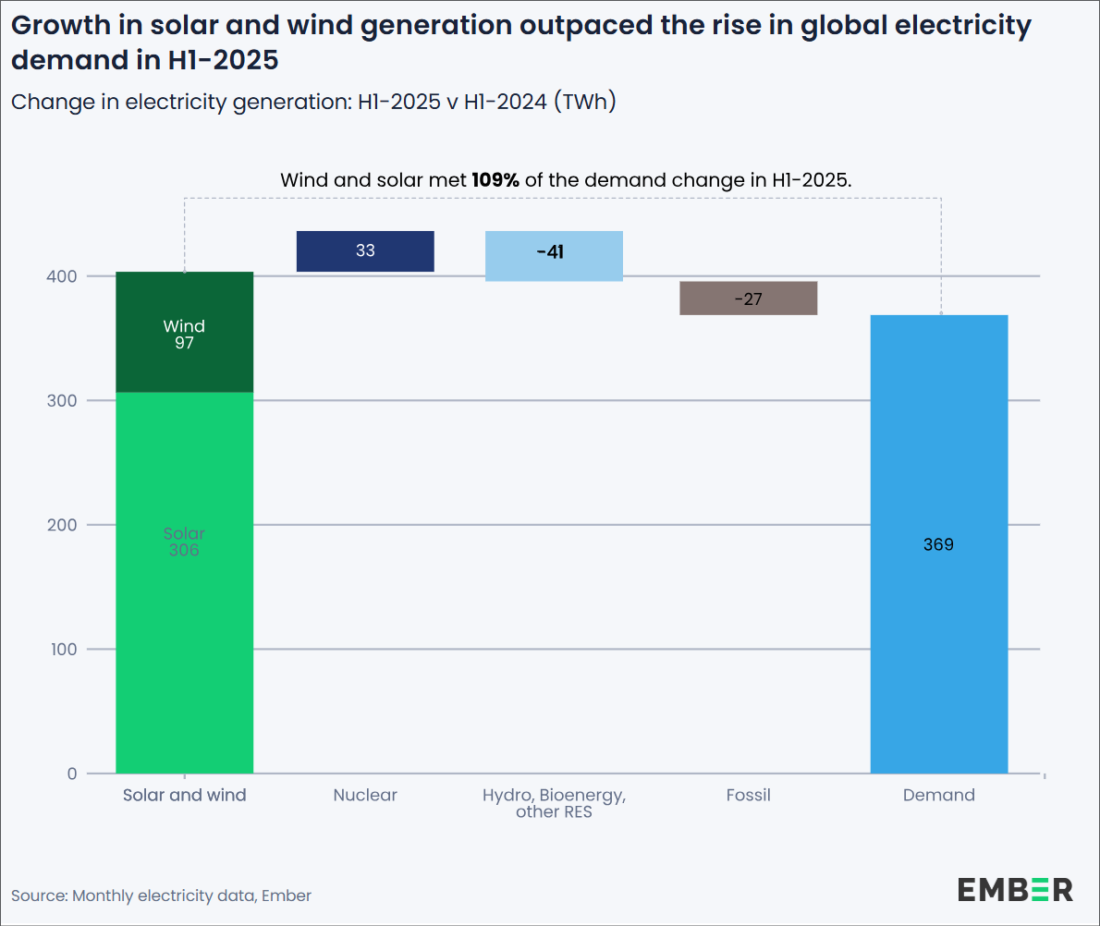
- Global electricity demand grew by 2.6% (+369 TWh) in the first half of 2025. This increase was more than met by increases in solar (+306 TWh, +31%) and wind (+97 TWh, +7.7%) generation, with solar alone covering 83% of the rise. Hydro fell significantly while bioenergy output dipped slightly, and nuclear rose modestly, while overall fossil generation fell marginally (-0.3%).
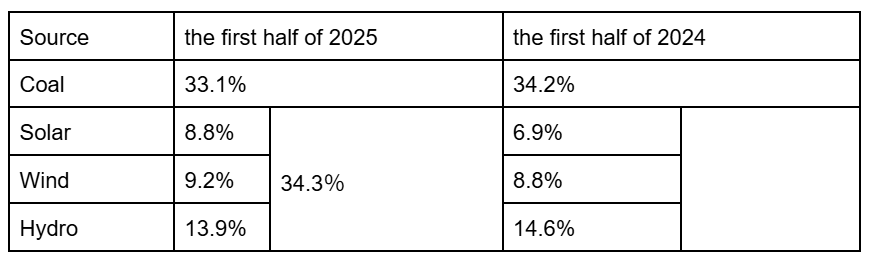
- Solar grew by a record 306 TWh (31%) in the first half of 2025. This increased solar’s share in the global electricity mix from 6.9% to 8.8%. China accounted for 55% of global solar generation growth, followed by the US (14%), the EU (12%), India (5.6%) and Brazil (3.2%), while the rest of the world contributed just 9%. Four countries generated over 25% of their electricity from solar, and at least 29 countries surpassed 10%, up from 22 countries in the same period last year and only 11 countries in H1-2021.
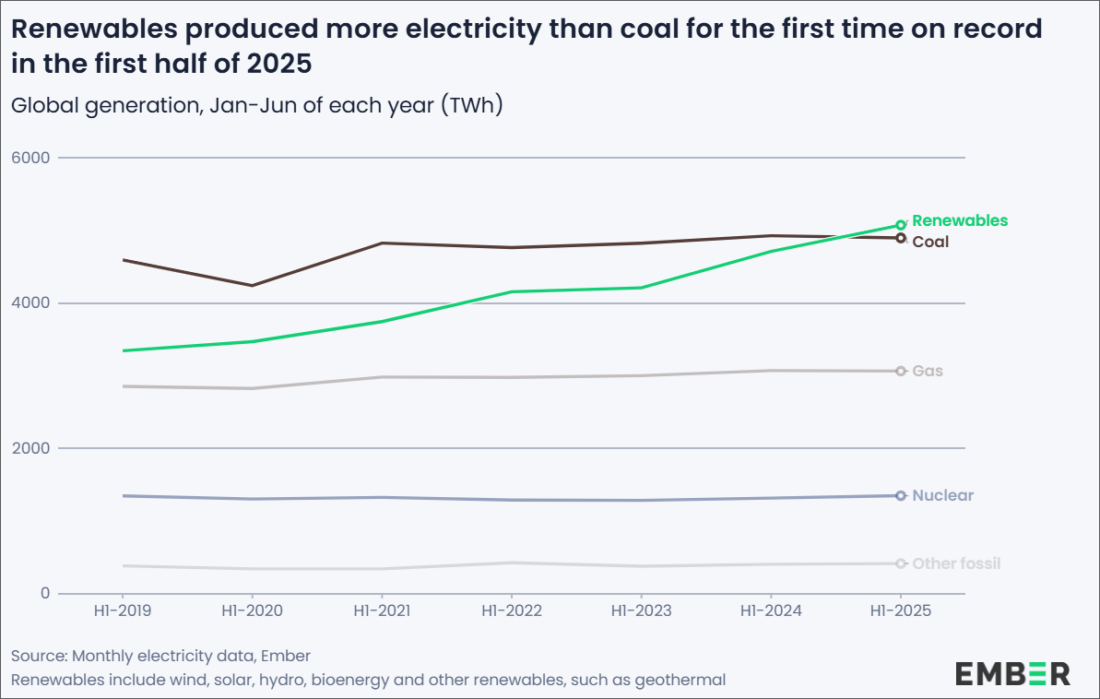
- A strong rise in solar, and to a lesser extent wind, led to renewables overtaking coal generation for the first time on record in the first half of 2025. Renewables grew by 363 TWh (+7.7%) to reach 5,072 TWh, while coal generation fell by 31 TWh to 4,896 TWh. As a result, renewables’ share of global electricity rose to 34.3% (from 32.7%), while coal’s share fell to 33.1% (from 34.2%).
- Global fossil fuel generation fell slightly in the first half of 2025, down 27 TWh from the same period last year. Among major economies, fossil fuel generation decreased in China and India, where clean generation outpaced demand growth. By contrast, in the US, clean sources did not keep pace with demand rise, so fossil generation increased. In the EU, both coal and gas inched up to offset lower wind, hydro and bioenergy output.
- Despite global electricity demand rising by 2.6%, emissions fell slightly by 12 MtCO2 in the first half of 2025. Declines in China (-46 MtCO2) and India (-24 MtCO2) reflected clean generation growth outpacing demand. By contrast, emissions increased in the EU (+13 MtCO2) and the US (+33 MtCO2) compared with the same period last year.
Electricity demand is glowing, but solar and wind grow rapidly. Not only did they meet 100% of global demand growth (supplying 109%), they also led to a slight decrease in coal-fired power generation.
China, India, the EU and the US accounted for 63% of global electricity demand and 64% of CO2 emissions in the first half of 2025. In the first half of 2025, while China and developing countries led the expansion of clean generation, wealthy countries such as the United States and EU member states increased their dependence on fossil fuels more than ever before. In the United States, partly due to the Trump administration’s policies, fossil generation and emissions rose in the US as clean generation did not keep pace with demand growth. In the EU, solar grew strongly, but falls in wind, hydro and bioenergy led to an increase in gas generation, and to a lesser extent coal, causing a slight rise in emissions.
China
China still relies heavily on coal-fired power generation and remains the world’s largest emitter of greenhouse gases. However, China has significantly outpaced other countries in clean energy growth, accounting for 55% of the global rise in solar generation and 82% of the rise in wind generation.
Unites States
The United States, the world’s largest economy, accounted for 15% (2,190 TWh) of global electricity demand and 12% of global power sector CO2 emissions in the first half of 2025. Solar and wind in the US grew less than electricity demand, meeting only 65% of the increase. To fill the gap, coal generation rose and also partly replaced gas drove an increase in emissions.
India
India accounted for 6.2% of global electricity demand and 9.1% of global CO2 emissions in the first half of 2025. At the same time, growth in clean sources was more than three times bigger than demand growth, with record solar and wind installations pushing coal generation and emissions down.
EU
The EU generated 8.8% (1,303 TWh) of global electricity and 4% (293 MtCO2) of the world’s power sector emissions in the first half of 2025. Although solar grew more than demand, poor conditions for wind and hydro caused their output to fall, resulting in higher gas generation and emissions.
Ember analyzes that, despite progress being uneven, global solar and wind growth can keep pace with rising electricity demand, and pointed out that “We are seeing the first signs of a crucial turning point” in our pursuit of a decarbonized society.
Ember Press Release:Solar and wind met all electricity demand growth, leading to a slight fall in fossil fuel generation
Report Download:Global Electricity Mid-Year Insights 2025
Another Report
Global Electricity Review 2025(Link)
Written/Published by: Ember
Published: October 7, 2025