
On October 7, 2026, the High Court of Australia ruled that the process for granting coal mine expansion permits must consider greenhouse gas emissions not only from mining, but also from subsequent exports. This ruling by the High Court of Australia, a major coal-producing country, which has halted a coal mine expansion plan, is expected to set a precedent for similar lawsuits in the future.
Mount Pleasant coal mine development project
The ruling concerns the Mount Pleasant coal mine, which is being developed by MACH Energy Australia in New South Wales (NSW) in eastern Australia. In fact, this coal mine has a relationship to Japan. The development and operation of this coal mine are handled by Mount Pleasant Joint Venture, established in 2018 by MACH Energy and JCDA (Australian subsidiary of Japan Coal Development*), in which JCDA holds a 5% stake.
*Japan Coal Development Co., Ltd. (JCD) was established in January 1980 by major Japanese electric power companies. JCD aims to ensure a stable coal supply for power plants through overseas surveying, prospecting, development, importing, and distribution. JCD’s shareholders include all nine major Japanese power companies.
The Mount Pleasant coal mine started producing thermal coal in December 2018. Although the Mount Pleasant operation is approved to produce up to 10.5 million tonnes per annum (Mtpa) of run-of-mine (ROM) coal until 2026, in 2022 it submitted an expansion plan to double its ROM extraction to 21 Mtpa and extend the mine life by 22 years to 2048. This expansion plan was approved by the NSW government.
◆Mount Pleasant Optimisation
By utilizing existing and planned infrastructure, the project plans to extract coal at deeper seams, extending the operating period until December 22, 2048, while increasing to a maximum of 21 Mtpa of ROM coal. Of this, the project is intended to produce and transport up to 17 Mtpa of product coal to domestic and export customers.
This plan was approved by the NSW government in September 2022.
◆Modification 8
This plan increases the ROM coal production in the existing open-pit coal mine from 10.5 Mtpa to 12.5 Mtpa and extends the life of the mine from December 22, 2026 to the end of 2032.
This plan was approved by the NSW government in August 2026.
Legal challenge by a community group
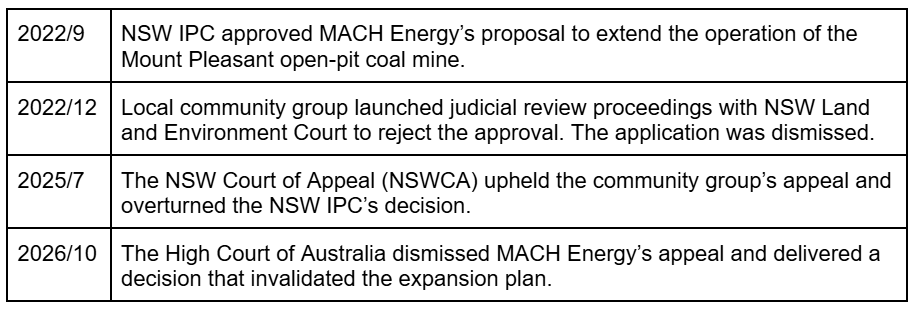
In November 2022, a local community group of residents and farmers filed a legal challenge against the NSW Independent Planning Commission’s (IPC) approval of MACH Energy’s expansion plan. The core issue was the legality of the NSW IPC’s decision to approve the plan on the grounds that “Scope 3” emissions were not subject to regulation. Scope 3 consists of greenhouse gas emissions from exported coal, which accounts for 98% of the total coal-related emissions of 870 million metric tons from that coal mine. The court ruled that excluding them from regulation and review was unlawful. The IPC had classified direct emissions (scope 1) and indirect emissions (scope 2) as subject to regulation, but had determined that emissions from exported coal (scope 3), including downstream coal combustion, were not subject to regulation.
Issues and the High Court’s ruling
There were three issues raised by the appeal.
First, Section 4.15 (1) (b) of the Environmental Planning and Assessment Act (EPA Act) requires the permitting authority to consider “the significant likely impacts of that development.” The question was, what counts as “likely impacts,” and how far the causal chain can extend for the purpose of applying this provision. The second issue was whether the Court of Appeal was correct to hold that the Commission took into consideration, as required by Section 4.15(1)(a)(i) of the EPA Act, and that greenhouse gas emissions are minimised to the greatest extent practicable. The third issue was whether the impact of climate change is capable of being an environmental impact in the locality of the development.
On October 7, 2026, the High Court dismissed the IPC’s approval and upheld the position of the community group that filed the lawsuit. The High Court stated that “while ‘Scope 3’ emissions constituted 98% of the project’s total predicted emissions, the Commission did not impose any conditions aimed at minimising those emissions.” The court also referenced advisory opinions from international courts, including the Advisory Opinion by the International Court of Justice (ICJ), which has reshaped state obligations in respect of climate change.
Following the ruling, MACH Energy released a statement that it would review practical implications with regulators and the government. However, the operations of the coal mine will not be extended, and production is expected to cease by the end of this year.
Relationship between Japan and Mount Pleasant coal mine
As mentioned earlier, JCD was involved in the establishment of the joint venture that operates the Mount Pleasant coal mine. It has also been pointed out that around 2 billion AUD in spending by investors in Indonesia and Japan, two major trading partners, went to the expansion plan (Mount Pleasant Optimisation). Coal from the mine is imported into Japan through JCDA.
Future impact
Following the ruling of the Australian High Court, which halted the coal mine expansion plan, it is expected that coal mines in NSW will have difficulty obtaining approval for plans based on increased production. This could potentially impact future fossil fuel production, renewal of export coal mining licenses, and even coal imports from Australia.
It remains to be seen how this precedent, which mandates the assessment of emissions resulting from coal consumption (including combustion) in export destinations, will affect similar cases in the future.
Related Information
Environmental Justice Australia, Climate change in the High Court
Climate Litigation Database: Denman Aberdeen Muswellbrook Scone Healthy Environment Group Inc (DAMSHEG) v MACH Energy Australia Pty Ltd
Climate in the Courts, Australia’s High Court Invalidates Coal Mine Expansion On Climate Grounds
Supplementary Information
Equity Generation Lawyers, Melbourne Climate Futures amicus curiae | MACH Energy Australia Pty Ltd v Denman Aberdeen Muswellbrook Scone Healthy Environment Group Inc & Anor