A briefing note titled “Japan’s ammonia co-firing strategy constrained by cost, supply, and timing” published by the Institute for Energy Economics & Financial Analysis (IEEFA) on July 9, 2026, addresses the major challenges in Japan’s ammonia co-firing strategy, which the Japanese government is promoting as part of its decarbonization strategy.
Is continuous investment in ammonia co-firing, supported by subsidy programs, really effective?
Japan positions ammonia co-firing in coal-fired power plants as a core measure of its decarbonization strategy in the electricity sector and has established a subsidy program to promote the development of the ammonia supply chain and the expansion of ammonia fuel use in power generation. However, this IEEFA’s briefing note points out that the budget allocated for ammonia subsidies in Japan could be better invested in commercially proven technologies, including renewable energy, battery energy storage systems, and grid infrastructure. These alternative technologies would not only reduce costs for businesses and households but also strengthen energy security and provide a pathway to achieving Japan’s decarbonization goals more cost-effectively and reliably.
The high production cost of blue ammonia at major supply hubs and concerns about stable supply
One of the country’s most significant prospective sources is the Blue Point Complex under development in Louisiana, United States, with JERA and Mitsui & Co. playing a major role. BluePoint is expected to produce 1.4 million metric tons of blue ammonia annually using natural gas and carbon capture and storage (CCS) (with production scheduled to begin in 2029). However, the estimated capital cost of this project appears to have been steadily increasing since the plan was announced and will be expected to increase further.*1
The ammonia produced at the Blue Point Complex is expected to be transported to Japan primarily for use at the Hekinan Thermal Power Station and the Tomatouatsuma Thermal Power Station; however, it is undeniable that if production and transportation costs rise, the price of ammonia will also increase. It has been noted that the cost of power generation using ammonia co-firing could be more expensive than existing renewable energy in Japan.
*1 When the development plan of the Blue Point Complex was first announced, the estimated cost was more than USD 2 billion. Since then, costs have continued to rise, and the estimated cost has increased further to USD 4 billion by 2025.
Securing the Future Supply of Fuel Ammonia
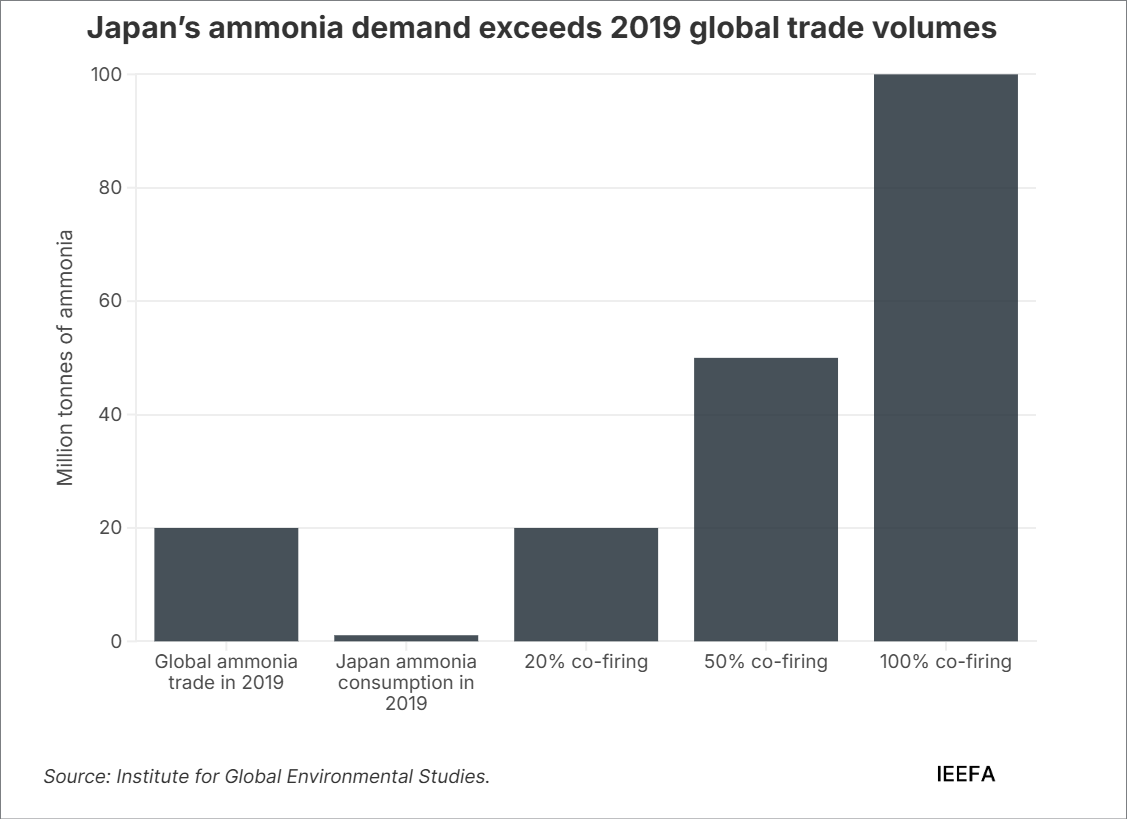
In addition to cost, securing a future supply of fuel ammonia for the introduction of ammonia co-firing is also a challenge. Japan currently consumes about 1.08 MTPA (million metric tons per annum) of ammonia, with the majority used as a nitrogen feedstock and for industrial uses; however, achieving 20% ammonia co-firing at Hekinan Power Station Unit 4 alone would require approximately 500,000 tonnes of ammonia annually.
The Japanese government has set a target of achieving 20% ammonia co-firing at domestic coal-fired power plants by 2030.*2 If Japan achieves a 20% co-firing rate across all coal-fired power plants operated by regional electric utilities, it would require approximately 20 MTPA of ammonia. This volume is roughly equivalent to the global ammonia trade volume in 2019. Even if renovation work on the four units*3 awarded through the Long-Term Decarbonization Power Source Auction (LTDA) proceeds with the help of subsidies, it is considered unrealistic to secure the supply of fuel ammonia required on the necessary scale.
*2 Since the Japanese Government has set targets of achieving 20% ammonia co-firing by 2030, 50% or more from 2030 onward, and 100% co-firing by 2050, fuel ammonia demand would increase as the co-firing rate rises in the future.
*3 The four units mentioned in the IEEFA’s briefing note are believed to be JERA’s Hekinan Thermal Power Station Unit 4, Hokkaido Electric Power’s Tomatouatsuma Thermal Power Station Unit 4, Shikoku Electric Power’s Saijo Power Station Unit 1, and Kobelco Power Kobe’s Kobe Power Plant Unit 1. Shikoku Electric Power has announced its withdrawal from the LTDA for the ammonia co-firing retrofit at the Saijo Power Station in April 2026.
Japan’s ammonia co-firing strategy constrained by cost, supply, and timing
To make ammonia co-firing a viable business under these circumstances, substantial subsidies are essential. However, those costs will ultimately be borne by domestic consumers through their electricity bills. Given the reality that all planned projects to begin commercial operation with a 20% co-firing during FY2027 and FY2030 rely entirely on subsidies (LTDA), IEEFA’s briefing note has stated that these challenges highlight the opportunity to reassess the role of ammonia co-firing within Japan’s broader decarbonization strategy.
IEEFA(English):Japan’s ammonia co-firing strategy constrained by cost, supply, and timing
IEEFA(Japanese): コスト、供給、導入時期が課題となる日本のアンモニア混焼戦略
※Image source is IEEFA’s Briefing Note “Coal Decarbonization Renewables & Storage Japan Asia
Japan’s ammonia co-firing strategy constrained by cost, supply, and timing”
Reference
JBC: 【Factsheet】 Hydrogen and ammonia fuels – Not a climate solution
Kiko Network: 【Report】Problems with Ammonia Co-Firing in Coal Power Generation in Japan – Real climate action should begin with a complete coal phase-out
Related article
JBC: 【News】Halved Budget and Reduced Capacity Expose the Limits of Ammonia Co-firing
Written/Published by: IEEFA
Published: July 9, 2026