| Key Points |
|---|
| □ Developed countries need to phase out all coal-fired power generation by 2030. □ The “fade-out of inefficient coal-fired power” is a commitment made by the Japanese government. □ The measures introduced to implement this commitment contain numerous loopholes and will not lead to meaningful reductions. Moreover, power producers’ plans are not publicly disclosed. □ As a first step toward fulfilling the government’s own commitment, Japan must take concrete action to reduce “inefficient coal-fired power” to zero. |
Developed countries need to “phase out” coal-fired power generation by 2030. Japan, however, has adopted a policy to “fade out inefficient coal-fired power.” Although the terms may sound similar, the policies are fundamentally different. Japan’s “fade-out” is a concept unique to the country, under which only less-efficient coal-fired technologies, such as subcritical and supercritical generating units, are to be gradually reduced.
Three measures addressing “inefficient coal-fired power”
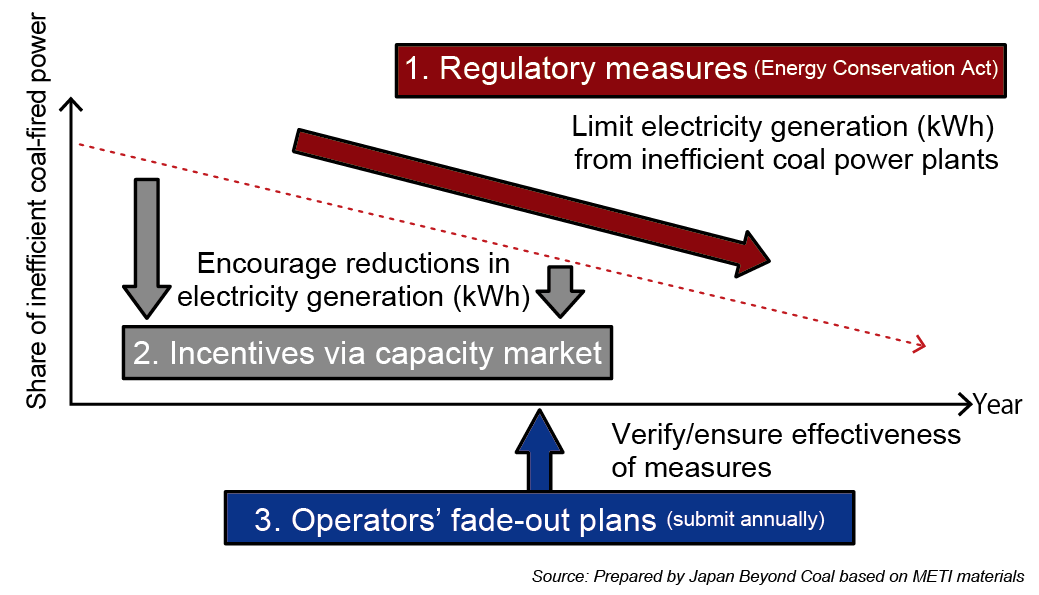
Japan has more than 100 “inefficient” coal-fired generating units. In March 2021, the government announced the three policy measures shown in Figure 1 as part of its efforts to “fade out inefficient coal-fired power,” with the stated objective of reducing the share of electricity generated by inefficient coal plants.
The policy of “fading out inefficient coal-fired power” has been incorporated into Japan’s Strategic Energy Plans since its Fifth Strategic Energy Plan. None of these measures, however, has provided effective regulation or incentives that would actually deliver the promised reductions. The reasons are examined below.
Source: Prepared by Japan Beyond Coal based on METI materials
1. Energy Conservation Act: Encouraging apparent “efficiency improvements”
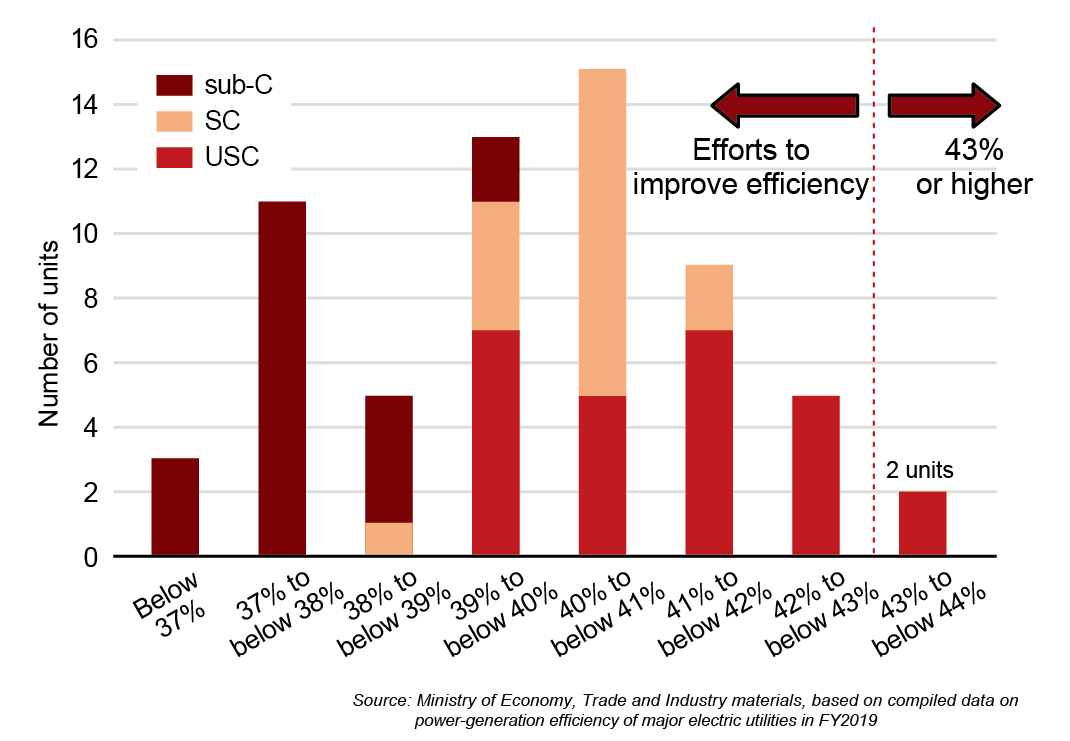
Under the Energy Conservation Act, operators are subject to a benchmark requiring them to achieve an average coal-fired power-generation efficiency of at least 43% by 2030. The Act also establishes benchmark indicators (A and B) for assessing the efficiency of thermal power generation.
However, when biomass, industrial by-products or ammonia are co-fired with coal, the calculated generation efficiency is adjusted upward. In practice, this creates the appearance that inefficient coal-fired power plants have become more efficient. It is therefore not a regulatory system requiring operators to reduce generation from, or retire, coal-fired capacity.
2. Capacity market keeps inefficient coal-fired power plants operating
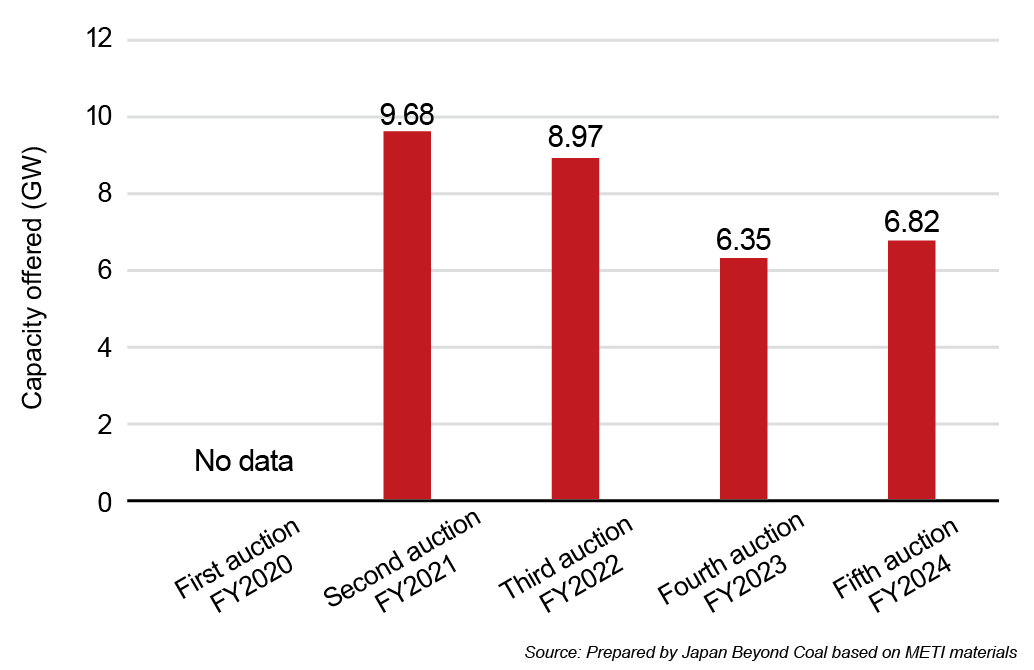
Coal-fired power plants are eligible to participate in Japan’s capacity market, which is intended to secure sufficient power-supply capacity four years in advance. For the purposes of the capacity market, inefficient coal-fired power is defined as capacity with a “design efficiency of less than 42%.” Successful bidders are subject to a penalty unless they limit their capacity factor to 50% or less.
According to the Organization for Cross-regional Coordination of Transmission Operators, Japan (OCCTO), however, the average capacity factor of all coal-fired power plants in FY2024 was 57.1%. Inefficient coal-fired power plants are likely to operate below that average. A threshold of “50% or less” therefore provides little meaningful deterrent.
In fact, substantial amounts of inefficient coal-fired capacity have secured contracts through the capacity market. For the FY2025 delivery year, the entire 5.27 GW of inefficient coal-fired capacity offered into the auction was awarded contracts. As a result, tens of billions of yen are paid each year to preserve inefficient coal-fired plants as available “supply capacity.”
3. Undisclosed “fade-out plans”
Major power producers are required to submit annual plans setting out their intended progress toward the 2030 “fade-out.” (Around 2024, these plans were renamed “thermal power decarbonization plans.”[YS5.1]) According to aggregated results published by the Agency for Natural Resources and Energy in materials submitted to the Strategic Policy Committee, electricity generation from inefficient coal-fired power is projected to decline from 116.1 TWh in 2019 to 39.7 TWh in 2030. The individual operators’ plans, however, are not publicly disclosed, making independent and objective verification impossible.
Meanwhile, OCCTO’s supply plans project that coal will still account for approximately 30% of Japan’s electricity mix in 2034—virtually unchanged from the current level.*
*Based on Kiko Network’s analysis of OCCTO’s compilation of electricity supply plans.
“Inefficient” coal power across Japan
Japan currently has 125 subcritical and supercritical coal-fired generating units that have not been retired, with a combined capacity of about 25 GW, as shown on the map.
To fulfill its commitment to “fade out inefficient coal-fired power,” Japan must first shut down these units.

Source: Prepared by Japan Beyond Coal based on METI materials
Map of “Inefficient” Coal-fired Power (as of Februsry 2026)
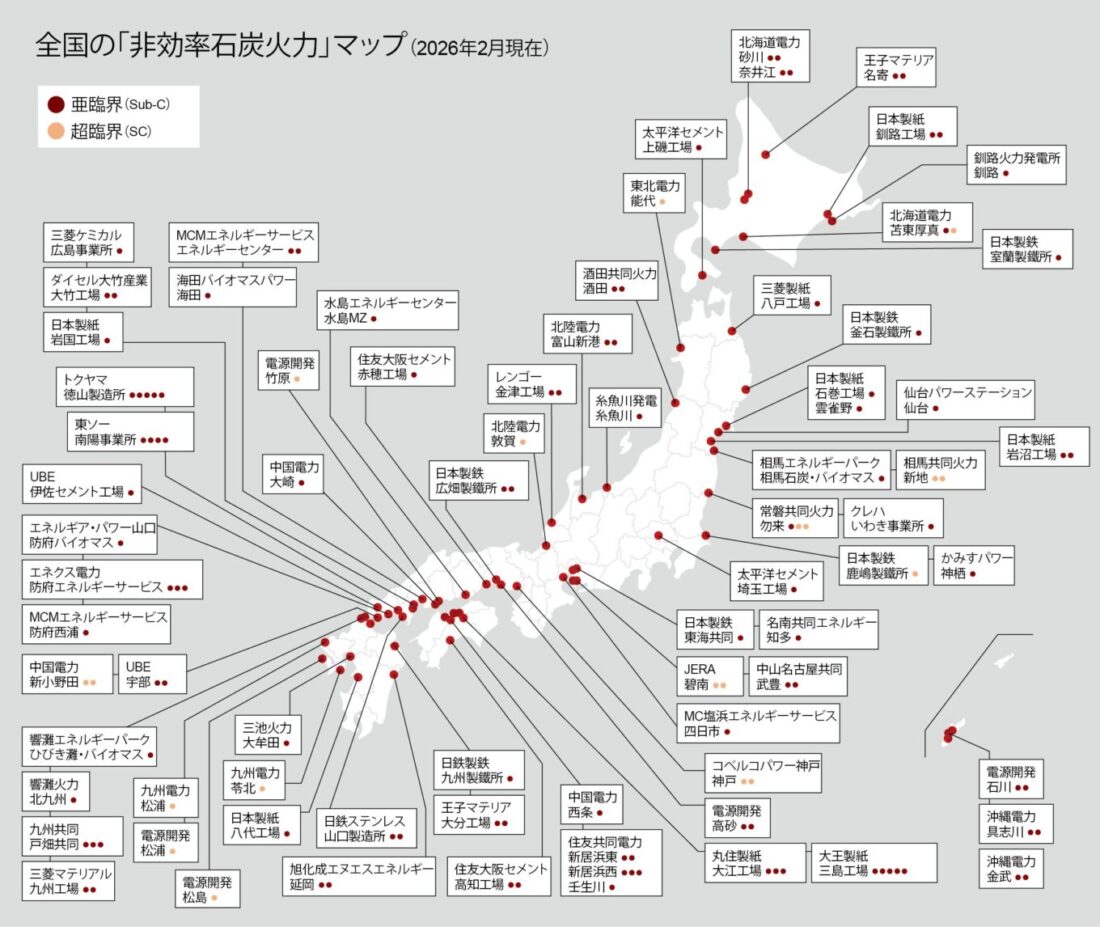
Lists of “Inefficient” Coal-fired Power Plants
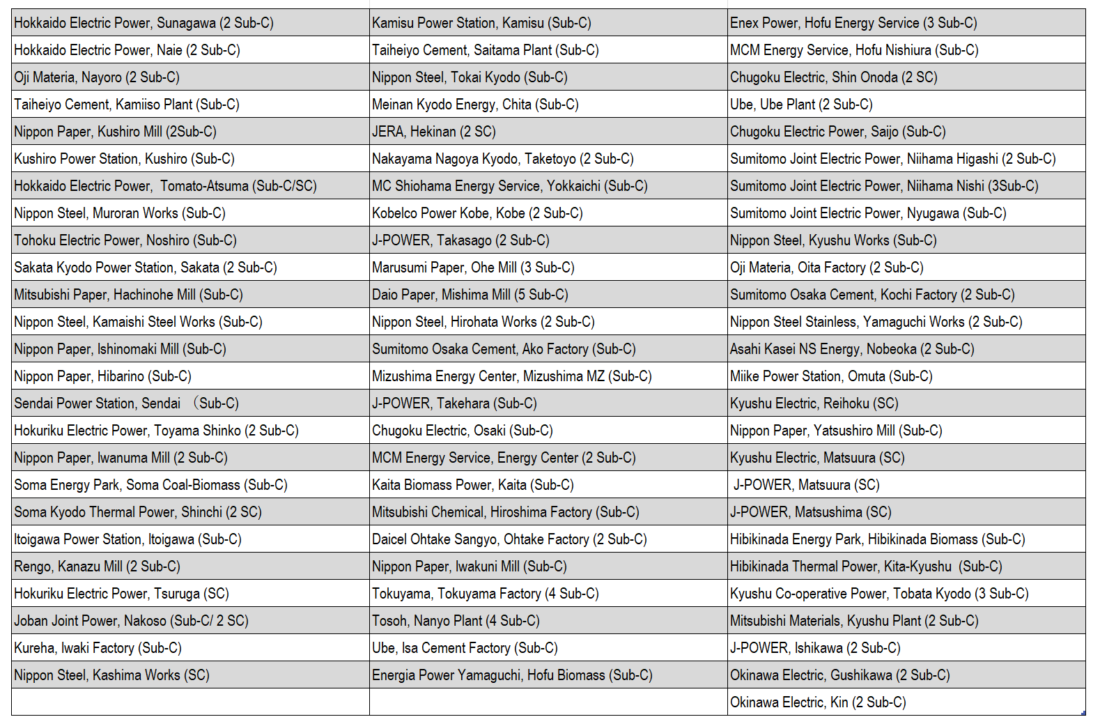
Published February 2026
The original Japanese version is in PDF.