
| Key Points |
|---|
| The capacity market uses our electricity payments to prop up and extend the lifespan of existing coal plants. |
Japan introduced a “capacity market” in 2020 to secure the country’s future electricity supply. This system enables power companies that own existing coal-fired power plants to earn money by maintaining coal-fired power capacity in the future. It can be described as the biggest factor in Japan’s inability to move away from coal power.
What is the “capacity market”?
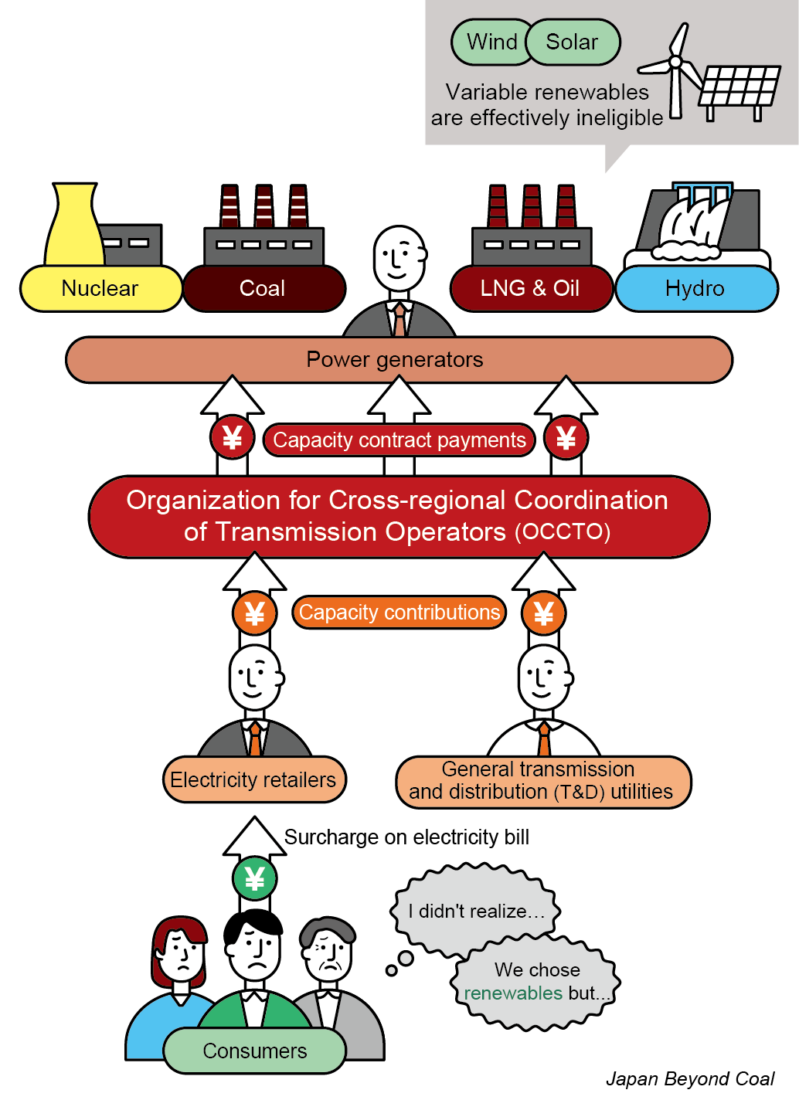
For the capacity market, the Organization for Cross-regional Coordination of Transmission Operators (OCCTO) estimates the maximum demand for electricity in four years, calculates the required power supply capacity (installed capacity in kilowatts) for every year, and selects the necessary power sources through auctions.
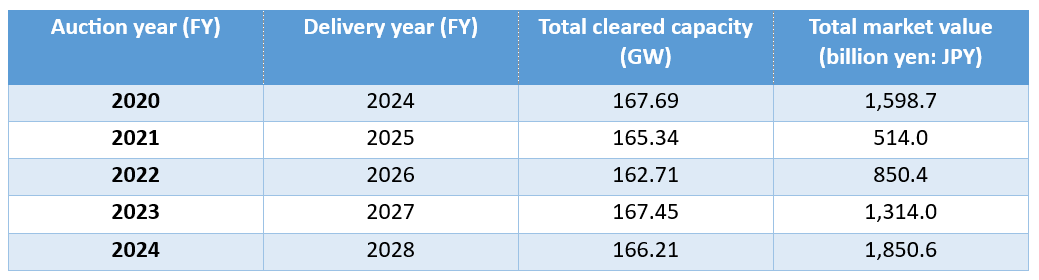
Successful bidders will receive a fixed contract amount to secure capacity, and depending on the demand for electricity the amount will be billed to electricity retailers and others as a “capacity contribution.”
The total annual amount is set to exceed one trillion yen. Capacity payment will be transferred four years after the auction, but retail electricity suppliers are responsible for approximately 90% of this burden. Consequently, these costs are passed through to electricity bills, ultimately becoming a burden on us, the consumers.
Coal-fired power plants (including aging plants) also targeted
Looking at the power sources with winning bids in the capacity market’s annual main auctions, coal-fired power generation accounts for about a quarter of the total. At about 4 gigawatts (GW), the scale of these auctions is massive, and it includes aging and inefficient coal-fired power plants. While inefficient coal plants* face operational restrictions that cap their utilization rates at 50% or below if they participate in the capacity market, they are still permitted to operate up to that 50% threshold. Consequently, they continue to emit vast amounts of CO2. Because hundreds of billions of yen are paid out annually to coal-fired plants that should ideally be fast-tracked for retirement, the capacity market effectively serves as an incentive for power utilities to keep these coal assets online for as long as possible.
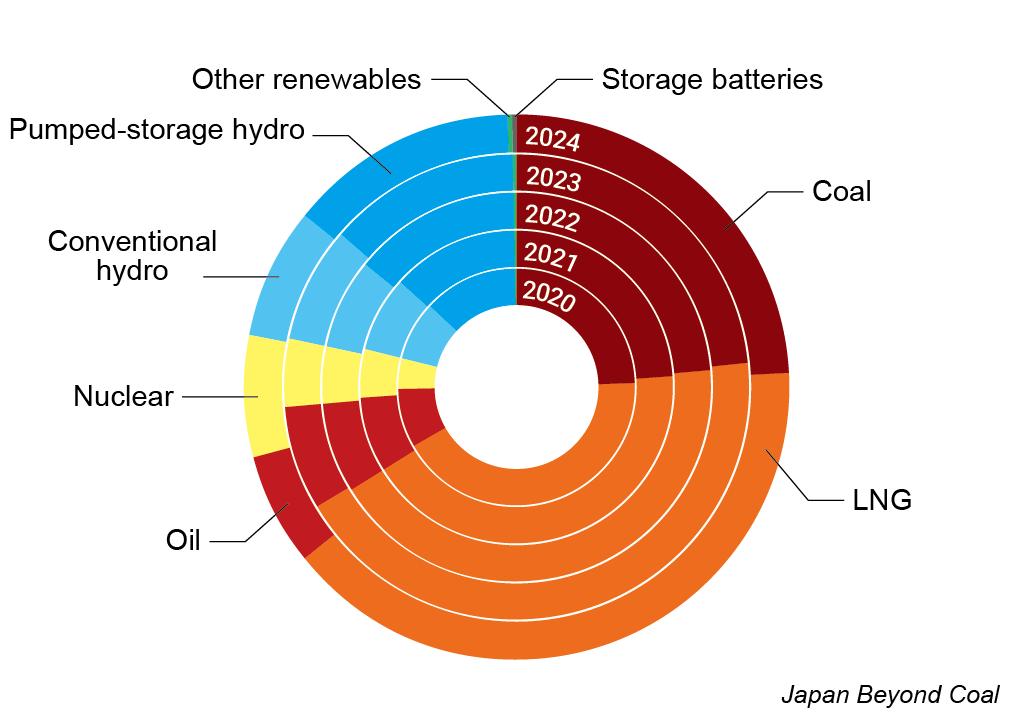
*Defined by OCCTO as stable, coal-primary power sources with a construction or modification design efficiency that cannot be verified at 42% or above.
Problems with the capacity market
Besides acting as a de facto subsidy that props up legacy coal-fired generation, the capacity market faces widespread criticism over its fundamental design and implementation. These flaws do more than just hinder climate action. They also threaten to undermine the integrity and fairness of the broader electricity market.
Problem 1: Contrary to climate action and international commitments
Propping up coal power via the capacity market runs entirely counter to the Paris Agreement’s 1.5°C target. Developed countries need to fully phase out coal-fired generation by 2030. Implementing life-extension measures for these polluting plants risks undermining international credibility. Ultimately, it highlights a stark mismatch between Japan’s domestic energy policies and its global pledges.
Problem 2: Increased burden on electricity retailers and consumers
The capacity market adds a staggering 1 to 2 trillion yen in new costs every single year. Electricity retailers have no choice but to pass this bill on to everyday consumers, causing electricity rates to climb. This creates a painful financial squeeze, especially for low-income families and local small businesses. To make matters worse, this money is being used to keep old fossil fuel and nuclear plants on life support, and this is counter to sustainability objectives. It is a broken structure that goes against fair competition and against what deregulation of the power market was supposed to achieve.
Problem 3: Lack of transparency
The capacity market keeps the identities of winning generation facilities hidden from the public. This lack of data disclosure prevents market participants and citizens from evaluating the legitimacy of the system. Additionally, the market’s design heavily favored the interests of incumbent[YS4.1] utilities, pointing to a serious deficit in transparency and democratic decision-making. Given that this framework operates with mechanisms akin to public funding, its failure to ensure accountability represents a major flaw.
Problem 4: Holding back renewable energy
Because weather-dependent renewables like solar and wind are practically shut out of the system, the capacity market has become a massive roadblock to clean energy. Renewables are supposed to be a crucial weapon against climate change. Plus, with stronger grids and modern battery storage, clean energy is now perfectly capable of maintaining stable supplies. Yet, the current rules completely ignore this progress. As a result, clean energy companies are losing out on critical revenue, which seriously diminishes the appetite for investing in Japan’s green transition
Problem 5: Lack of fairness
The rules of this market were clearly written to favor the big, established power companies that own large scale fossil fuel plants. The system is stacked against new green energy startups and independent electricity retailers. The real problem that utility giants can use massive revenues from the capacity market to cover what they owe in fees. Meanwhile, renewables-focused retailers face massive bills they can’t avoid. This warps the playing field and ruins any chance of fair competition.
COLUMN
Comparisons with other capacity mechanisms
Capacity mechanisms are regulatory frameworks designed to ensure long-term grid reliability by securing backup power sources for peak periods and system stress events. In other jurisdictions they are deployed with several different approaches. Japan’s capacity market model follows in the footsteps of the UK and the US PJM market*. Critics of these established markets have long pointed out inherent flaws, including the artificial life-extension of legacy plants, price instability, and the continuous subsidization of heavy polluters.
Today, many jurisdictions are shifting toward a “strategic reserve” model instead. In this setup, a fixed amount of generation capacity is maintained outside the normal market. These plants only run during extreme grid stress and do not participate in regular market trading. Notably, EU regulations now bar highly polluting sources—meaning coal—from being eligible for these backup programs.
*PJM Interconnection (US): A regional transmission organization that coordinates the movement of wholesale electricity and operates the grid across a massive portion of the eastern United States
Published Dec 2025
The original Japanese version is in PDF.