
On April 14, 2026, the Ministry of the Environment and the National Institute for Environmental Studies released data for “Japan’s National Greenhouse Gas Emissions and Removals in FY2024,” and the Ministry of Economy, Trade and Industry (METI) released the “FY2024 Energy Supply and Demand Report (Revised Report).”
While GHG emissions are on a downward trend, the rate of decline slows down
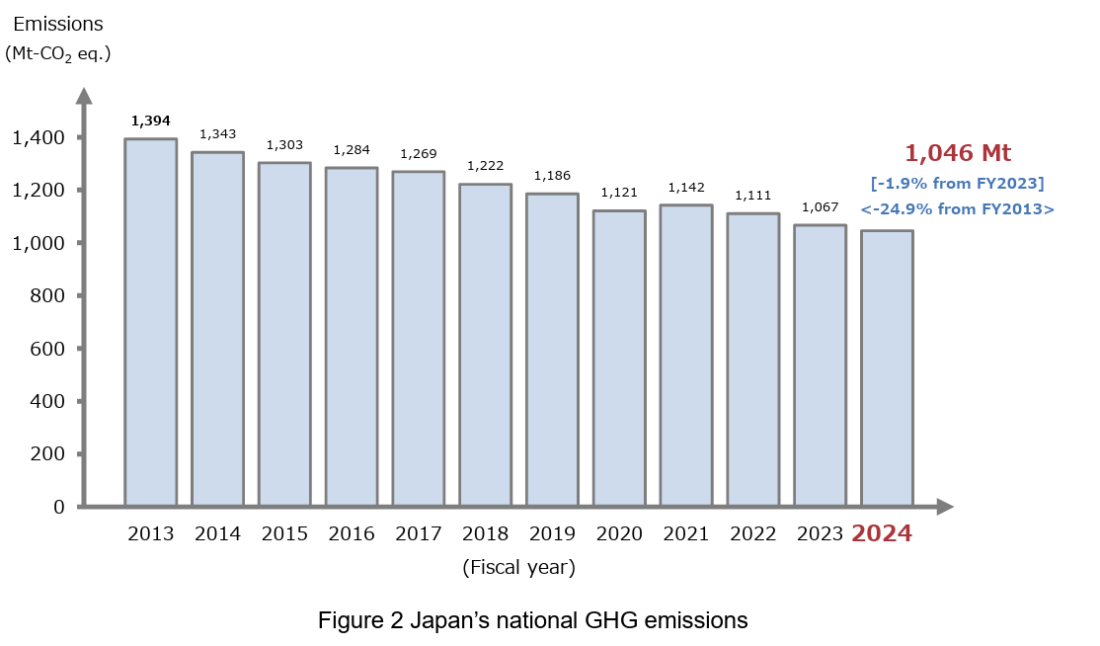
According to the Ministry of Environment’s announcement, domestic greenhouse gas (GHG) emissions in FY2024 were 1,046 Mt, a decrease of 347.1 Mt CO2 eq. (24.9%) from FY2013, Japan’s base year for its reduction targets. This is the lowest value since Japan began reporting GHG emissions, with data going back to FY1990, based on the UN Framework Convention on Climate Change (UNFCCC). However, in terms of the rate of decrease year-on-year, while emissions in FY2023 had decreased by 4% (44 Mt), the decrease in FY2024 was only 1.9% (20.3 Mt).
Factors contributing to a decrease in emissions include improvements in the CO2 emissions intensity of electricity (CO2 emissions produced per kilowatt hour of electricity consumed) and a decrease in energy consumption due to a reduction in manufacturing production. However, it is clear that the reduction is not consistent with the level required for reaching the 1.5℃ target, as essential climate change countermeasures, such as the gradual phaseout of coal-fired power plants, have not been implemented.
Both energy consumption and supply decline
On the other hand, looking at the demand trends in the energy supply and demand results shown in the FY2024 Energy Supply and Demand Report (Revised Report), final energy consumption in FY2024 decreased by 2.0% year-on-year. Within this, coal decreased by 3.9% and oil by 3.8%, while city gas increased by 3.2% and electricity by 0.6%.
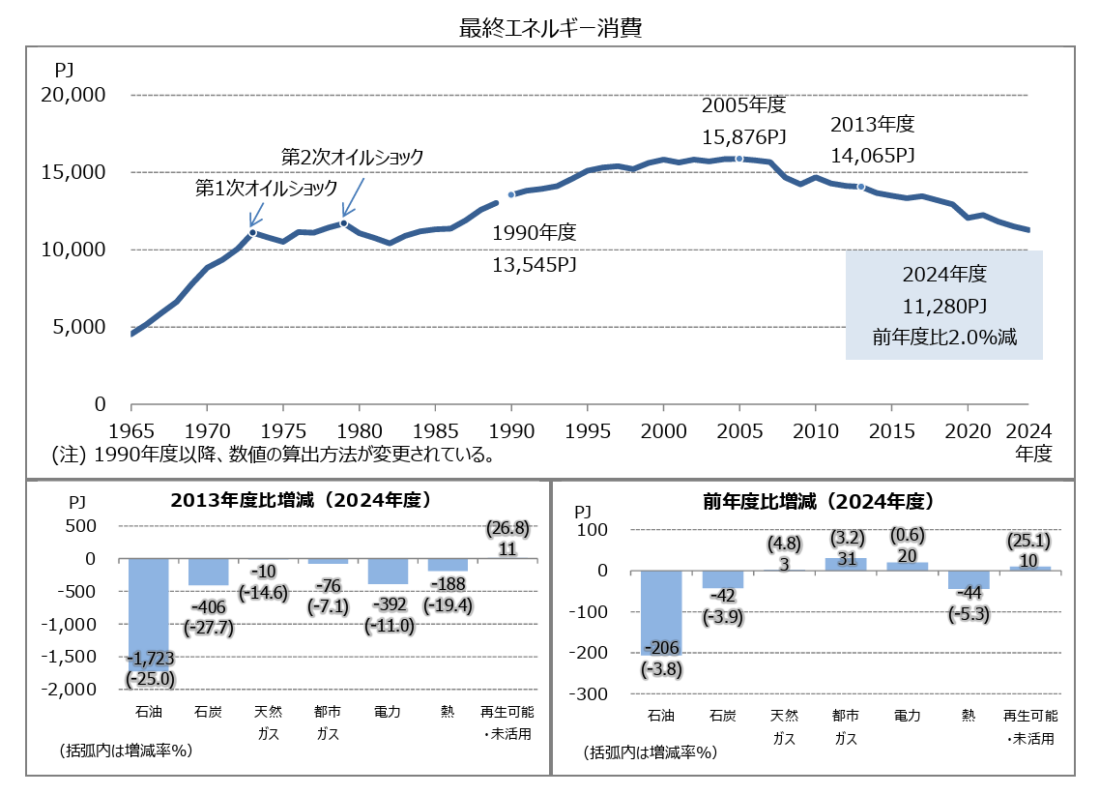
*This “Energy Consumption” figure is available only in Japanese.
Furthermore, domestic primary energy supply decreased by 0.5% compared to the previous year. Within this change, fossil fuels decreased by 1.3% and non-fossil fuels increased by 2.5%, resulting in a 0.6% point decrease in dependence on fossil energy. Nonetheless, looking at the breakdown of fossil fuels, while oil decreased by 3.7%, coal and natural gas/city gas increased by 0.1% and 1.2%, respectively. METI’s release notes that the share of non-fossil fuels rose to 19.9%, but this was primarily due to the restart of two nuclear power plants*. Its increase (9.6%) significantly exceeds the increase in renewable energy (1.8%**, excluding hydropower).
* Tohoku Electric Power’s Onagawa Nuclear Power Station Unit 2 and Chugoku Electric Power’s Shimane Nuclear Power Station Unit 2 were restarted in 2024.
** This 1.8% includes a 0.6% increase from “unused” sources such as waste-to-energy, recycled oil, and waste heat utilization.
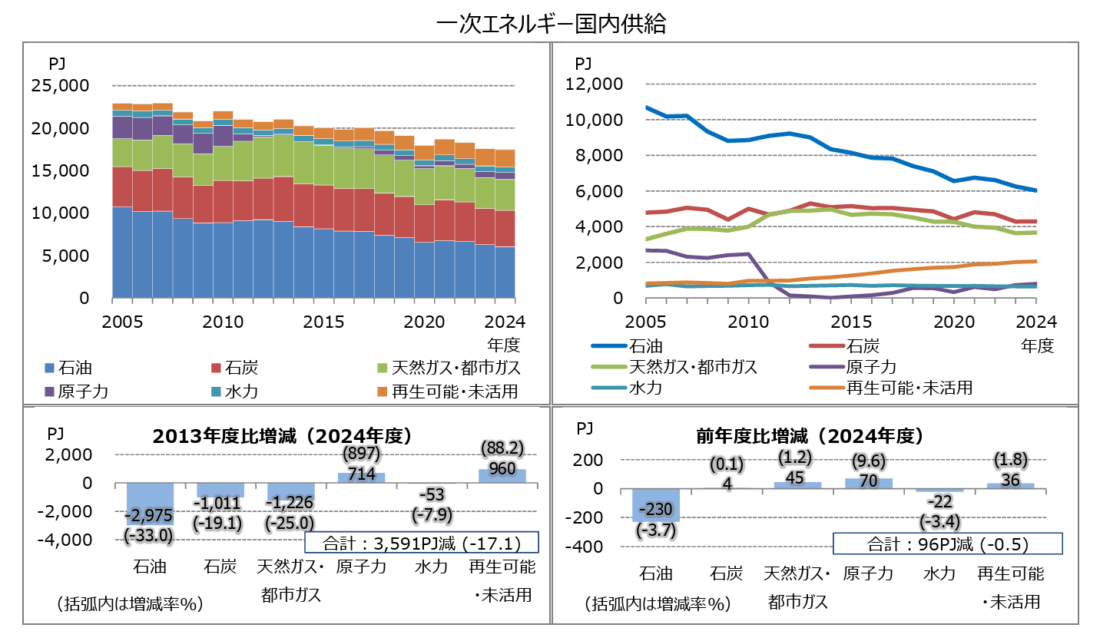
*This “Domestic Primary Energy Supply” figure is available only in Japanese.
This data shows that Japan’s GHG emission decline is mainly due to sluggish energy demand and nuclear power plant restarts, and it is evident that progress toward structural decarbonization has been limited. The reduction rate is slowing down. If this trend continues, it is likely impossible to achieve the 2030 target. Emission reductions dependent on slowing demand are due to economic stagnation. This means that if the economy returns to growth, demand will increase again, which could lead to increased emissions. At the same time, a restart of nuclear power could constrain the expansion of renewables. As a result, delays in decarbonization will lead to higher future reduction costs and undermine international competitiveness, becoming a significant risk to the Japanese economy.
Related Information
Ministry of the Environment: Japan’s National Greenhouse Gas Emissions and Removals in FY 2024
Ministry of Economy, Trade and Industry: FY2024 Energy Supply and Demand Report (Revised Report)