On January 7, 2026, the Ministry of Economy, Trade and Industry (METI) quietly posted a notice (only available in Japanese) titled “Public Notice and Public comments Regarding the Test Drilling Permit (off the coast of Kujukuri, Chiba Prefecture) Based on Article 4, Paragraph 1 of the Act on Carbon Dioxide Storage Business (CCS Business Act).” Although this survey aims to confirm the seabed strata—a key element of the Metropolitan Area CCS project—it is simplified as a “test drilling” and not mentioned whatsoever of the entire CCS project. Various environmental NGOs and local residents are raising concerns regarding this matter.
Purpose of Test Drilling Unstated
The purpose of this test drilling is to confirm whether there are suitable geological formations (existence of reservoir and caprock layers) for storing CO₂ beneath the seabed. The reason this test drilling is being conducted offshore of Kujukuri is related to the ongoing “Metropolitan Area CCS Project.” Under this Project, CO2 separated and captured in the industrial areas on the Tokyo Bay side (Uchibo) is to be transported via pipeline to Kujukuri, located on the opposite side of Chiba Prefecture (Sotobo), for storage; therefore, it is necessary to verify the seabed strata offshore of Kujukuri. However, the public notice posted by METI contained absolutely no explanation of the “Metropolitan Area CCS Project”.
Where will they test drill?
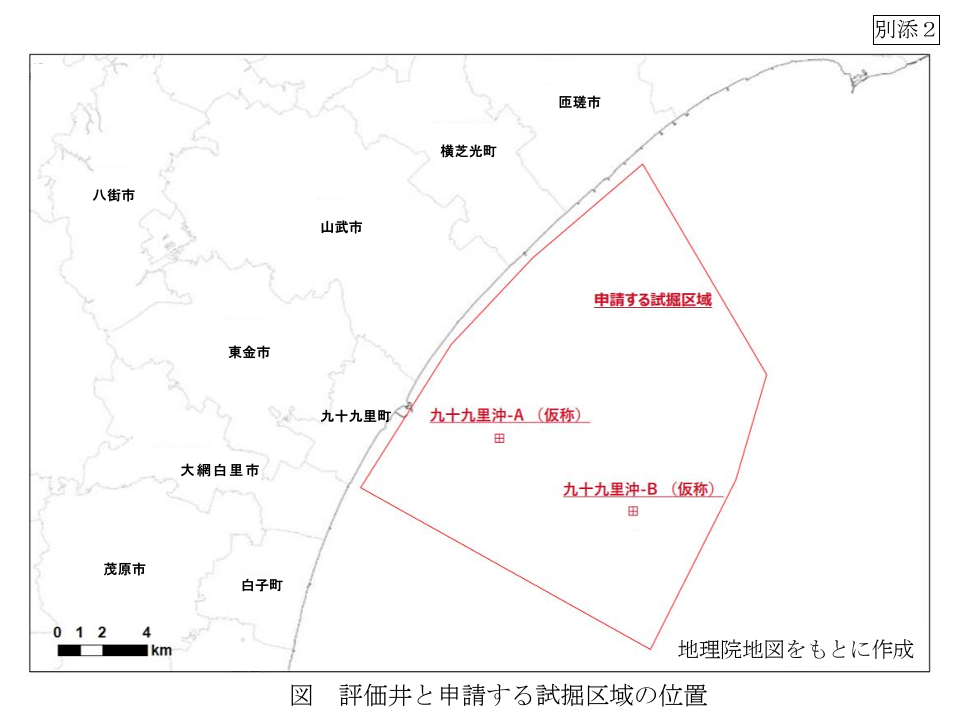
The map below shows the area where test drilling is planned (within the red box) and where the exploration wells are located (A and B).
What is the problem?
JBC summarizes the issues regarding the permit for this test drilling
1.Its role not clearly explained in relation to overall scope of the Metropolitan Area CCS Project
Although this test drilling is based on the assumption that the Metropolitan Area CCS Project will be implemented, the purpose for the test drill stated on the public notice is merely “to confirm the existence of seabed strata that could serve as reservoir and caprock layers.” In this way, residents and stakeholders cannot fully understand the “further” reason for this test drilling or overall picture of the Metropolitan Area CCS Project. It is necessary to clarify how the results of this test drilling will be used in decision-making for the Project.
2.Announcement made far too quietly—raising doubts about whether METI had genuine intention to solicit public comments
This announcement was quietly posted with the PDF format on the website of the Agency for Natural Resources and Energy under the METI, without any prior notification to residents in the Kujukuri area. The document (nine pages in total) makes no mention whatsoever of the connection between this test drilling and the Metropolitan Area CCS Project. It also fails to indicate how any opinions or questions received -will be handled.
3.No detailed information on the exploration wells
Although location of two exploration wells (A and B) are shown on the map, no detailed information has been disclosed regarding the pipeline to be drilled from them. Within the exploratory area outlined in red on the map above, it is completely unclear what will be happening where.
4.No mention of assessments of the safety and environmental impact of test drilling
Although the drilling method (technique) is described in the document, the information provided is limited. The document does not specify what is meant by “safety” in the context of test drilling, nor does it explain how the environmental impact of such drilling will be assessed. These waters are not only excellent fishing grounds but also home to a diverse array of marine life. Unless environmental impacts are measured and evaluated both during and after test drilling, the feasibility of the Metropolitan Area CCS Project could be determined only based on the existence of reservoir layer and caprock layers.
5.No explanation provided to those involved in the fishing and tourism industries in Kujukuri area
The test drilling is scheduled to begin this April, however, at the time this notice was issued, apparently none of explanations were provided to those affected — such as people in the fishing industry or those involved in vessels navigating the designated waters, as well as those in the summer tourism industry and surfing-related shops. On top of this, the public notice was not widely announced and was closed for comments before any explanations were given to affected residents and stakeholders. Surely this could be seen as a disregard for the residents.
6.Restricting who may submit comments
This call for comments states that “any person with a stake in the test drilling permit (omitted) may submit comments.” Although neither this document nor the CCS Act specifies who qualifies as a stakeholder, the wording in this document restricts who may submit comments. Furthermore, as noted in point 5, there is no sign that residents who are likely to be affected were notified or provided with an explanation.
7.Overall scope of the Metropolitan Area CCS Project not explained at the previously held public briefings
The Metropolitan Area CCS Project was not at all mentioned in this call for public comments, nor a comprehensive explanation of the entire project was provided at any public briefings held in advance.
8.The results of the test drilling should be made public, yet…
The result of this test drilling, confirmation of the existence of the reservoir and caprock layer, is a critical factor in determining the implementation of the Metropolitan Area CCS Project. For this reason, the results of the test drilling and the project decisions based on them should be made public; however, there is no mention of how the survey results will be handled.
With strong government backing, private companies such as INPEX, Nippon Steel, Kanto Natural Gas Development and Metropolitan CCS (INPEX 85%, Kanto Natural Gas Development 15%) are involved in the Metropolitan Area CCS Project. Neither the preliminary briefings held exclusively for residents living along the planned pipeline route nor the joint seminar organized by the Ministry of Economy, Trade and Industry (METI) and Chiba Prefecture provided an overview of the project. Furthermore, no briefings have been held at all in the Kujukuri region, the planned site for CO₂ storage. Residents cannot fully grasp the scope of the project based on only partial explanations. In this public notice, METI intentionally treated the test drilling separately which also makes it hard to know if the test is actually related to the Metropolitan Area CCS Project and its plan to store CO2 off the coast of Kujukuri. Since the CCS project is currently exempt from environmental impact assessment (EIA), it is important to start evaluating the impact on the surrounding environment from the test drilling stage.
Before all else, CCS has been criticized for being costly and economically unviable. It is critical to prevent public and private entities from pushing forward with CCS projects under the banner of “decarbonization strategy,” without properly listening to the voices of local residents and civil society.
Related JBC article: 【News】CCS Policy Seminar: Who Was It Really For?